
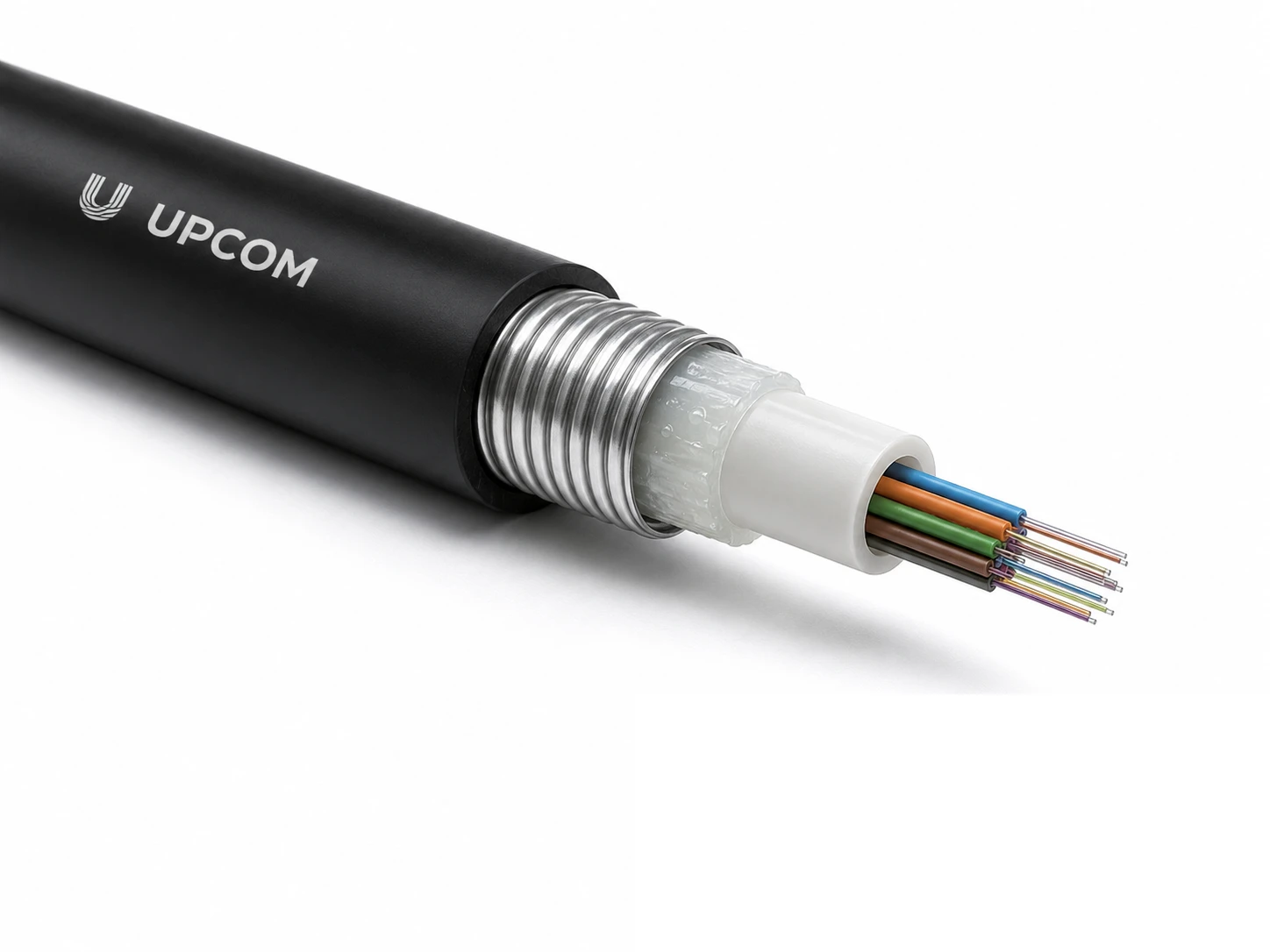
- Optical fibers: 4, 6, 8, 12 or 24 fibers in the standard product range
- Loose tube: PBT central loose tube filled with thixotropic gel
- Water-blocking elements: Swellable glass yarn for longitudinal water resistance and peripheral tensile support
- Armor: Corrugated steel tape for improved crush, impact and rodent protection
- Ripcord: Polyester ripcord beneath the armored layer for easier sheath removal
- Outer sheath: Black, UV-resistant polyethylene for outdoor routes
Outdoor Armored Fiber Optic Cable
Outdoor armored fiber optic cable is designed for outdoor duct, underground, campus backbone and anti-rodent routes requiring increased mechanical protection. The A-DQ(ZN)(SR)2Y construction combines a gel-filled PBT central loose tube, swellable glass yarn, corrugated steel tape armor and a black UV-resistant PE outer sheath. Standard configurations are available with 4, 6, 8, 12 or 24 fibers.
Construction
Central Loose Tube
Mechanical Protection
Corrugated Steel Tape
Outer Sheath
UV-Resistant PE
Cable Range
Fiber Optic and Data LAN Cables
Indoor Fire-Rated Option
B2ca Fiber Optic Cable
Fiber Termination
Fiber Optic Patch Panels
Project Enquiry
Request a Quote
Outdoor Armored Fiber Optic Cable Construction
Ordering Options
- G.652.D, G.657.A2, G.657.B3 and OM fiber options
- Project-specific drum length and sheath marking
- Alternative sheath, color or construction subject to engineering confirmation
- CPR/DoP documentation where applicable to the supplied configuration
Outdoor Cable Applications
- Outdoor duct and conduit networks
- Underground utility and telecom routes
- FTTC and FTTB secondary distribution
- Campus and industrial backbone cabling
- Routes with elevated rodent or mechanical risk
- LAN and WAN backbone links between buildings
- Connections between outdoor distribution points
- Access and distribution networks with 4-24 fibers
For related infrastructure, browse the
fiber optic cable range,
review fiber optic patch panels,
or read the CPR-compliant cable guide when fire-performance classification is part of the project specification.
Mechanical and Environmental Benefits
Compact route cable
A central loose tube construction accommodates 4-24 fibers in an approximately 8.0-8.2 mm cable.
Longitudinal water resistance
Thixotropic gel and swellable elements support water blocking along the cable route.
Mechanical protection
Corrugated steel tape improves resistance to crush, impact and rodent-related damage.
Outdoor durability
The black UV-resistant PE sheath is intended for outdoor duct and underground routes.
Product designation: A-DQ(ZN)(SR)2Y, central loose tube metallic armored outdoor cable. Steel armor improves protection but does not make a cable immune to rodents or unsuitable installation practices.
Standards and Test References
Mechanical and environmental performance is evaluated using IEC 60794 test methods. The current datasheet cites the following references:
- IEC 60794-1-2 E1: tensile performance
- IEC 60794-1-2 E3: crush resistance
- IEC 60794-1-2 E4 and E6: impact and repeated bending
- IEC 60794-1-2 E11: minimum bending radius
- IEC 60794-1-22 F1 and F5B: temperature cycling and water penetration
Fiber reference: ITU-T G.652
CPR note: The standard black PE outdoor construction may be supplied with an Fca declaration only where the ordered cable is covered by the applicable CPR/DoP documentation. Confirm the required fire class and route before ordering. LSZH or higher fire-performance requirements require a separately confirmed construction.
Technical Specification
The values below are taken from the current A-DQ(ZN)(SR)2Y datasheet. Final values remain subject to production confirmation and the ordered configuration.
Construction and Dimensions
| Parameter | 4-12 fibers | 24 fibers |
|---|---|---|
| Loose tube outer diameter | 2.5 mm ±3% | 3.0 mm ±3% |
| Loose tube material / filling | PBT / thixotropic gel | PBT / thixotropic gel |
| Peripheral strength member | Swellable glass yarn | Swellable glass yarn |
| Armor | Corrugated steel tape | Corrugated steel tape |
| Outer sheath | Black UV-resistant PE | Black UV-resistant PE |
| Approximate cable diameter | 8.0 mm ±0.2 mm | 8.2 mm ±0.2 mm |
| Approximate cable weight | 68 kg/km ±10% | 76 kg/km ±10% |
Mechanical and Environmental Performance
| Parameter | Value | Reference |
|---|---|---|
| Maximum tensile load | 1000 N during installation / 400 N in service | IEC 60794-1-2 E1 |
| Minimum bending radius | 20xD during installation / 15xD in service | IEC 60794-1-2 E11 |
| Crush resistance | 3000 N/dm short term / 1600 N/dm long term | IEC 60794-1-2 E3 |
| Impact resistance | 3 impacts at 1.5 J | IEC 60794-1-2 E4 |
| Water penetration | Passed: 1 m water head, 48 hours | IEC 60794-1-22 F5B |
| Temperature range | Installation: 0 to +70°C Service: -30 to +60°C Storage: -20 to +70°C | IEC 60794-1-22 F1 |
Optical Fiber Options
| Fiber type | Availability | Datasheet reference |
|---|---|---|
| G.652.D single-mode | Standard option | Typical attenuation: 0.40 dB/km at 1310 nm; 0.30 dB/km at 1550 nm |
| G.657.A2 / G.657.B3 single-mode | Available by ordered configuration | Confirm final optical values in the quotation and production datasheet |
| OM1 / OM2 / OM3 / OM4 multimode | Available on request | Confirm bandwidth and attenuation for the selected fiber type |
How to Specify Outdoor Armored Fiber Optic Cable
- Fiber count: 4, 6, 8, 12 or 24 fibers
- Fiber type: G.652.D, G.657.A2, G.657.B3 or the required OM grade
- Route: outdoor duct, conduit, underground utility route or another specified installation environment
- Mechanical risk: expected pulling load, crush exposure and rodent risk
- Compliance: required CPR class, DoP, RoHS or project-specific documentation
- Delivery: drum length, marking text, language, packing and destination
Send the route conditions and required configuration through the contact page or email info@upcom.com.tr.
Frequently Asked Questions
What is an outdoor armored fiber optic cable used for?
It is used on outdoor duct, underground, campus backbone and utility routes where improved protection against crush, impact or rodent damage is required.
Is this cable suitable for direct burial?
The datasheet lists underground route applications. Approval for direct burial without conduit depends on soil conditions, installation method, local requirements and the final cable configuration; confirm these points during quotation.
What is the difference between PE and LSZH sheath?
The standard black PE sheath is intended for outdoor durability and UV exposure. LSZH is a different sheath option used when smoke and halogen performance is required; its mechanical, environmental and CPR values must be confirmed separately.
What provides rodent protection?
Corrugated steel tape improves resistance to rodent damage and mechanical loads. No armored cable should be described as completely rodent-proof.
Which fiber counts are available?
The current standard range includes 4, 6, 8, 12 and 24 fibers in the central loose tube construction.
Where can I download the datasheet?
Download the A-DQ(ZN)(SR)2Y datasheet.