
U-D(ZN)(SR)H Armoured Fiber Optic Cable
U-D(ZN)(SR)H Armoured Fiber Optic Cable is a central loose tube, corrugated steel tape armored fiber optic cable developed for outdoor routes, ducts, conduits and building backbone installations where mechanical protection is required.
This construction combines a thixotropic jelly-filled PC+PBT tube, glass yarn strength support and a UV-stabilized LSZH-FR outer sheath to provide a balanced solution for telecom backbones, campus networks, FTTB building entries and protected access links. You can also browse the wider fiber optic and data LAN cables family for adjacent cable structures.
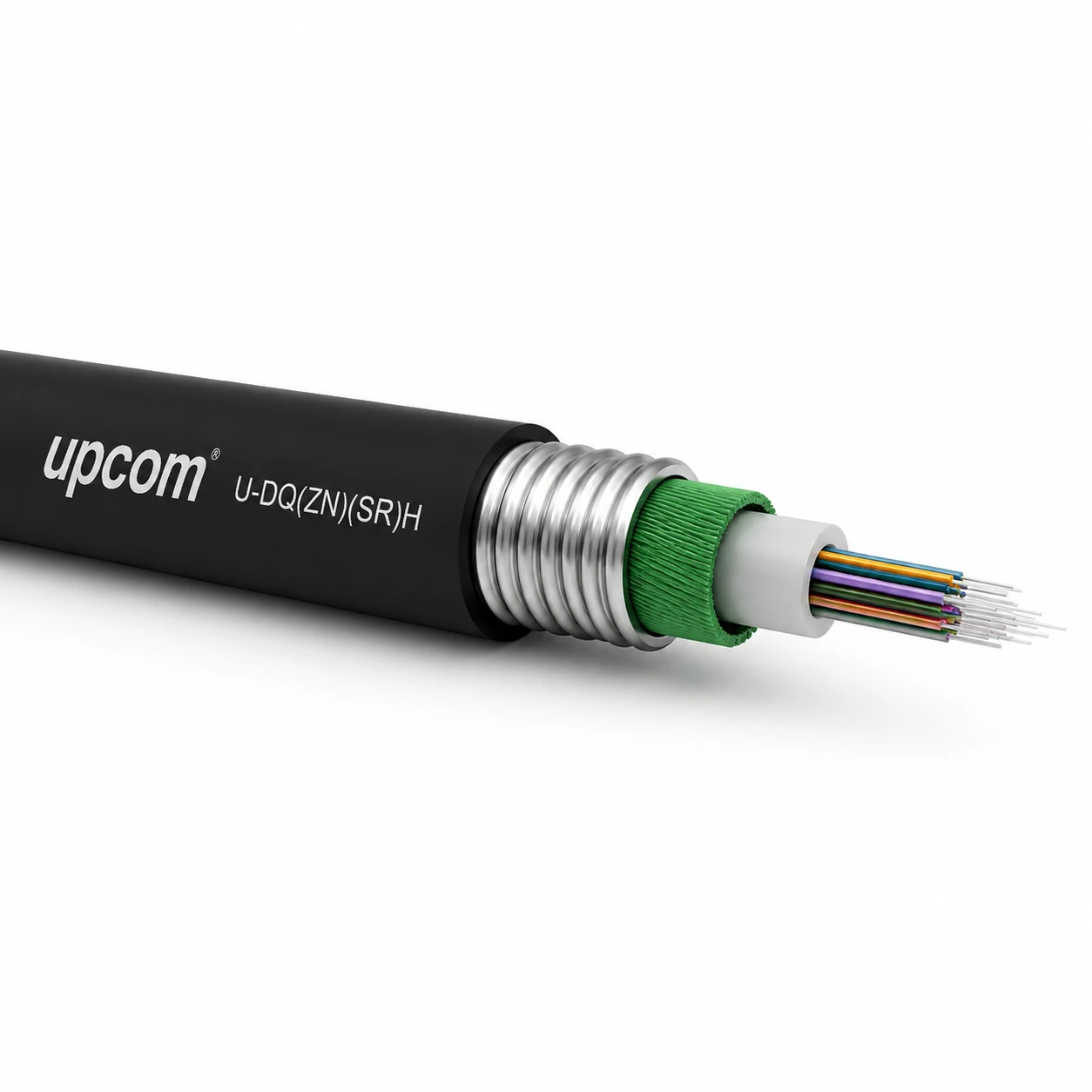
U-D(ZN)(SR)H Armoured Fiber Optic Cable Overview
U-D(ZN)(SR)H Armoured Fiber Optic Cable is positioned for projects that need a more protected outdoor / indoor transition cable with central tube simplicity and metallic armor reinforcement. Compared with lighter indoor designs, this structure is better suited to routes where crush resistance, impact protection and cable robustness matter more.
The design is especially relevant for inter-building links, campus backbones, telecom trunks, FTTB building entries and distribution runs where installers want one practical cable family for protected external routes and controlled internal transitions. For broader category navigation, see all fiber optic cable types and for foundational background, visit what is fiber optic cable.
Match route conditions and mechanical requirements to the selected construction. Request the technical documentation for the ordered variant.
U-D(ZN)(SR)H Armoured Fiber Optic Cable Applications
U-D(ZN)(SR)H Armoured Fiber Optic Cable is a practical choice when the installation route includes outdoor exposure, ducted sections and protected building entry points. Its armored central tube construction helps the cable stay relevant in projects that need better mechanical protection than a lighter indoor backbone cable.
Backbone networks
LAN / WAN backbones, telecom trunks, inter-building links and campus infrastructure where cable protection is as important as optical performance.
FTTB and access links
Suitable for protected FTTB, feeder and access network segments that need a compact low-count armored cable family.
Duct and conduit routes
Recommended for ducts, conduits and controlled underground pathways where sheath integrity and armor support help protect the fibers.
- Inter-building voice and data communication networks
- Campus cabling and distribution backbone links
- Telecommunication data trunk systems
- Primary and secondary distribution runs
- Outside plant routes installed in ducts and conduits
- Harsh premises environments that need stronger cable protection
U-D(ZN)(SR)H Armoured Fiber Optic Cable Construction & Features
The construction logic is straightforward: a central PC+PBT loose tube holds the optical fibers in thixotropic jelly, glass yarn strength support contributes tensile performance and corrugated steel tape armor adds a stronger protection layer against external mechanical risks.
This is why U-D(ZN)(SR)H Armoured Fiber Optic Cable works well in projects where routing conditions are not extreme enough to demand a much heavier special cable, but still require a noticeably more robust structure than a basic indoor or unarmored design.
Central loose tube design
A practical architecture for low-count fiber constructions, helping maintain compact cable geometry.
CST armored protection
Corrugated steel tape improves crush and impact resistance where route conditions are less forgiving.
Jelly-filled PC+PBT tube
Thixotropic jelly fills the central PC+PBT loose tube; this is not a dry-tube construction.
LSZH outer sheath
UV-stabilized LSZH-FR outer sheath.
For other cable constructions, browse the fiber optic cable range before finalizing your enquiry.
Technical Documentation and Selection
Select this steel tape armoured cable by route conditions, fiber type, fiber count and mechanical requirements. Match the required sheath and delivery length to the selected configuration.
Request technical documentation for the exact supplied construction, including its fiber configuration, sheath, dimensions and mechanical data.
Cable construction
Central PC+PBT tube with thixotropic jelly, glass yarn reinforcement and corrugated steel tape armour.
Mechanical requirements
Check installation tensile force, crush resistance, impact resistance and permitted bending radius for the route.
What to verify
Product code, fiber type, fiber count, installation route, sheath and delivery requirements.
Confirm the ordered configuration and installation conditions before finalizing the quotation.
How to Select U-D(ZN)(SR)H Armoured Fiber Optic Cable
Confirm the cable requirements
Check the fiber type, fiber count and cable construction required by the project.
Map the route conditions
Define whether the route is outdoor, ducted, conduit-based, riser-adjacent or building-entry focused.
Choose fiber count and type
Match the network design to the correct core count and optical fiber specification before quoting.
Check protection expectations
If the project expects stronger crush or impact resistance, CST armor becomes a meaningful selection point.
Verify documentation and labeling
Confirm that the supplied cable matches the specified product code, construction and technical data.
Request a project-based quote
Share route type, fiber count, fiber type, drum length and required construction for your quotation.
FAQ About U-D(ZN)(SR)H Armoured Fiber Optic Cable
What is U-D(ZN)(SR)H Armoured Fiber Optic Cable mainly used for?
It is a central loose tube, steel tape armoured cable for protected outdoor, duct, conduit and backbone routes.
Is this cable suitable for outdoor and building-entry routes?
Yes. Its armored central tube design is suited to protected outdoor routes, telecom backbones and controlled building-entry applications.
What is the cable filling?
The central PC+PBT loose tube contains thixotropic jelly. Glass yarn provides strength support and corrugated steel tape provides armour.
What should be confirmed before ordering?
Confirm fiber count, fiber type, installation route, drum length and the required mechanical protection.
Where can I compare cable constructions?
Explore fiber optic cable types before finalizing the project specification.
Need a project-based armoured cable quotation?
Send your required cable construction, fiber count, fiber type, route details and target application. UPCOM can review the required cable construction, technical specifications and documentation before preparing a quotation.