
What Is Fiber Optic Cable?
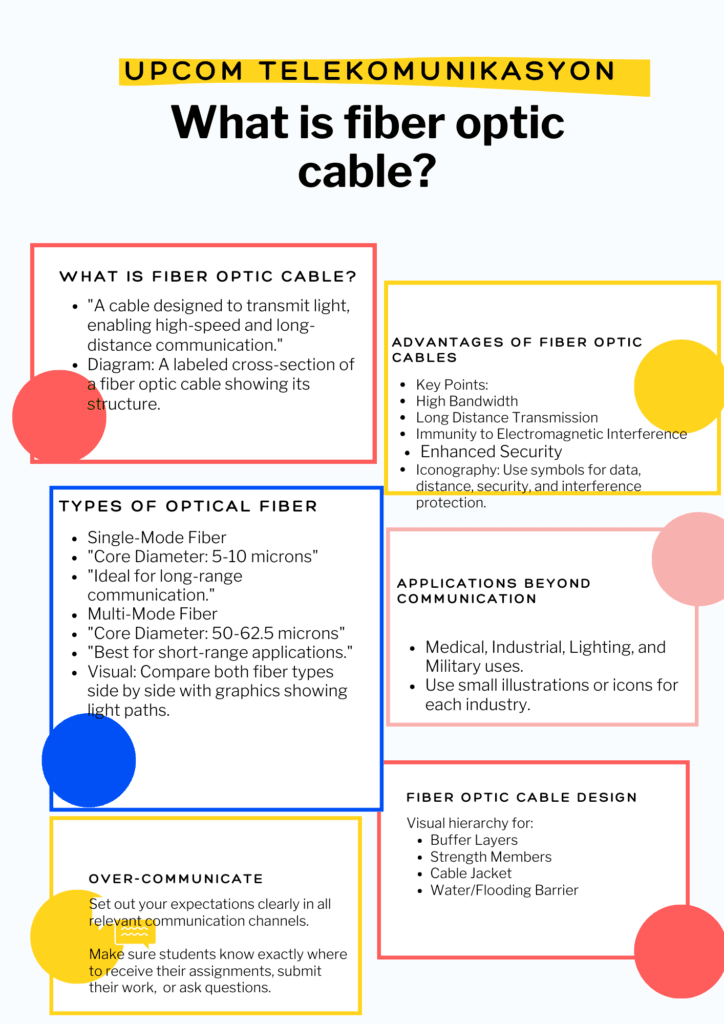
Fiber optic cables are communication cables that transmit data as pulses of light instead of electrical signals. This is why they are used where higher bandwidth, longer transmission distance, lower signal loss, and stable performance are required.
In practical terms, fiber optic cable is the backbone of modern telecom, FTTH, ISP infrastructure, data centers, industrial communication, and many high-reliability networks. It is not just a faster alternative to copper. It is a different transmission medium with different design logic, installation requirements, and application strengths.

What Is Fiber Optic Cable?
Fiber optic cable is a cable assembly that carries information through light traveling inside ultra-thin strands of glass or plastic. Unlike copper cables, which transmit electrical signals, optical fiber uses light pulses. This allows much higher bandwidth, greater distance, and much better resistance to electromagnetic interference.
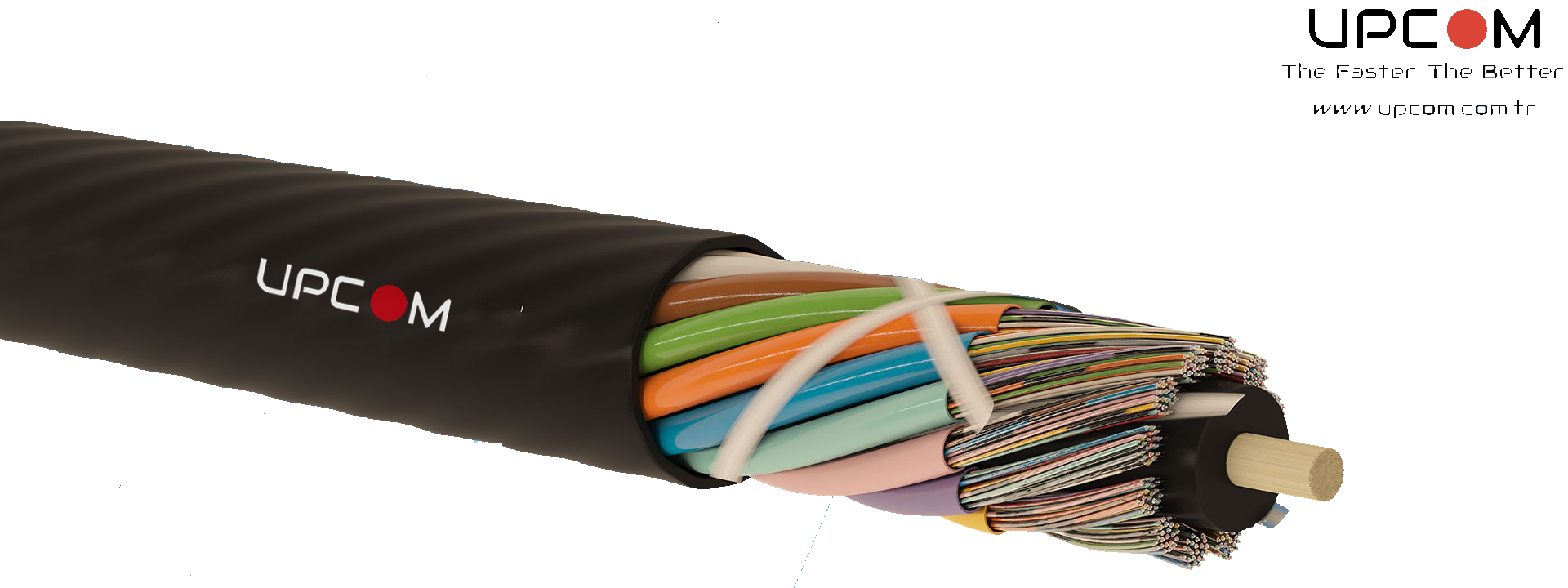
A standard fiber optic cable is not only the fiber itself. It is a complete construction that includes the optical core, cladding, protective coatings, strength members, water-blocking elements where needed, and the outer jacket designed for the target environment.
The History of Fiber Optic Cables
Fiber optic communication started developing in the mid-20th century, but the technology became commercially important in the late 1970s. Since then, it has changed long-distance communication, replacing or complementing copper systems in backbone networks, access networks, undersea communication, and high-capacity enterprise infrastructure.
Commercial adoption accelerated because optical transmission solved core limitations of legacy media: distance, attenuation, and capacity. If you want a broader timeline, you can explore the detailed history of fiber optics.
What Is Optical Fiber and How Does It Work?
Optical fiber is the actual light-carrying strand inside the cable. It is usually made from glass, sometimes plastic, and is only slightly thicker than a human hair. Data moves through this fiber as light pulses.
The basic transmission principle is simple: light stays confined inside the fiber core because of the relationship between the core and the cladding. This allows signals to travel long distances with very low loss compared to traditional electrical cabling.
Key Components
- Core: The part that carries the light signal.
- Cladding: Surrounds the core and keeps light confined.
- Coating: Protects the fiber from moisture and handling damage.
Basic Function
Light enters the fiber from a laser or LED source, travels through the core, and reaches the receiver with minimal attenuation. This is why fiber is preferred for high-speed, long-distance, and low-interference transmission environments.
Advantages of Fiber Optic Cables
Fiber is widely preferred because its technical advantages are structural, not marginal. It is not just slightly better than copper in some cases. In many applications, it solves different engineering problems altogether.
Performance Benefits
- High bandwidth: Suitable for very large data volumes.
- Long distance transmission: Low signal loss over kilometers.
- Stable signal integrity: Better for backbone and critical links.
- Scalability: Networks can often be upgraded by changing optics, not the entire cabling path.
Environmental and Operational Benefits
- Immunity to EMI/RFI: Ideal in electrically noisy environments.
- Improved security: Harder to tap than standard copper links.
- Lower attenuation: Supports long links with fewer regeneration points.
- Lightweight structure: Useful in telecom and infrastructure projects.
Types of Optical Fiber
Single-Mode Fiber
Single-mode fiber has a very small core, typically around 5–10 microns in general explanation, and allows light to travel in one primary path. This reduces modal dispersion and makes single-mode fiber the standard choice for long-distance telecom, backbone networks, CATV, and FTTH infrastructure.
- Core diameter: very small
- Transmission behavior: one optical path
- Main use: long-distance and high-capacity networks
- Practical advantage: lower dispersion and longer reach
Compare single-mode and multi-mode fibers.
Multi-Mode Fiber
Multi-mode fiber has a larger core, typically 50–62.5 microns, and allows multiple light paths. It is commonly used in shorter-distance applications such as LAN networks, campus links, and some data center environments.
- Core diameter: larger than single-mode
- Transmission behavior: multiple light paths
- Main use: shorter-distance internal network links
- Practical advantage: economical for many short-range installations

Fiber Optic Cable Design
Fiber optic cable construction changes according to installation environment. Indoor cables, outdoor cables, duct cables, armored constructions, FTTH drop cables, and backbone cables are not designed the same way because each application has different mechanical and environmental demands.
1. Buffer Layers
Buffer layers help protect the optical fibers from stress, movement, and external forces.
- Loose Tube: Common in outdoor and rugged cable structures, often used where water protection and longer route durability are needed.
- Tight Buffer: Compact design, commonly used for indoor applications and controlled environments.
2. Strength Members
Strength members support tensile performance and installation durability.
- Aramid Yarn (Kevlar): Lightweight and strong.
- Steel Strands: Added where extra structural support is required.
3. Cable Jacket
The outer sheath is selected according to the installation environment.
- PE: UV-resistant and durable for outdoor use.
- PVC: Common in certain indoor applications.
- LSZH: Preferred in enclosed or public areas where smoke and halogen emissions matter.
4. Water or Flooding Barrier
Outdoor and underground cable designs often include water-blocking elements.
- Moisture-resistant materials
- Gel or dry water-blocking solutions
- Metallic barriers such as aluminum-based layers in some structures
Applications Beyond Communication
Fiber optics are strongly associated with telecom and internet, but their use goes beyond standard communication networks.
| Application Area | How Fiber Is Used |
|---|---|
| Telecommunications and internet | FTTH, backbone networks, ISP transport, campus networks, data centers |
| Medical industry | Endoscopic devices and optical imaging systems |
| Industrial inspection | Fiberscopes for engines, pipelines, and narrow inspection spaces |
| Military and aerospace | Secure, lightweight, EMI-immune communication and sensing systems |
| Lighting and decorative systems | Architectural lighting, display effects, and controlled visual systems |
Innovations in Fiber Optics
Fiber technology continues to evolve. The cable itself, the transmission systems, and the installation methods all keep improving.
- Wavelength Division Multiplexing (WDM): Multiple signals over a single fiber.
- Bend-insensitive fibers: Better performance in tighter routing conditions.
- Plastic Optical Fiber (POF): Cost-effective for some short-range use cases.
- Higher density connectivity: Growth of MPO/MTP and structured high-capacity cabling systems.
Common Questions About Fiber Optic Cable
What does a fiber optic cable do?
A fiber optic cable carries data as light through optical fibers. In practice, it is used for FTTH, telecom links, data centers, and high-performance network infrastructure where copper reaches its limits.
Is fiber optic better than WiFi?
They are not direct alternatives. Fiber is the wired transport medium. WiFi is the local wireless access layer. In modern networks, fiber usually feeds the router or ONT, and WiFi distributes the connection inside the home or office.

What are the disadvantages of fiber optic cable?
- Higher infrastructure cost in some projects
- Installation quality matters more
- Bend radius and handling are critical
- Termination, splicing, and testing require specialized tools
- Repairs can be more technical than basic copper replacement

What is the difference between fiber optic and Ethernet?
Ethernet is a networking standard. It can run over copper or fiber. The more practical comparison is usually fiber cabling versus copper cabling. Fiber uses light, copper uses electrical signals.
- Distance: fiber supports much longer links
- Interference: fiber is immune to EMI/RFI
- Use case: fiber is preferred for backbones, risers, campus links, and high-speed uplinks
- Common connectors: LC, SC, ST, MPO/MTP for fiber; RJ45 for copper
Is fiber optics becoming obsolete?
No. Fiber is the core infrastructure behind global internet traffic, data center interconnection, backbone systems, and FTTH growth. Wireless networks expand, but they still depend heavily on fiber backhaul.
Is fiber optic cable wired or wireless?
Fiber optic cable is wired. It must be physically installed, terminated, and connected through optical interfaces.
How is fiber optic connected to a house?
- A fiber drop cable is routed from a nearby distribution point.
- The fiber is spliced or terminated inside the building.
- An ONT converts the optical signal into Ethernet.
- A router then provides local wired and WiFi access.
Interesting facts about fiber optic cables
- Many field issues come from dirty connectors, not broken fiber.
- Most international data traffic depends on long-distance fiber systems.
- Fiber infrastructure often remains in place while optics are upgraded over time.
- Fiber is widely used far beyond telecom, including medical and industrial systems.
Looking for Fiber Optic Cable for a Specific Project?
If your target is not only to understand what fiber optic cable is, but also to select the right construction for your application, the next step is to match the cable design to the route, environment, CPR requirement, installation method, and mechanical needs.