
Data LAN structured cabling
CAT 7 S/FTP Cable
CAT 7 S/FTP Cable is a shielded data LAN cable built for Class F structured cabling, using 23 AWG bare copper conductors, individually foil-screened pairs and an overall tinned copper braid for installations where signal integrity and EMI control matter.
The UPCOM range is available with PVC, HFFR and PE sheath options, so the same CAT 7 shielded LAN cable family can be aligned with indoor building routes, fire-performance targets and project-specific installation conditions.
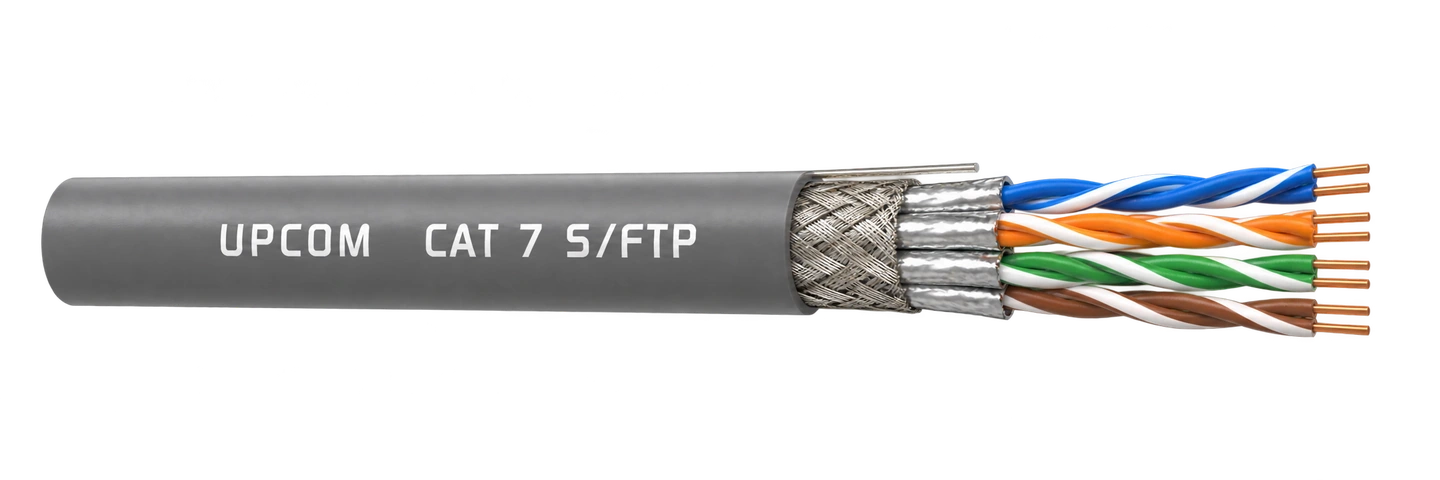
CAT 7 S/FTP cable for controlled, shielded data transmission
This CAT 7 S/FTP cable is intended for structured cabling environments that need a more protected copper transmission path than standard unshielded constructions. The combination of pair-level foil shielding and an overall tinned copper braid helps reduce external interference and supports cleaner signal behavior in electrically noisy routes, equipment rooms and dense cable bundles.
Supported applications include Ethernet, Fast Ethernet, Gigabit Ethernet, 10GBase-T and PoE / PoE+. This application range makes the cable suitable for robust copper distribution in enterprise, industrial and data-room environments.
Where this CAT 7 shielded LAN cable fits best
- Data rooms, server spaces and technical floors with elevated cable density
- Industrial or utility areas where electromagnetic noise is harder to ignore
- Projects that need shielded copper links and a structured-cabling style specification path
- Routes where sheath choice matters, such as indoor PVC, low-smoke HFFR or outdoor-oriented PE
- Networks that still rely on copper endpoints while requiring stronger shielding discipline
CAT 7 S/FTP cable construction
The core structure follows the logic expected from a shielded high-performance LAN cable: solid copper conductors, foam-skin insulation, foil around each pair and an overall braid outside the laid-up pairs. That build makes this CAT 7 Ethernet cable a better fit for routes where alien noise, switching equipment, power proximity or dense infrastructure can challenge signal stability.
For technical buyers, the important point is not only category naming but the actual construction stack. Pair screening reduces pair-to-pair disturbance, while the external braid adds another layer of protection and helps the cable behave more predictably in demanding installations.
Construction details
- 23 AWG bare copper conductor
- Skin / Foam / Skin PE insulation
- Al-Pet foil with 100% coverage
- Tinned copper drain wire
- Tinned copper wire braiding
- Outer sheath options: PVC, HFFR or PE
Enterprise and building networks
CAT 7 S/FTP cable is suitable where equipment rooms, backbone transitions, floor distributors and horizontal routes need a more shielded copper medium than lower-category or unshielded options.
Industrial and EMI-sensitive areas
In production facilities, utility corridors and machine-adjacent paths, extra shielding can help keep copper links more stable when surrounding electromagnetic conditions are less forgiving.
Data rooms and monitored spaces
This CAT 7 shielded LAN cable is also relevant for data-room and cabinet infrastructure where cable density, thermal load and environmental control are managed more tightly than in standard office routes.
Technical specifications for CAT 7 S/FTP cable
| Property | Value |
|---|---|
| Copper weight | 33.5 kg/km |
| Minimum bending radius during draw-in | 60 mm |
| Minimum bending radius, permanently installed | 30 mm |
| Maximum tensile strength | 95 N |
| Minimum crush resistance | 1000 N / 10 cm |
| Minimum impact | 10 impacts |
| Installation temperature | 0°C to +50°C |
| Operating temperature | -30°C to +70°C |
| Packing | 305 / 500 m |
| Max. conductor resistance | Test value available on request at 20 °C |
| Max. resistance unbalance | < 2% |
| Min. insulation resistance | 5000 MΩ × m |
| Mutual capacitance | 43 pF / m |
| Max. capacitance unbalance | 1600 pF / km |
| Impedance at 100 MHz | 100 ± 5 Ω |
| Velocity of propagation | 0.79 |
| Delay skew | 25 ns / 100 m |
| Min. TCL | Level 1 |
| Coupling attenuation | Type 1 |
| Transfer impedance | Class 1 |
| Test voltage | 1000 V |
| Operating voltage | 125 V |
The stated values apply to this CAT 7 S/FTP cable family. Confirm the selected sheath, Euroclass and packing length in the final project specification.
Sheath and Euroclass options
| Variant | Outer sheath | Euroclass | Cable weight |
|---|---|---|---|
| CAT 7 S/FTP | PVC | Eca | 68 kg/km |
| CAT 7 S/FTP HFFR | HFFR | Dca | 69 kg/km |
| CAT 7 S/FTP PE | PE | Fca | 59 kg/km |
How to read these sheath options
PVC is typically the practical starting point for standard indoor routes. HFFR is the stronger candidate when you want lower smoke and halogen-free behavior aligned with stricter fire-performance expectations. PE fits projects that need a sheath more aligned with tougher outdoor or environmental exposure conditions.
If Euroclass and sheath selection are part of the specification process, it is worth checking your project’s fire-performance requirements against the broader guidance in the CPR compliant cables guide.
CAT 7 S/FTP cable performance table
Selected electrical performance values are listed below. The full product datasheet provides the complete frequency table, with values extending from 1 to 900 MHz.
| Frequency (MHz) | Attenuation (dB/100 m) | NEXT (dB) | PS-NEXT (dB) | ACR (dB/100 m) | PS-ACR (dB/100 m) | ACRF (dB/100 m) | PS-ACRF (dB/100 m) | Return loss (dB) |
|---|---|---|---|---|---|---|---|---|
| 1 | 2.0 | 104 | 101 | 99 | 96 | 101 | 98 | 24 |
| 4 | 3.4 | 104 | 101 | 97 | 94 | 98 | 95 | 30 |
| 10 | 4.9 | 101 | 98 | 95 | 92 | 98 | 95 | 32 |
| 100 | 17.3 | 100 | 97 | 82 | 79 | 84 | 81 | 34 |
| 250 | 28.2 | 95 | 92 | 63 | 60 | 70 | 67 | 27 |
| 500 | 42.0 | 95 | 92 | 56 | 53 | 61 | 58 | 24 |
| 600 | 44.0 | 88 | 85 | 45 | 42 | 59 | 56 | 22 |
| 700 | 53.5 | 84 | 81 | 30 | 27 | 52 | 49 | 20 |
| 800 | 55.5 | 83 | 80 | 28 | 25 | 50 | 47 | 19 |
| 900 | 57.3 | 80 | 77 | 23 | 20 | 49 | 46 | 18 |
How to choose the right CAT 7 S/FTP cable
-
Define the route environment.
Start by deciding whether the cable will run in a standard indoor pathway, a lower-smoke project environment or a route that needs a PE sheath for harsher exposure conditions. -
Check the shielding requirement.
If the installation passes through dense cabinets, plant rooms, utility areas or other EMI-sensitive zones, an S/FTP construction is easier to justify than a lighter-shielded or unshielded option. -
Match the cable to the application profile.
Confirm whether the project calls for Ethernet, Gigabit Ethernet, 10GBase-T or PoE / PoE+ support and align the cable choice with the broader structured-cabling design. -
Review mechanical handling limits.
Bend radius, pulling load, temperature range and packing length should be checked before procurement, not after the reels reach the site. -
Compare with adjacent categories.
For lighter-duty cost-sensitive work, compare with CAT 5e or CAT 6. If the specification is moving upward in bandwidth class, review the CAT 7A option before finalizing.
Quick comparison path
- CAT 5e U/UTP for simpler, lower-spec copper links
- CAT 6 SF/UTP for mid-tier shielded structured cabling
- CAT 7A S/FTP when the project is moving beyond CAT 7 scope
- CAT6 vs CAT6A vs CAT7 selection guide for broader category comparison
Compliance and standards
The cable specification lists EIA/TIA-568-C.2, ISO/IEC 11801 2nd edition, IEC 61156-5, EN 50173-1 and EN 50288-4-1. The required standard revision and channel-performance criteria should be stated explicitly in project and tender documents.
- ISO/IEC 11801 overview
- IEC 61156-5 preview
- IEEE 802.3 Ethernet standard page
Procurement specification checklist
A complete procurement specification should state CAT 7 / Class F, 23 AWG solid bare copper conductors, S/FTP shielding, sheath type, Euroclass, reel length and the applicable standard revisions. Shielded termination hardware and the grounding / bonding design should be compatible with the complete cabling channel.
FAQ about CAT 7 S/FTP cable
What does S/FTP mean in a CAT 7 cable?
S/FTP means the cable uses individual foil shielding around each twisted pair plus an overall braided screen. That combination is used to improve shielding performance against electromagnetic interference and internal crosstalk.
Is this CAT 7 S/FTP cable suitable for 10G Ethernet?
Yes. Supported applications include 10GBase-T, Ethernet, Fast Ethernet, Gigabit Ethernet and PoE / PoE+.
Which sheath option should I choose: PVC, HFFR or PE?
PVC is the usual starting point for standard indoor routes, HFFR is the better fit when low-smoke and halogen-free behavior is part of the project requirement, and PE is the more route-specific option for tougher environmental conditions.
When should I compare CAT 7 with CAT 7A?
If the project brief is moving beyond a CAT 7-level specification, compare the required bandwidth, shielding, channel design and termination system against the CAT 7A S/FTP option before freezing the bill of materials.
Can this cable be used with lower-category equipment?
In practical network planning, CAT 7 S/FTP cable is often considered alongside lower-category systems, but the real benefit comes when the full channel design, shielding approach and termination path are planned coherently.