
JV-H Fiber Optic Pigtail Cable
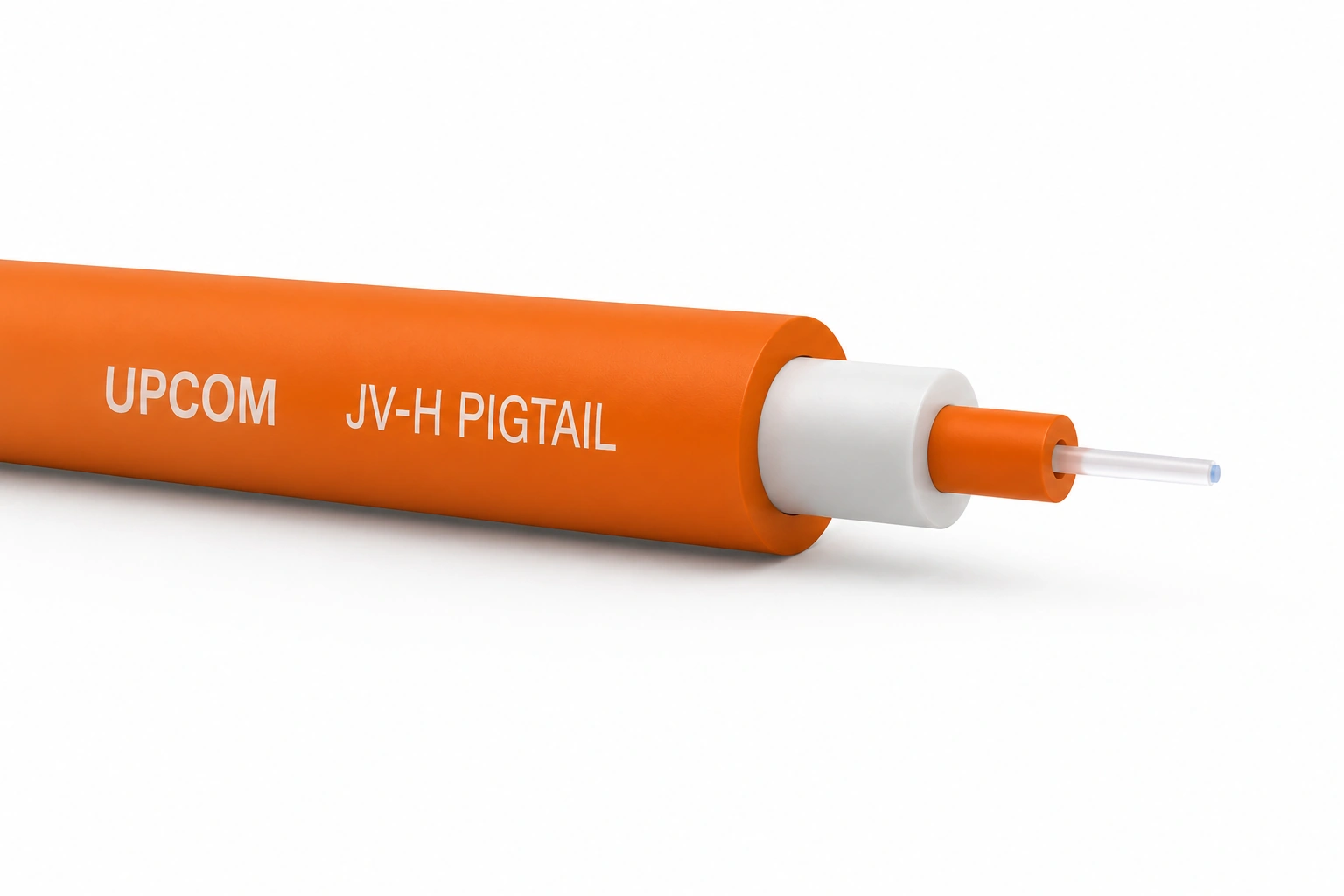
JV-H fiber optic pigtail cable is a single-fiber indoor tight buffer cable for direct termination, pigtail and jumper connections, and compact patching points. Its dry, all-dielectric construction uses a 250 µm coated fiber inside a 900 µm LSZH/HFFR tight buffer.
The cable is available for single-mode 9/125, multimode 50/125 and multimode 62.5/125 fiber applications. It can be ordered as cable or, subject to project requirements, as a connectorized pigtail with the connector type and polish specified in the RFQ. For broader cable families, see our fiber optic and data cable range.
On this page
JV-H Fiber Optic Pigtail Cable Overview
JV-H Pigtail consists of one 250 µm color-coated optical fiber inside a 900 µm LSZH/HFFR tight buffer. The compact construction supports clean stripping and direct connectorization without the bulk of multi-fiber indoor cable designs.
Compared with larger indoor cable types such as Premises Distribution Cable I-V(ZN)H or Mini Breakout Cable, JV-H Pigtail is intended for compact single-fiber termination work, localized patching and jumper preparation.
If you are comparing basic fiber structures first, our fiber optic cable overview gives a broader starting point before moving into specific indoor cable selections.
JV-H Pigtail applications
Indoor interconnect points
Suitable for indoor cross-connect areas, telecom rooms, cabinet terminations and controlled internal routing where a single-fiber pigtail is required.
Patchcord and jumper preparation
Used for pigtail, jumper and controlled indoor patchcord applications where direct termination and a small handling diameter are required.
Structured cabling support
Suitable for building interiors and network rooms that require halogen-free tight buffer material and clean single-fiber organization.
Compliance and standards
Referenced standards are EN DIN VDE 0888 Part 2, IEC 61034, IEC 60332-1 and IEC 60754-2. Temperature and bending performance are specified according to IEC 60794-1-2 F1 and E11.
IEC 61034 addresses smoke density, IEC 60332-1 addresses vertical flame propagation on a single insulated wire or cable, and IEC 60754-2 covers the acidity and conductivity of gases generated during combustion. For standards information, see IEC and VDE.
JV-H Pigtail features and benefits
Easy stripping
The 900 µm tight buffer supports clean stripping and practical handling during connector preparation.
Direct termination
Supports connector assembly on one end for indoor fiber distribution, patching and jumper applications.
Low installation cost
The compact, dry construction simplifies preparation and routing in controlled indoor environments.
Dry, all-dielectric design
A dry non-metallic structure supports simple indoor use where metallic elements are not necessary.
LSZH/HFFR tight buffer
The halogen-free tight buffer supports indoor applications with defined flame, smoke and combustion-gas requirements.
Single-fiber flexibility
Well suited for individual terminations, repair works, localized transitions and cabinet-side fiber finishing.
JV-H Pigtail technical specifications
| Fiber count | 1 |
|---|---|
| Fiber options | Single-mode 9/125, multimode 50/125 or multimode 62.5/125 |
| Tight buffer material | LSZH / HFFR |
| Standard buffer colors | Yellow (SM) / Blue (MM 50/125) / Orange (MM 62.5/125) |
| Approximate weight | 0.9 kg/km |
| Tight buffer diameter | 0.90 ± 0.05 mm (900 ± 50 µm) |
| Permissible installation load | 10 N |
| Maximum production length | Up to 8,000 m, subject to production and packing confirmation |
| Temperature range | −10 °C to +60 °C (IEC 60794-1-2 F1) |
| Minimum bending radius | 20 × outer diameter (IEC 60794-1-2 E11) |
Confirm fiber type, buffer color, delivery length, connector and polish requirements, packing format, and project-specific compliance documents with the RFQ. Technical values are subject to final production confirmation.
JV-H Pigtail termination and ordering
- Confirm the fiber type. Specify single-mode 9/125, multimode 50/125 or multimode 62.5/125 according to the connected equipment and link design.
- Define the supply format. Confirm whether bare tight buffer cable or a connectorized pigtail is required. For connectorized supply, state the connector type and UPC or APC polish.
- Prepare the buffer correctly. Use a stripping tool suitable for 900 µm tight buffer and follow the connector or splice-system instructions to avoid damaging the 250 µm coated fiber.
- Clean, inspect and terminate. Complete connectorization or splicing with the approved process and inspect the prepared fiber before assembly.
- Test and identify. Verify optical performance, label the connection and maintain the specified minimum bend radius during routing.
JV-H Pigtail FAQ
Related indoor fiber cables and guides
For product comparison and broader cable selection, continue with the related pages below.