
Mini-Breakout Cable
Mini-Breakout Cable is an armored tight buffer fiber optic cable designed for outdoor use, direct connection work, and mechanically demanding routes where compact construction and added protection are both required.
This cable structure combines 900 µm tight-buffered fibers, central strength support, swellable glass yarns, corrugated steel tape armor, and an outdoor jacket to deliver a practical solution for campus links, FTTB, inter-building runs, harsh premises areas, and direct-burial projects where rodent and crush resistance matter.
If you are comparing cable families, you can also review our Premises Distribution Cable, read the guide on Breakout vs Mini-Breakout Fiber Cable, or browse the full fiber optic cable category.
- Tight buffer construction
- Corrugated steel tape armor
- Outdoor / harsh premises use
- Direct burial for PE version
- Up to 24 fibers on request
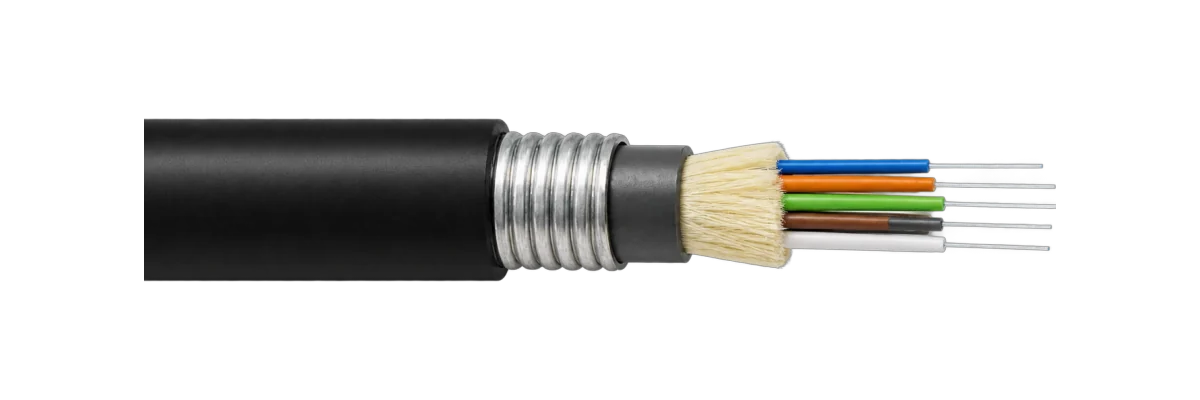
Mini-Breakout Cable overview
Mini-Breakout Cable is positioned between standard indoor distribution constructions and heavier outdoor loose tube alternatives. It gives the installer the handling advantage of tight buffer design while adding an armored barrier for routes exposed to pressure, abrasion, rodent activity, and installation stress.
For projects that require simpler indoor routing with lower mechanical demand, a lighter Premises Distribution Cable may be sufficient. For outdoor backbone routes where a loose tube design is preferred, you can review Armored Loose Tube LSZH.
When fire performance becomes a major selection criterion, the relevant alternatives are Fire Resistant Fiber Optic Cable A-DQ(MK)BNS(RH) and fiber cable fire resistant solutions.
Why this structure is preferred
- Compact tight buffer construction supports direct termination and cleaner handling.
- Corrugated steel tape armor improves crush resistance and rodent protection.
- Outdoor sheath system supports dry outdoor routing and demanding site conditions.
- Suitable for FTTB, campus, riser transition zones, inter-building links, and customer equipment connections.
- Custom variants can be discussed for higher tensile demand, different sheath preferences, and higher fiber counts.
Mini-Breakout Cable applications
Campus and inter-building links
Mini-Breakout Cable is well suited to short and mid-range outdoor runs between buildings where installers want armored protection without moving to a bulkier loose tube construction.
FTTB and customer connection points
The tight buffer architecture supports termination convenience in building entrances, floor distribution transitions, and customer equipment connection areas.
Harsh premises and ducted outdoor routes
Where ducts, conduits, exposed transitions, or mechanically sensitive passages exist, the armored design gives a more robust installation margin than lighter indoor-only cable families.
Typical installation areas
- Inter-building and campus cabling
- FTTB and FTTX access networks
- Riser and horizontal transitions
- Distribution frame to customer equipment connections
- Outdoor ducts and conduits
- Harsh premises environments
- Direct burial applications for PE-jacketed versions
When not to use it
If the route is fully indoor and mechanically protected, a lighter premises distribution structure may be more economical. If the route is longer, wetter, or heavily exposed and loose tube design is specified by the project, a dedicated outdoor armored loose tube cable may be the better fit.
A quick comparison is available in our Breakout vs Mini-Breakout Fiber Cable article.
Mini-Breakout Cable construction details
The cable is built around individually colored 900 µm tight-buffered fibers arranged around a central support element. Swellable glass yarns provide additional tensile strength and moisture-blocking support. A corrugated steel tape armor layer improves mechanical and rodent resistance, and a high-strength ripcord under the armor simplifies stripping during installation.
The standard outdoor concept is based on PE-oriented construction logic for dry outdoor use and direct burial suitability where applicable. Depending on project requirements, alternative sheath preferences such as LSZH can also be discussed.
To understand the broader cable family structure, you may also review what fiber optic cable is and how different cable designs are selected in real network environments.
Construction summary
- Colored 900 µm tight-buffered fibers
- Central strength support
- Aramid / yarn-based strength contribution
- Swelling yarn for added protection
- Corrugated steel tape armor
- Ripcord for easier jacket access
- Outdoor sheath with optional variants
For standards background, see IEC and CEN-CENELEC.
Mini-Breakout Cable technical specifications
Standard construction and mechanical values are listed below. Configurations with up to 24 fibers are available on request. Confirm the final jacket construction, dimensions, and applicable standards for the selected version before ordering.
Construction and mechanical data
| Item | Value |
|---|---|
| Standard fiber counts | 2 / 4 / 6 / 8 / 12 fibers |
| Higher fiber counts | Available up to 24 fibers on request |
| Tight buffer diameter | 900 ± 50 µm |
| Strength members | Aramid yarns |
| Armor | Corrugated steel tape |
| Jacket options | UV-resistant PE for outdoor use; LSZH available on request |
| Crush resistance | 2000 N (IEC 60794-1-2 E3) |
| Temperature range | -20 °C to +60 °C (IEC 60794-1-2 F1) |
| Minimum bending radius | 20 × outer diameter (IEC 60794-1-2 E11) |
| Referenced standards | EN 50173-1; IEC 60754-2; IEC 60794-1 and IEC 60794-2; IEC 60793-1 and IEC 60793-2; IEC 60332-1 and IEC 60332-2. Applicability depends on the selected jacket construction. |
Typical dimensional data by fiber count
| Fiber count | Weight (kg/km) | Outer diameter (mm) | Permissible / installation tensile load (N) |
|---|---|---|---|
| 2 | 140 | 10.5 | 1000 / 1800 |
| 4 | 150 | 11.0 | 1000 / 1800 |
| 6 | 160 | 11.5 | 1200 / 2000 |
| 8 | 175 | 12.0 | 1200 / 2000 |
| 12 | 220 | 13.3 | 1200 / 2000 |
Available optical fiber options
| Fiber type | Operating wavelengths (nm) | Maximum attenuation (dB/km) |
|---|---|---|
| 62.5/125 OM1 | 850 / 1300 | 3.2 / 1.2 |
| 50/125 OM2 | 850 / 1300 | 3.0 / 1.0 |
| 50/125 OM3 | 850 / 1300 | 2.8 / 0.8 |
| 50/125 OM4 | 850 / 1300 | 2.7 / 0.7 |
| 9/125 G.652.D | 1310 / 1550 | 0.34 / 0.25 |
How to specify Mini-Breakout Cable
Step-by-step selection logic
- Define whether the route is indoor, outdoor, direct burial, or mixed transition.
- Confirm required fiber count and whether multimode or single mode fiber is needed.
- Check if tight buffer convenience is preferred over a loose tube construction.
- Evaluate crush, rodent, moisture, and stripping requirements along the route.
- Specify sheath preference, fire-performance expectation, and any custom tensile requirement.
- Request datasheet confirmation before RFQ if the project has approval or consultant review stages.
Practical selection notes
Mini-Breakout Cable is usually chosen when the installer wants more handling convenience than a classic loose tube cable, but still needs a more protected structure than a standard indoor distribution cable.
Where fire performance is central to the specification, review A-DQ(MK)BNS(RH) and related fire resistant fiber cable alternatives before final selection.
Mini-Breakout Cable FAQ
What is Mini-Breakout Cable used for?
Mini-Breakout Cable is used for outdoor, inter-building, FTTB, campus, and harsh premises installations where tight buffer handling and added mechanical protection are both required.
Is Mini-Breakout Cable suitable for direct burial?
The PE-oriented outdoor version is suitable for direct burial applications where the project specification allows it. Final selection should always match the exact sheath and project requirement.
What is the difference between Mini-Breakout Cable and Premises Distribution Cable?
Premises Distribution Cable is lighter and typically intended for indoor environments with lower mechanical exposure. Mini-Breakout Cable adds more protection and is more suitable for outdoor or tougher route conditions. See Premises Distribution Cable and our comparison article.
Which fiber types are available?
The structure can be supplied with multimode options such as OM1, OM2, OM3, and OM4, as well as single mode 9/125 G.652.D depending on the project requirement.
When should I choose a fire resistant alternative instead?
If the project specification is driven mainly by fire survival or fire reaction requirements, a dedicated fire resistant fiber optic cable family will usually be the correct direction instead of a standard outdoor armored breakout design.
Need project support for Mini-Breakout Cable?
If your route includes outdoor transitions, direct-burial segments, consultant approval requirements, or mixed fire-performance requirements, send the route details and requested fiber count so the correct cable construction can be confirmed.