



14 Mar MPO polarity guide
MPO Polarity A/B/C, Gender and Loss Budget: The RFQ Checklist Data Center Buyers Need
Most MPO polarity guide problems start before the order is placed, not during installation. Buyers usually do not need more theory. They need a cleaner way to lock the application, fiber base, connector gender, cassette plan and loss budget into one RFQ so trunks, modules and jumpers map correctly the first time.
If the project will land on cassettes or a Fiber Optic Patch Panel, the polarity method has to match the module logic. If it will be a direct array-to-array channel, the polarity method has to match the transmit and receive lane map of the end application.
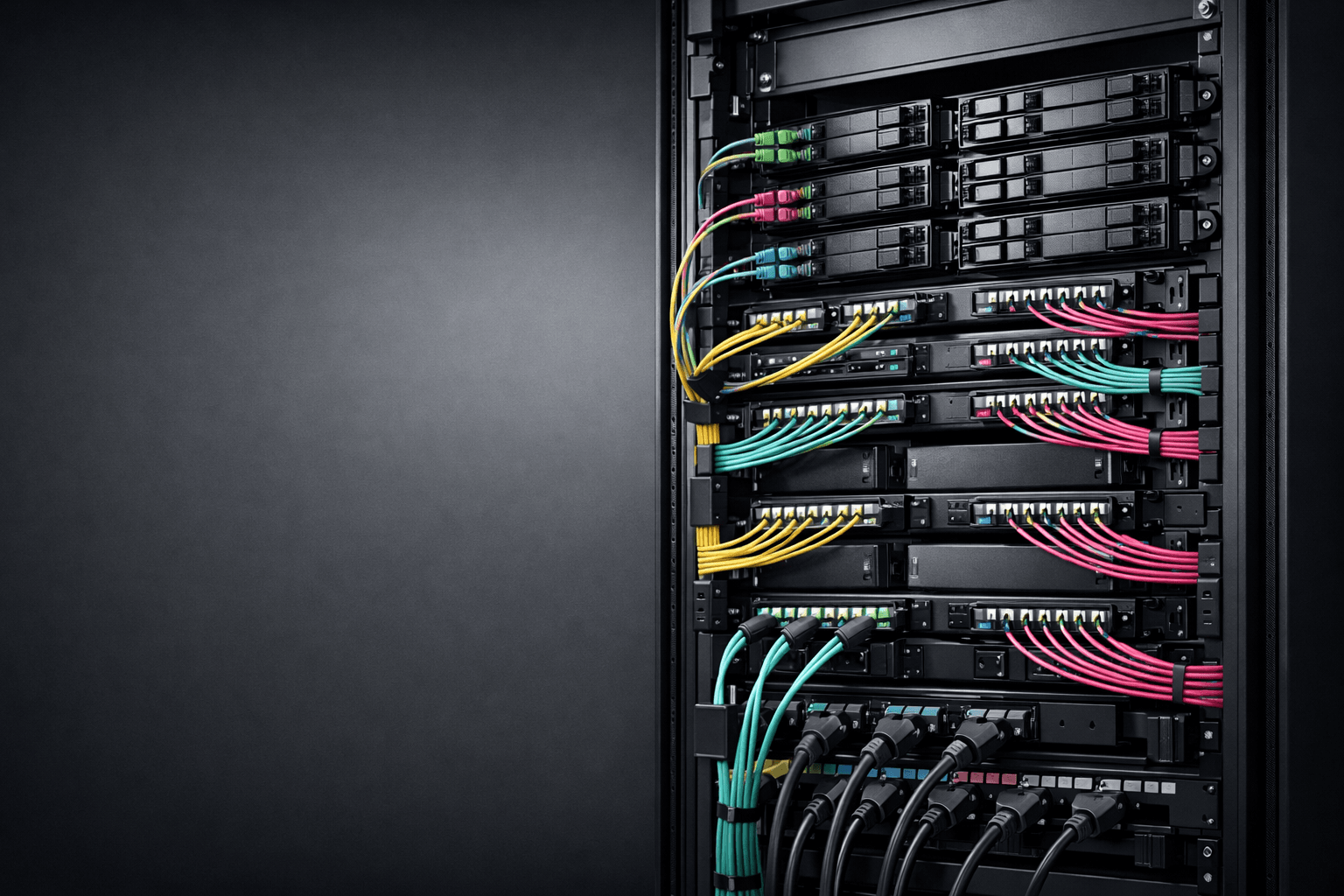
The real buying problem is where polarity will be managed in the channel and whether that logic stays consistent across the trunk, cassette, adapter, jumper and final port map. UPCOM’s MPO Cable range already covers Base-8, Base-12 and Base-24 assemblies for cassettes, panels and fan-out applications. The RFQ still has to state exactly which behavior the project expects.
Quick answer
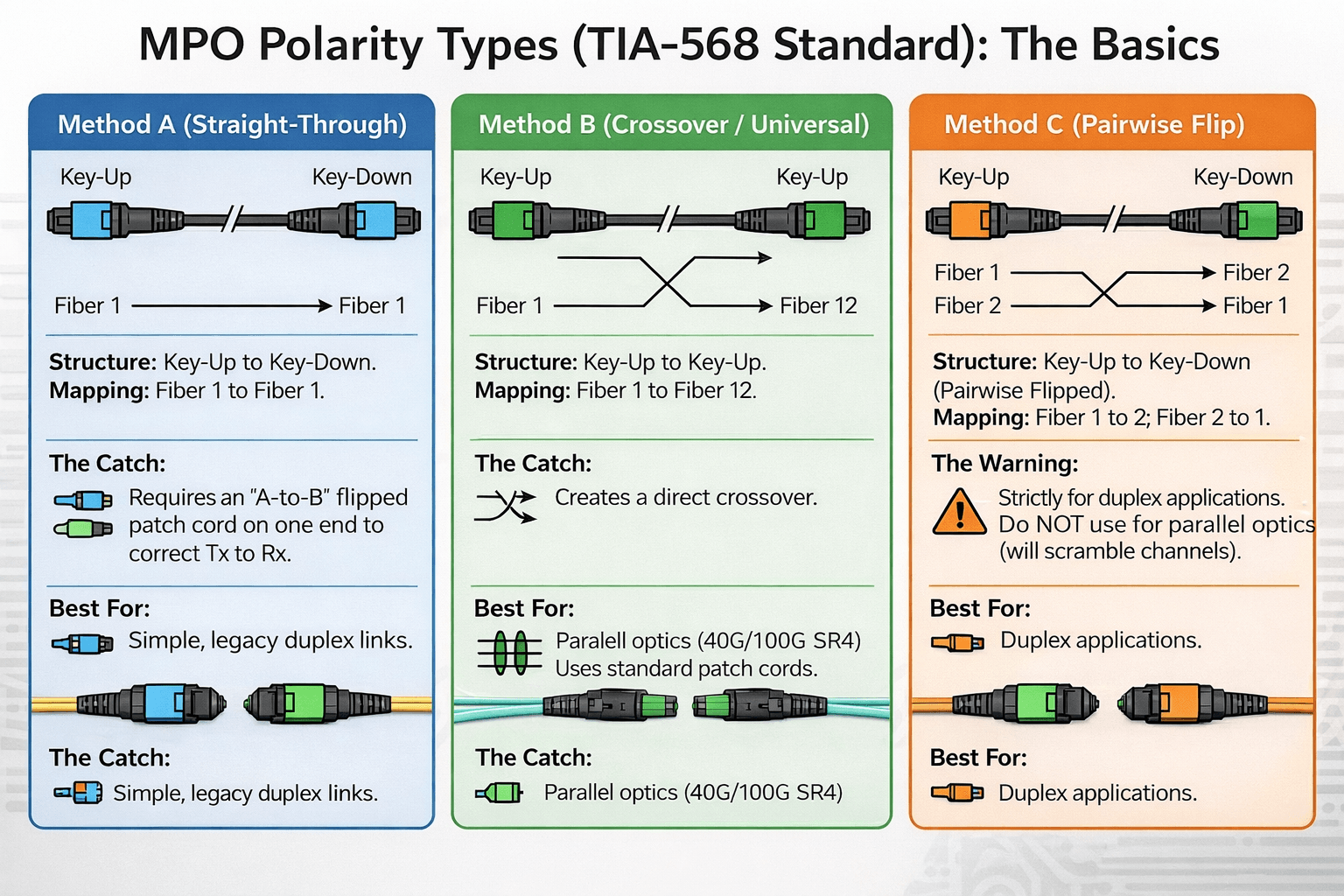
Choose MPO polarity only after four items are frozen together: application, fiber base, connector gender and total channel loss budget. Method A is usually the safer fit when the design uses modular cassettes and structured patching. Method B is common when the channel intentionally needs full-array reversal for direct parallel-optics mapping. Method C only makes sense when pair-flip behavior is documented across the entire link.
If those four items are not written into the enquiry, the quote can still look correct while the delivered channel is wrong. That is how projects end up with incompatible trunks, wrong cassette assumptions or a mechanically mateable link that still misses the optical budget.
Comparison / decision table
The decision table below is built for RFQ use, not classroom explanation. It tells you where each polarity option usually fits, what it changes, what constraint buyers forget, and which internal product family should stay aligned with that choice.
| Option | Best-fit use case | Key constraint | RFQ field | Internal link target |
|---|---|---|---|---|
| Method A | Structured cabling with modular cassettes, duplex breakout and defined patching rules. | “Straight-through” trunk language does not mean end-to-end duplex mapping is automatically solved. | Write trunk method, cassette type, adapter assumption, fiber base and jumper logic. | Fiber Optic Patch Panel |
| Method B | Direct MPO links or parallel-optics channels that intentionally need full-array reversal. | Mixing Method B trunks into a Method A cassette workflow creates fast confusion and rework. | Write method, target application, array mapping assumption and whether cassettes are present. | MPO Cable |
| Method C | Pair-flip channels where duplex breakout behavior is explicitly planned and documented. | Easy to misread in shorthand purchasing language and less forgiving for future migration. | Write pair mapping logic, breakout objective and migration plan. | Fiber Optic Connectivity Products |
| MPO gender | Every MPO mating interface, regardless of polarity method. | A correct polarity method still fails if both sides expect the same pin state. | Write male/female or pinned/unpinned condition for end A and end B. | MPO Cable |
| MPO loss budget | Any project comparing standard-loss and elite-loss assemblies. | Connector-grade language is meaningless without a total channel target. | Write maximum total insertion loss and any per-mated-pair limit. | Products |
| Choice | Choose this when | Avoid this when |
|---|---|---|
| Base-8 | The design is led by parallel optics and you want cleaner lane alignment with less stranded-fiber waste. | The facility is already standardized around Base-12 cassette inventory and duplex breakout habits. |
| Base-12 | You need broad structured-cabling compatibility for cassettes, modules and common breakout patterns. | The migration path will repeatedly waste fibers in parallel-optics applications. |
| Base-24 | You need higher density and already know cassette count, breakout logic and spare strategy. | The field team is still expected to decide the breakout approach after delivery. |
Selection criteria by application / route / environment
The easiest way to avoid wrong MPO ordering is to make the selection in sequence instead of letting connector terms float independently. Start with the application, then the fiber base, then the polarity method, then the gender, and only then compare loss grades and commercial options. That sequence keeps the channel logic intact.
Route and environment matter too. A high-density row with multiple future patching events needs more conservative documentation than a short direct equipment link. Every extra cassette, adapter and service touchpoint increases the value of a precise RFQ.
- Lock the application: cassette-based, duplex breakout or direct MPO-to-MPO.
- Choose Base-8, Base-12 or Base-24 before you freeze polarity.
- Define exactly where polarity is managed inside the channel.
- Write gender or pinning at every MPO mating interface.
- Specify the complete channel loss budget, not only connector marketing language.
- Include panel, cassette and labeling assumptions in the RFQ, not in later email clarifications.
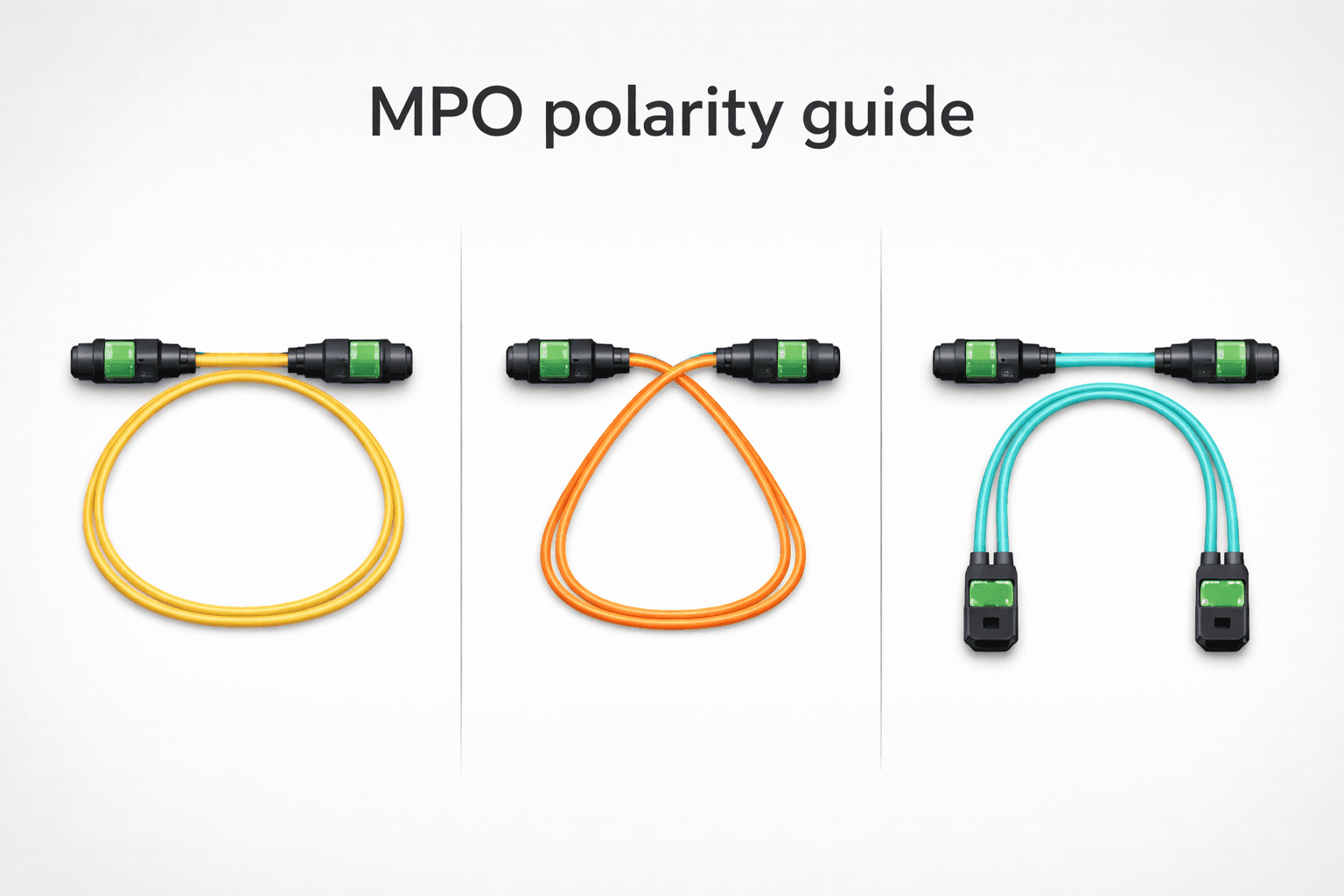
Usually cleaner choice
- High-density duplex breakout: Base-12 or Base-24 with documented modular planning, often using Method A logic.
- Direct parallel-optics equipment link: application-led array planning, often Base-8, with documented reversal logic.
- Mixed-use data hall: conservative structured-cabling logic with explicit cassette behavior and labeling rules.
Rework trigger
- Picking Base-24 for density before the cassette and spare strategy exist.
- Using direct-array assumptions in a channel that later lands on duplex cassettes.
- Letting the installer decide polarity, pinning or module type after procurement.
If the design already points to a modular data-center backbone, compare assemblies on the MPO Cable page first, then align them with the patching architecture you expect from the Fiber Optic Patch Panel side.
Compatibility and standards to verify
Standards should be used as a compatibility checkpoint, not as decorative text on a datasheet. Supplier literature often mixes brand names, interface names and older shorthand references. The procurement team should verify what is actually required in the project and whether the quote matches that language.
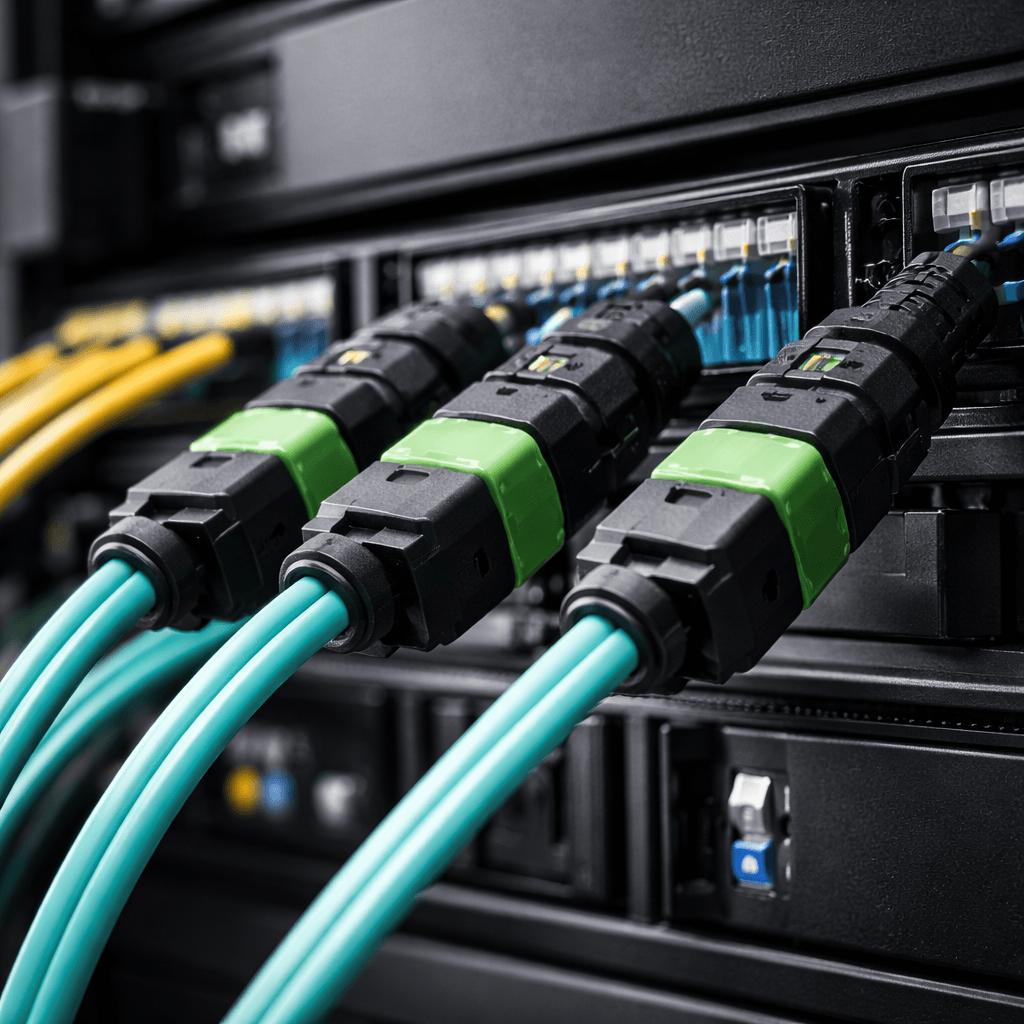
- Connector format: MPO is the interface style; MTP is a branded MPO-format connector family. Write whether branded hardware is required or whether MPO-compatible assemblies are acceptable.
- Interface reference: Verify the current MPO connector standard reference used by the supplier and confirm alignment with IEC 61754-7.
- Panel and cassette fit: Confirm adapter orientation, cassette mapping and spare-port strategy before comparing quotes.
- Acceptance criteria: Ask for insertion-loss results, polarity mapping evidence, end-face inspection expectations and traceability.
On UPCOM’s own MPO product page, the assemblies are positioned for high-density backbone cabling and interconnection between cassettes, panels and fan-out applications. That makes compatibility with the rest of the channel just as important as the trunk itself.
Common mistakes and rework triggers
Most field failures trace back to vague procurement language. The hardware may be well made and still be wrong for the channel because the RFQ never stated the architecture clearly enough. The result is usually not a dramatic failure. It is slower commissioning, extra patch cords, more connector mating points, avoidable loss and last-minute quote revisions.
Too little detail
“MPO trunk, low loss, OM4” is not a real specification. It says nothing about polarity method, gender, base count or cassette logic.
Wrong planning order
Choosing connector type first and application later usually creates hidden assumptions the supplier has to guess around.
Loss language without numbers
“Elite” or “low loss” does not protect the project unless the full channel budget is also written and checked.
The order is placed with incomplete polarity and gender details. Modules are chosen later. The patching map changes after rack layout review. Then extra jumpers, adapters or replacement trunks are used to recover the design in the field. That recovery costs more than a better RFQ would have.
RFQ checklist — exact fields buyers should include
This is the section that should go straight into the enquiry workflow. The goal is not a longer tender. The goal is a quote request with fewer hidden assumptions and cleaner apples-to-apples comparison.
| Field | Why it matters | What a clean entry looks like |
|---|---|---|
| Application | Defines whether the channel is cassette-based, duplex breakout or direct array-to-array. | “Structured cabling backbone with cassette breakout” or “direct MPO equipment link”. |
| Fiber type | Prevents mismatch between optics, trunks and cassettes. | OS2, OM4, OM5 or customer-defined equivalent. |
| Base / fiber count | Changes cassette count, migration path and density planning. | Base-8 / Base-12 / Base-24 and exact trunk fiber count. |
| Polarity method | Removes guesswork about where mapping is managed. | Method A, B or C, written explicitly. |
| Connector format | Clarifies whether branded MTP is required or MPO-compatible assemblies are acceptable. | “US Conec MTP required” or “MPO-compatible acceptable”. |
| End A gender / pinning | Stops mateability errors before the order is placed. | Female no pins / male with pins, plus key orientation if relevant. |
| End B gender / pinning | Keeps the channel complementary at the second mating side. | Write separately; do not assume it mirrors end A unless that is intended. |
| Panel / cassette mapping | Prevents a correct trunk from becoming a wrong channel. | Patch panel family, cassette type, breakout target and spare strategy. |
| Installed length / route | Affects slack, serviceability and total optical path planning. | Trunk lengths, route type and service loop requirement. |
| Maximum channel loss | Determines acceptable connector grade and total connection count. | Total insertion loss target plus per-mated-pair limit if required. |
| Test deliverables | Turns acceptance into a documented requirement. | Insertion-loss results, polarity map, end-face inspection and traceability. |
| Labeling rule | Prevents commissioning confusion later. | From-to ID, rack position, cassette or panel port logic. |
Project / location: [site name]
Application: [cassette-based structured cabling / duplex breakout / direct MPO-to-MPO]
Target application speed: [10G breakout / 40G / 100G / 400G / mixed]
Fiber type: [OS2 / OM4 / OM5]
Base and fiber count: [Base-8 / Base-12 / Base-24], [12F / 24F / 48F / 96F]
Connector format: [US Conec MTP required / MPO-compatible acceptable]
Polarity method: [Method A / Method B / Method C]
End A connector: [male with pins / female without pins], [key orientation if required]
End B connector: [male with pins / female without pins], [key orientation if required]
Cassette / module mapping: [exact cassette type or "not used"]
Patch panel interface: [panel family / adapter format / tray type]
Trunk lengths: [xx m / xx m / xx m]
Maximum total channel insertion loss: [x.xx dB]
Maximum per mated pair insertion loss: [x.xx dB]
Labeling requirement: [from-to naming rule + port ID logic]
Test and acceptance package: [IL report + polarity map + end-face inspection + traceability]
Commercial note: [custom length / split delivery / project label / packaging rule]
Need the RFQ to match the hardware stack, not only the trunk?
Check the related product families before you freeze the wording. A clean MPO enquiry usually aligns the trunk assembly, patching environment and surrounding connectivity products in one pass.
FAQ
What is the main decision point in MPO Polarity?
The main decision point is where polarity is managed across the full channel: in the trunk, in the cassette, or in the patching model around it.
Which option fits the application best in MPO Polarity?
Method A usually fits structured, cassette-based environments. Method B is common for direct parallel-optics links with full-array reversal. Method C only makes sense when pair-flip behavior is already documented across the whole channel.
What should be included in an RFQ for MPO Polarity?
Include the application, fiber type, base or fiber count, polarity method, connector format, connector gender or pinning at both ends, panel or cassette mapping, route length, total channel loss budget, labeling rules and test deliverables.
What are the most common mistakes buyers make when specifying MPO Polarity?
The most common mistakes are leaving polarity implicit, omitting connector gender, mixing base counts, asking for low loss without a channel budget, and ordering trunks before cassette or panel mapping is finalized.
Which standards, compliance or compatibility checks matter most for MPO Polarity?
Verify the MPO interface reference used by the supplier, IEC 61754-7 alignment, panel and cassette compatibility, key-orientation assumptions, insertion-loss acceptance criteria and inspection requirements.