



Kucuksu Rasathane
Uskudar Istanbul Turkey

Mon–Fri 09:00–18:00 (GMT+3)
Weekend: Closed
Duplex LSZH Fiber Assembly
Fiber Breakout Patch Cord 4.8mm
Fiber Breakout Patch Cord 4.8mm is a duplex fiber assembly built for clean termination, dependable handling and stable optical performance in LAN rooms, patch panels, equipment cabinets, FTTH/FTTA runs and data center interconnects. Two simplex 900 µm buffered fibers sit under an overall 4.8 mm LSZH jacket, giving the cable a practical balance between flexibility, protection and day-to-day serviceability.
It is a strong choice when you need orderly routing, repeatable connector performance and a more robust construction than lighter indoor alternatives. LC, SC, FC and ST connector families can be configured according to the network side and equipment side, while singlemode and multimode builds can be prepared for telecom, enterprise and structured cabling projects.
4.8 mm overall cable
900 µm buffered subunits
LSZH jacket
LC / SC / FC / ST options
Indoor & protected outdoor builds
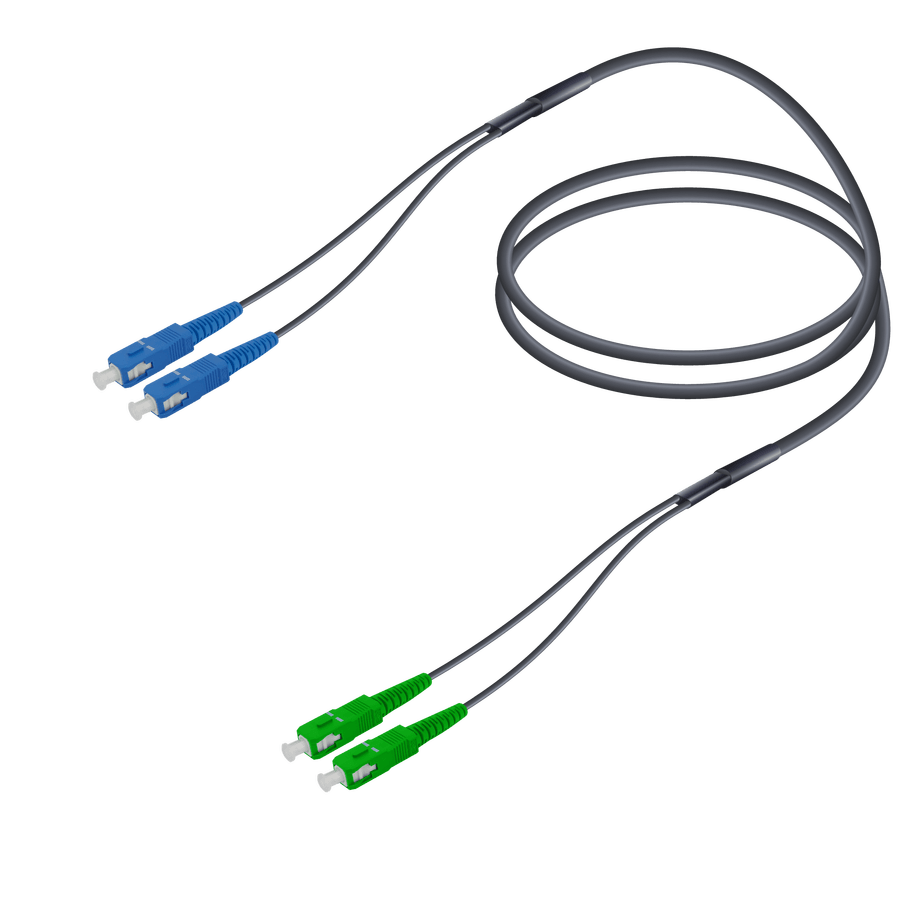
Fiber Breakout Patch Cord 4.8mm overview
This construction is designed for applications where the cable is handled regularly and where cleaner routing matters: office LAN connections, pigtails, patching fields, equipment rooms, user outlets and internal point-to-point links. Because the two simplex units are grouped under one outer jacket, installers get simpler cable management without losing the separation needed at the connector end.
For projects that extend beyond standard indoor pathways, the same family can also be specified for more demanding environments. Depending on the route, the assembly can be prepared with UV-resistant and rodent-resistant options, and selected builds can include extra corrugated protection for harsher telecom infrastructure conditions.
Quick technical snapshot
- Construction: duplex breakout assembly with two simplex units
- Outer jacket: LSZH for cleaner indoor fire-performance requirements
- Buffered fiber: 900 µm subunits for direct connector-ready handling
- Overall diameter: 4.8 mm
- Connector families: LC, SC, FC, ST and project-based combinations
- Fiber choices: singlemode or multimode depending on application
4.8 mm
Overall cable diameter
900 µm
Buffered fiber subunit
1000+
Mating cycles
-40°C / +85°C
Operating range
Why choose this 4.8mm breakout patch cord
Cleaner field termination
The 900 µm buffered subunits make the assembly easier to terminate and organize in patching environments where installers need a more controlled, service-friendly build.
Better handling margin
Compared with lighter compact constructions, a breakout patch cord gives more mechanical confidence where repeated movement, re-patching and technician access are expected.
Flexible connector planning
SC, LC, FC and ST combinations can be arranged according to active equipment, distribution panels and project-specific port architecture.
Orderly cabinet routing
When used with a fiber optic patch panel or a rack mount fiber optic patch panel, the assembly supports neat labeling and easier maintenance access.
Indoor-first, project-ready
The LSZH base construction suits building pathways and equipment spaces, while project variants can be specified for tougher telecom routes where extra protection is needed.
Good fit for structured networks
This cable family is well suited for LAN rooms, telecom cabinets, enterprise networks, FTTH transitions, FTTA links and controlled data center interconnect tasks.
Fiber Breakout Patch Cord 4.8mm technical specifications
| Parameter | Specification |
|---|---|
| Construction | Duplex breakout assembly with two simplex units under an overall LSZH jacket |
| Overall cable diameter | 4.8 mm |
| Subunit diameter | 900 µm buffered fiber |
| Connector families | LC, SC, FC, ST, E2000 and project-based combinations |
| Insertion loss | ≤ 0.30 dB |
| Return loss | ≥ 50 dB (UPC), ≥ 60 dB (APC) |
| Durability | ≥ 1000 mating cycles |
| Flammability | UL94 V-0 |
| Operating temperature | -40°C to +85°C |
| Connector end face geometry | IEC 61755-3 |
| Connector compliance | LC: IEC 61754-20 / TIA 604-10-A • SC: IEC 61754-4 / TIA 604-3 • FC: IEC 61754-13 / TIA 604-4-A • ST: IEC 61754-2 / TIA 604-2 • E2000: IEC 61754-15 / TIA 604-16 |
| Project protection options | Standard tube or corrugated protection variants, according to route and handling requirements |
Exact optical values and fiber class should be confirmed against the final connector polish, fiber type and project build matrix. For bend-insensitive singlemode planning, see ITU-T G.657.
Where a breakout patch cord fits best
Patch panels and racks
Use this assembly where termination quality, labeling discipline and front-end service access matter. It is a natural companion to a fiber optic patch panel and a rack mount fiber optic patch panel.
LAN and equipment rooms
The 4.8mm breakout format is practical for office LAN rooms, equipment cabinets, user outlets and short internal point-to-point links where cables are touched, moved and re-routed over time.
FTTH, FTTA and telecom cabinets
For selected outdoor or semi-protected telecom paths, request the appropriate UV-resistant or reinforced construction. Where splicing and route protection are needed, pair the assembly with fiber optic inline closures.
When to consider an alternative
If the route needs a lighter one-fiber indoor solution, the I-V(ZN)H 1x1 SX Zip family may be the better fit. If the main requirement is denser routing rather than direct, robust termination, compare this page with our Breakout vs Mini Breakout Fiber Cable guide.
How to select the right breakout patch cord
Choosing the right assembly is easier when the specification follows a simple order. Start with the interface, then match the fiber, route conditions and termination environment.
- Define the connectors
Confirm the equipment side and distribution side connector types, including UPC or APC geometry where needed. - Choose the fiber class
Select singlemode or multimode according to link distance, bandwidth target and active equipment design. - Check the route
Decide whether the path is indoor, controlled outdoor, UV-exposed or mechanically demanding. - Match the termination point
Align the cable with the panel, splice point or cabinet architecture to keep routing and labeling clean. - Confirm build details
Finalize length, polarity, identification, jacket preference and any special protection requirement.
| Selection point | Breakout patch cord | Mini-breakout alternative |
|---|---|---|
| Handling margin | Higher mechanical confidence for repeated handling | Better where route density is the priority |
| Termination logic | Very suitable for direct, service-friendly termination | Chosen more often for compact indoor distribution |
| Typical environment | Patch fields, cabinets, LAN rooms, telecom transitions | Dense indoor pathways and higher-count internal routing |
| Best next step | Use when robustness and access matter more than density | Use when tighter cable packing is the main target |
For basic handling and fiber cable construction references, the Fiber Optic Association cable guide is also a useful technical reference alongside the product datasheet.
Frequently asked questions
What is a Fiber Breakout Patch Cord 4.8mm typically used for?
It is commonly used for office LAN connections, pigtails, patching fields, equipment rooms, user outlets and internal point-to-point fiber links where cleaner routing and more dependable day-to-day handling are needed.
Which connector options are available?
Standard project combinations include LC, SC, FC and ST, with additional options prepared according to equipment interface, connector polish and site requirements.
Can this breakout patch cord be supplied in singlemode or multimode?
Yes. The family can be prepared in singlemode or multimode builds depending on the network architecture, transmission distance and application target.
Is the cable suitable only for indoor use?
The standard construction is strongly suited to indoor and controlled building environments, but project variants can be specified for tougher conditions with UV-resistant, rodent-resistant or reinforced protection features where the route requires it.
What is the difference between breakout and mini-breakout fiber cable?
Breakout constructions are generally preferred when direct termination and better handling margin matter most, while mini-breakout solutions are chosen more often for denser routing. See our Breakout vs Mini Breakout Fiber Cable page for the full comparison.
Need a custom Fiber Breakout Patch Cord 4.8mm build?
Share connector types, fiber class, length, polarity and route conditions. That is enough to move from a generic cable request to a project-ready specification.