



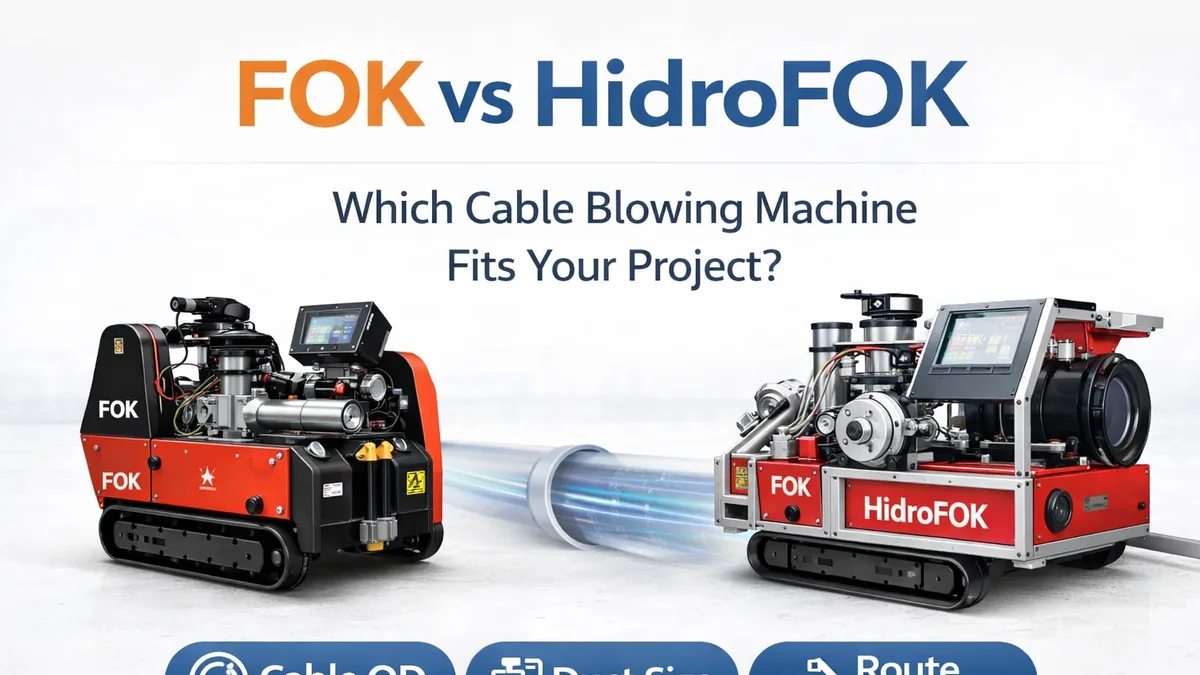
03 Mar FOK vs HidroFOK: Choose the Right Cable Blowing Machine
FOK vs HidroFOK: Which Cable Blowing Machine Fits Your Project?
If you are comparing FOK vs HidroFOK, you are already in the decision stage. This page helps you pick the right model based on cable OD, duct size, target distance, and route difficulty (bends, friction, and unknown duct condition).
In practice, the best choice is the machine that completes the job with fewer stops, lower cable damage risk, and predictable output. This comparison focuses on real installation conditions.
What you will get from this page
- A fast selection logic you can share with your field team.
- A side-by-side comparison focused on real deciding factors.
- A decision tree image (60 seconds selection).
- Clear inputs for a correct quote: cable OD, duct ID/OD, distance, bends.
Contents
- Core differences (why the choice matters)
- FOK vs HidroFOK comparison table
- Key specs visual
- When FOK is the better choice
- When HidroFOK is the better choice
- Decision tree (choose in 60 seconds)
- How to choose (step-by-step)
- What we need for the correct configuration
- FAQ
Core differences: what really changes between FOK and HidroFOK
Both machines support professional fiber cable blowing. The difference becomes clear when the duct route includes unknown segments, higher friction, or longer distance targets.
FOK is a versatile workhorse for many backbone installations and is often the efficient choice when route preparation is verified. HidroFOK is built for tougher conditions and longer distance targets, where extra operating margin reduces mid-route stops.
For a neutral explanation of the method itself, see cable blowing.
FOK vs HidroFOK comparison table
| Item | FOK | HidroFOK |
|---|---|---|
| Best positioning | Versatile backbone cable blowing machine | Heavy-duty long distance cable blowing machine |
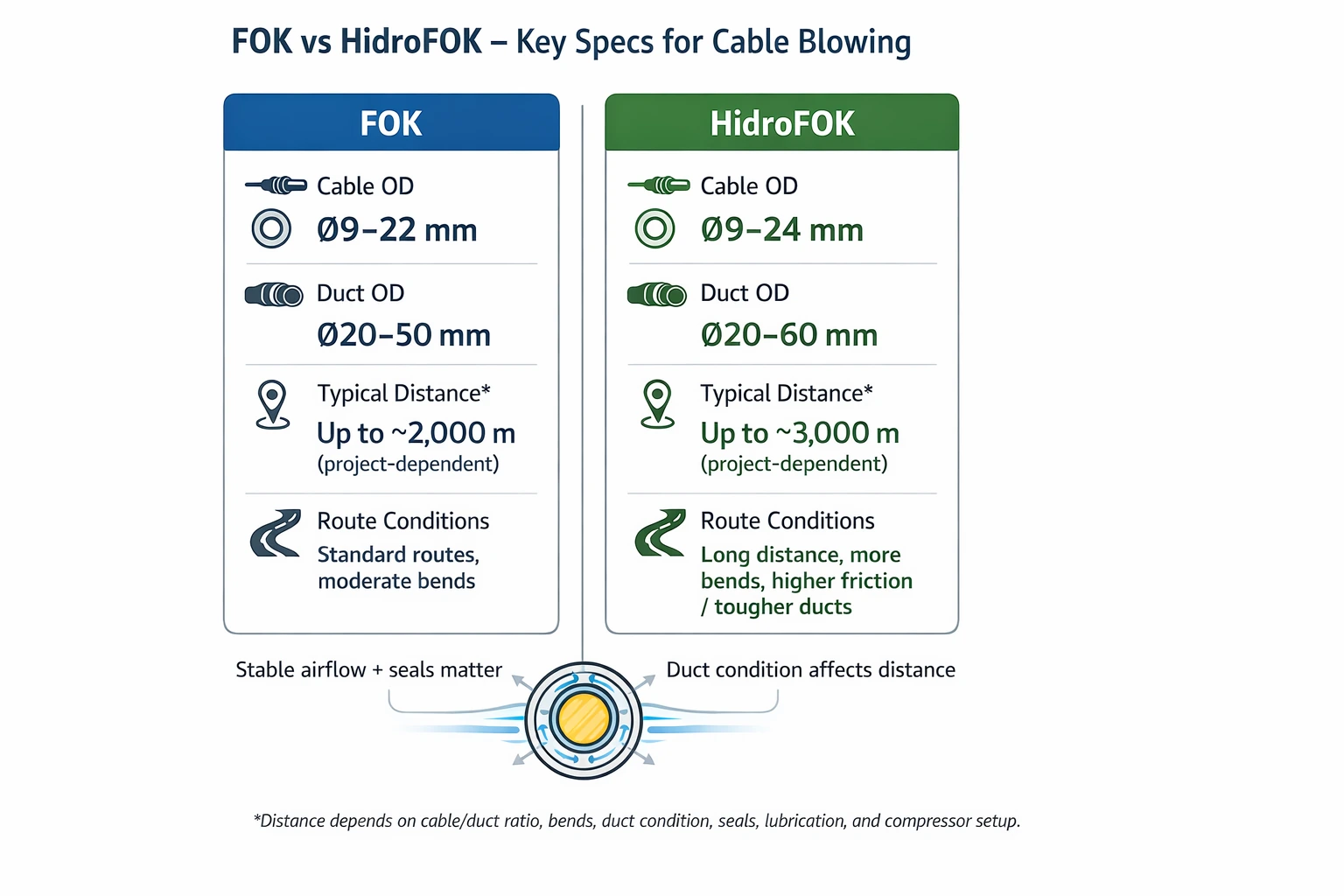
| Cable OD range | Ø9–Ø22 mm | Ø9–Ø24 mm |
| Typical duct range | Commonly used across Ø20–Ø50 mm duct OD projects (project-dependent) | Commonly used across Ø20–Ø60 mm duct OD projects (project-dependent) |
| Distance potential | Up to ~2,000 m (example: 12 mm cable in 40 mm duct, project-dependent) | Up to ~3,000 m (example: 12 mm cable in 40 mm duct, project-dependent) |
| Best when | Route prep is controlled, friction risk is lower, standard distances | Longer distance targets, higher route uncertainty, higher friction risk |
| Risk management | Great when duct condition is verified (clean, sealed, predictable) | Preferred when you need more margin against bad segments |
| Logistics | Typically easier field deployment for multi-site jobs | Heavier-duty build, shipping/handling impact can be higher |
Important: distances are always project-dependent. Duct condition, sealing quality, bends, and lubrication can change results dramatically. If you want a confident selection, share cable OD, duct ID/OD, target distance, and bends count.
Key specs visual (quick scan)
When FOK is the better choice
Choose FOK when your project is a controlled installation and you want predictable performance with an efficient setup.
- You work with repeatable duct quality across sites.
- Your route is verified (clean duct, good connectors, stable airflow).
- Target distances are ambitious but not extreme.
- You want a versatile machine for many common backbone combinations.
When HidroFOK is the better choice
Choose HidroFOK when route risk is higher or when you must push distance targets harder.
- You target longer distances and want safer project delivery.
- Route condition is uncertain (older ducts, variable friction, tough segments).
- Stopping mid-route is expensive (crew time + rework).
- You want more margin against air leaks, friction spikes, and bend-heavy routes.
Decision tree: choose FOK vs HidroFOK in 60 seconds

- Cable OD > Ø22 mm? If yes, prefer HidroFOK. If no, continue.
- Duct OD > Ø50 mm? If yes, HidroFOK is usually safer. If no, continue.
- Tough route (long distance / many bends / friction risk)? If yes, choose HidroFOK. If no, choose FOK.
How to choose between FOK and HidroFOK
- Confirm sizes: Confirm cable OD and duct ID (or OD/ID).
- Define distance target: Set the required blowing distance and decide if extra margin is needed.
- Assess route risk: Count bends and evaluate duct condition (new/clean vs existing/unknown).
- Select the model: Choose FOK for controlled routes and standard distances; prefer HidroFOK when distance targets and route uncertainty increase.
- Confirm configuration: Send details to confirm correct pallets, seals, and duct connectors.
What we need for the correct configuration (and quote)
To recommend the right model and the correct setup (pallets, seals, duct connectors), send these four inputs:
- Cable outer diameter (OD): mm
- Duct inner diameter (ID) or OD/ID: mm
- Target distance: meters
- Route notes: bends count, old/new duct, any known friction issues
If you also want practical selection background, use this internal guide: Cable OD vs Duct Size – Practical Fit Guide.
FAQ
Is HidroFOK always better than FOK?
No. If your route is well-prepared and predictable, FOK can be the smarter total-cost choice. When route risk and distance targets increase, HidroFOK is usually the safer option.
Can both machines handle the same duct sizes?
They overlap in many projects. Suitability depends on duct ID/OD, route bends, sealing quality, and friction. Share your duct/cable details and we will confirm the correct configuration.
What information do you need for a correct selection?
Cable OD, duct ID (or OD/ID), target distance, bends count, and whether the duct is new/clean or existing/unknown.
What causes blowing distance to drop the most?
Friction from poor duct condition, air leaks from seals/connectors, wrong pallet match, and too many bends usually cause distance loss.
Next step: Send your cable OD + duct ID + distance + route notes via contact form. We will recommend the right model and configuration quickly.