
CAT 5e F/UTP Cable
CAT 5e F/UTP cable provides 100 MHz performance, an overall foil screen and reliable transmission for voice, data and Gigabit Ethernet. With 24 AWG bare copper conductors and PVC, HFFR or PE sheath options, it can be specified for commercial buildings, technical rooms and structured cabling routes according to the required installation environment.
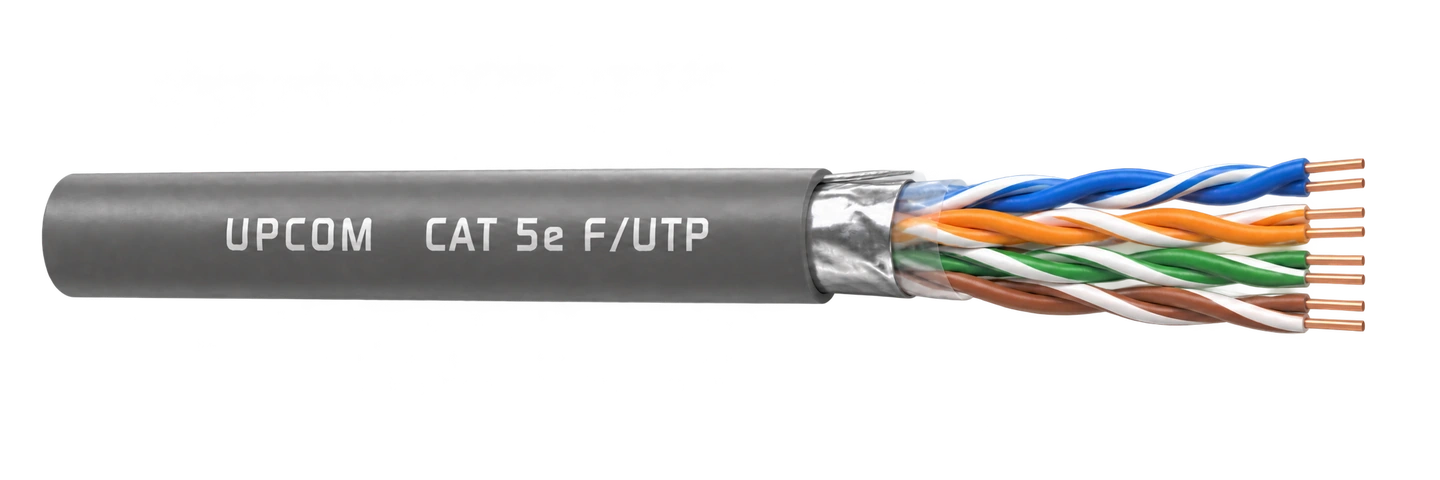
CAT 5e F/UTP Cable Overview
This shielded LAN cable is produced for balanced cabling systems that need reliable signal transmission together with an additional screening layer around the twisted pairs. The overall foil screen helps improve performance in routes where better protection against external interference is preferred, while the cable still keeps the practical handling expected from a Cat 5e solution.
Suitable for basic voice and data installations up to 100 MHz, this cable supports common Class D applications including Ethernet, Fast Ethernet and Gigabit Ethernet. It also fits naturally into broader fiber optic and data LAN cable projects where a shielded copper link is required within the structured cabling architecture.
Construction and Shielding Details
Conductor and pair structure
The cable uses 24 AWG bare copper conductors with PE insulation. This construction is widely preferred where stable electrical performance and consistent pair geometry are required for copper network links.
Screening and grounding support
A PES band, Al/PET foil with 100% coverage and a tinned copper drain wire form the cable’s shielding package. This structure supports grounding continuity and adds an extra layer of screening for network environments.
Outer sheath options
The outer sheath can be specified as PVC, HFFR or PE. The current datasheet lists Euroclass Eca for PVC, Dca for HFFR and Fca for PE, so the sheath must be matched to the installation route and the project’s fire-performance requirements.
- 24 AWG bare copper conductor
- PE insulation
- PES band with full coverage
- Tinned copper drain wire
- Al/PET foil with full coverage
- PVC, HFFR or PE outer sheath
CAT 5e F/UTP Technical Specifications
The values below help specifiers and procurement teams review mechanical, environmental and electrical suitability before final project approval.
Applications and Standards
Typical application areas
- IEEE 802.3 Ethernet networks
- 10BASE-T, 100BASE-TX and 1000BASE-T links
- IEEE 802.5 16 Mb/s Token Ring
- ISDN, TPDDI and ATM
- Power over Ethernet (PoE) and PoE+
- Indoor structured cabling for voice and data
Datasheet standards references
- IEC 60754-2
- ANSI/TIA-568-C.2
- ISO/IEC 11801 2nd edition
- IEC 61156-5
- EN 50173-1
- EN 50288-3-1
Fire, smoke and CPR performance varies by sheath. Confirm the selected construction, the required standard edition and the applicable declaration before project approval. For current North American cabling references, consult the TIA standards catalogue.
How to Select the Right Cable for a Project
A correct cable choice is not only about category. It should also match shielding level, installation route, jacket requirement and the expected network service.
-
Define the network service.
Confirm whether the channel will be used for voice, 10BASE-T, 100BASE-TX or 1000BASE-T and whether 100 MHz CAT 5e performance is sufficient for the project scope. -
Choose the right sheath.
Select PVC, HFFR or PE according to the building type, installation practice and project specification. -
Review routing conditions.
Check bend radius, available pathway and pulling conditions before installation to protect pair integrity. -
Verify environmental and mechanical limits.
Make sure the project stays within the stated installation temperature, operating temperature, tensile strength and crush resistance values. -
Compare with adjacent cable families.
If the project needs unshielded construction or a higher category, review the alternatives below before finalizing the bill of materials.
Compare Other LAN Cable Options
Compare CAT 5e U/UTP for standard unshielded links, CAT 6 SF/UTP for higher-category shielded installations, and CAT 7 or CAT 7A S/FTP when higher bandwidth and pair-level shielding are required. The full copper and fiber cable range is available from the main cable category below.
FAQ About CAT 5e F/UTP
What does F/UTP mean?
F/UTP indicates an overall foil shield around the twisted pairs, while the individual pairs remain unshielded.
Is this cable suitable for Gigabit Ethernet?
Yes. CAT 5e supports 1000BASE-T over all four pairs in a standards-compliant channel, subject to correct installation and compatible connectivity hardware.
Which jacket options are available?
The outer sheath can be specified as PVC, HFFR or PE depending on the installation environment and project requirement.
What installation values should I review first?
Key values include a 50 mm minimum bending radius during draw-in, a 25 mm minimum bending radius after installation, maximum tensile strength of 100 N and operating temperature from -30°C to +70°C.
Can CAT 5e F/UTP be used for PoE and PoE+?
Yes. The datasheet lists Power over Ethernet (PoE) and PoE+. Final suitability must also be checked against bundle size, ambient temperature, channel length and connector ratings.
Need detailed specifications?
Download the datasheet for detailed values and continue to the main LAN cable category to review adjacent product families for your project.