
Indoor/outdoor fiber optic cable
Multi Loose Tube Unarmored Cable | I-A-DQ(BN)H-MLT
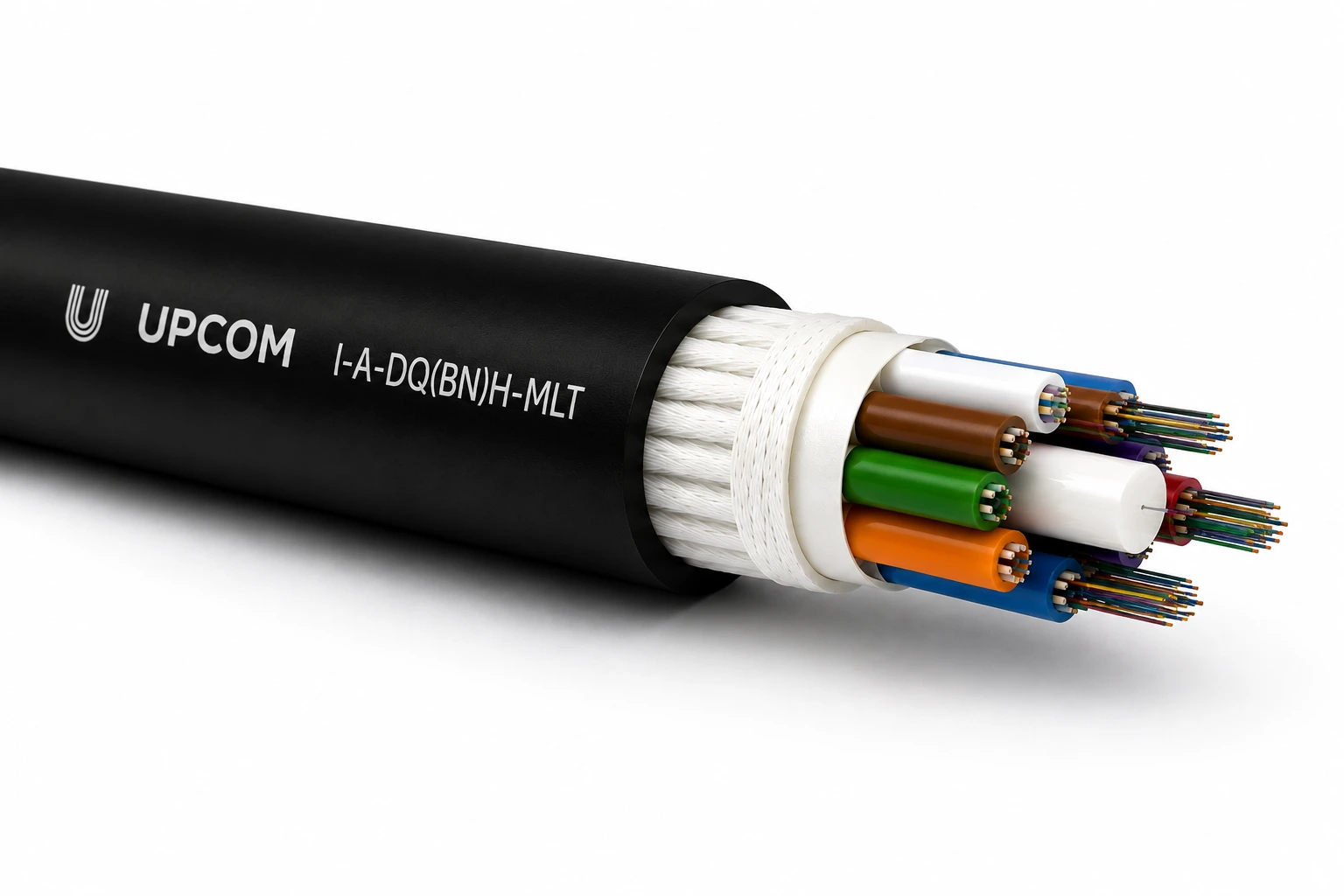
Multi loose tube unarmored cable is designed for indoor and protected outdoor fiber routes that need an LSZH outer sheath, dielectric construction and dry water blocking in ducts, conduits and inter-building backbone links.
This cable family combines colored PBT loose tubes around a central strength member, water-swellable tape, glass yarn reinforcement and a single LSZH jacket. The result is a practical indoor/outdoor loose-tube design for campus, telecom and building-to-building deployments where low-smoke, zero-halogen sheath performance is required and metallic armor is not needed.
Why choose this multi loose tube unarmored cable
Balanced indoor and outdoor use
This indoor/outdoor fiber optic cable is suited to inter-building links, campus backbones, ducts, conduits and protected outside-plant sections where an LSZH sheath is required and the route does not need metallic armor.
Structure built for route stability
The cable uses colored loose tubes stranded around a central strength element. Water-swellable tape helps limit longitudinal water migration, while glass yarn improves tensile support during pulling, handling and installation.
Single-mode fiber options
The cable family is available with 9/125 G.652.D, G.657.A1 or G.657.A2 single-mode fiber to suit backbone, access-network and bend-sensitive route requirements.
Tube and core protection
Water-swellable tape and the dry core structure help limit longitudinal water penetration in mixed indoor/outdoor routes, especially where the cable passes between building and duct sections.
Non-metallic loose-tube design
A fully dielectric loose-tube cable can be a cleaner choice where electrical isolation, lighter handling and non-metallic construction are preferred as part of the route design.
If the route includes repeated crush risk, rodent exposure, heavy impact or unprotected direct-burial sections, compare this model with the metallic armored PE jacket version, the metallic armored LSZH version or the armored loose tube LSZH cable.
Key features and benefits
LSZH outer jacket
Supports indoor transitions and enclosed environments where low-smoke, zero-halogen sheath behavior is specified.
Water-blocked construction
Water-swellable tape and the dry core structure help limit longitudinal water penetration in ducts and protected outdoor routes.
Glass yarn reinforcement
Additional glass yarn support helps the cable cope with pulling forces during installation without moving to a heavier metallic cable architecture.
PBT loose tubes
PBT loose tubes provide mechanical isolation and controlled fiber accommodation within the stranded cable core.
UV-resistant sheath
The black outer jacket is suitable for protected outdoor sections and indoor transitions, subject to the route and project requirements.
4–192-fiber family
Fiber counts from 4F to 192F cover access, campus and higher-capacity backbone requirements within one construction family.
Typical applications for indoor and outdoor fiber networks
Best-fit deployments
- Inter-building voice and data communication networks
- Campus backbone and building distribution links
- FTTB and FTTC infrastructure sections
- Duct and conduit installations
- Primary and secondary telecom routes
- Distribution box, distribution frame and customer-side panel interconnections
- Protected outside-plant sections where LSZH sheath behavior is preferred
When to step up to armored cable
- True direct-buried runs without extra pathway protection
- Routes with higher crush or repeated impact exposure
- Outdoor paths with stronger mechanical risk
- Segments where rodent protection is a design priority
- Projects that call for a PE jacket rather than LSZH at the outer layer
For route planning context, you can compare this construction with our tight-buffered and loose-tube cable guide and the broader fiber optic cable overview. Buyers working with lower fiber counts can also review the CLT non-metallic armored SJ cable.
Multi loose tube unarmored cable construction
Layer-by-layer structure
- Single-mode optical fibers inside colored loose tubes
- PBT loose tube layer for fiber isolation and handling stability
- Central strength member for the cable core
- Water-swellable tape around the core to reduce water ingress
- Glass yarn reinforcement for additional tensile support
- Single LSZH outer sheath for indoor and protected outdoor routes
Compliance and technical references
Fiber options follow the relevant ITU-T single-mode recommendations. Mechanical and environmental cable performance is evaluated using IEC 60794 and the applicable IEC 60794-1-2 test methods.
- ITU-T G.652 for G.652.D single-mode fiber characteristics
- ITU-T G.657 for bend-insensitive G.657.A1 and G.657.A2 single-mode fibers
- IEC 60794-1-2 for general optical cable test procedures
Technical specifications
The standard family covers 4F to 192F with dimensions that vary by fiber count. Confirm the final build, fiber type, diameter, CPR requirement, drum length and sheath marking before order approval.
| Specification | Value |
|---|---|
| Fiber count range | 4F to 192F |
| Fiber type options | 9/125 G.652.D, G.657.A1 or G.657.A2 |
| Loose tube material | PBT |
| Water blocking | Water-swellable tape and dry core structure |
| Strength members | Glass yarn |
| Outer jacket | Black LSZH / HFFR |
| Typical cable diameter | 4–24F: 10–12 mm; 48–96F: 12–15 mm; 144–192F: 15–18 mm |
| Tensile strength | Up to 4000 N (IEC 60794) |
| Crush resistance | 2000 N (IEC 60794-1-2 E3) |
| Operating temperature | -30°C to +70°C (IEC 60794) |
| Minimum bending radius | 20 × cable diameter (IEC 60794) |
| Installation route | Indoor and protected outdoor ducts, conduits and backbone links |
If your route needs a PE jacket, metallic armor or a different multi-tube construction, compare A-DQ(BN)2Y multi tube fiber optic cable and the broader fiber optic and data LAN cable range when matching the cable construction to the route risk.
FAQ about multi loose tube unarmored cable
Is this cable suitable for both indoor and outdoor use?
Yes. This cable family is intended for indoor/outdoor transition routes and protected outside-plant sections, especially where an LSZH outer sheath is preferred at the building side.
What is the difference between this cable and an armored loose-tube cable?
This version focuses on dielectric construction, water blocking and lighter handling. Armored versions add mechanical protection for harsher routes, direct-buried sections or elevated crush risk.
Can I use this cable for direct burial?
For true direct-buried sections or routes with high mechanical risk, an armored or PE-jacket alternative is usually the safer choice. The unarmored LSZH construction is better aligned with ducts, conduits and protected transition routes.
Which single-mode fiber types are available?
The cable family is available with G.652.D, G.657.A1 and G.657.A2 single-mode fibers. Selection depends on transmission, bend-performance and project requirements.
Why is LSZH important for some projects?
LSZH outer jackets are selected where low-smoke, zero-halogen sheath behavior is required. LSZH describes the sheath material; it does not by itself establish a CPR fire-reaction class.