
Field-deployable fiber optic cable
Tactical Fiber Optic Cable | 5.8 mm Tight-Buffer Design
Tactical fiber optic cable is designed for rapid deployment, repeated winding and recovery in demanding field conditions. This 4-fiber, 5.8 mm tight-buffer cable uses G.657.A2 single-mode fiber for outside broadcast, temporary communications, security links and industrial monitoring routes that require flexibility and high crush resistance.
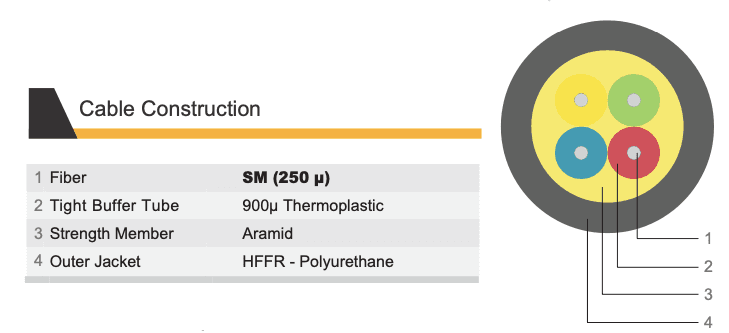
The construction combines thermoplastic 900 µm tight-buffered fibers, aramid yarn reinforcement and a rugged polyurethane outer jacket to support repeated handling, reliable connector assembly and stable performance in demanding environments.
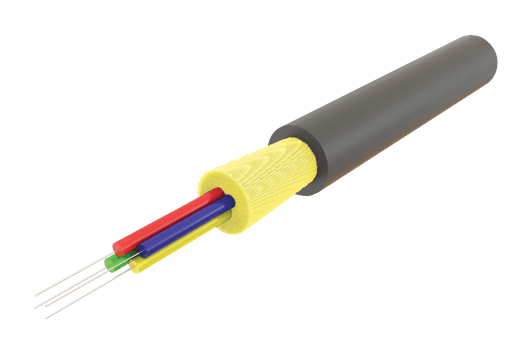
Overview of the 5.8 mm Tight-Buffer Design
This cable is intended for temporary routes where deployment speed matters and the cable is reeled, handled and recovered repeatedly. Its polyurethane outer jacket and aramid yarn reinforcement provide better protection against field handling and crush loads than standard indoor cable constructions.
For projects that combine temporary field links with permanently installed sections, use this tactical cable on the deployable route and select the fixed sections from the Fiber Optic and Data LAN Cables range. The fiber optic cable overview explains the main construction and transmission choices.
Why this construction is different
- Tight-buffered fibers support direct connector assembly and easier end preparation.
- Aramid yarn improves tensile handling and field termination strength.
- Polyurethane outer jacket supports abrasion resistance and outdoor durability.
- Compact diameter helps reel handling, temporary routing and rapid deployment.
- All-dielectric, metal-free construction eliminates the need to ground metallic strength members.
Application Areas for Tactical Fiber Optic Cable
Select this cable for deployable optical links rather than permanent building cabling. It supports fast setup and repeated handling on routes exposed to impact, crush or abrasion.
- Military and tactical field communication links
- Outside broadcast and temporary event connectivity
- Security systems and rapid perimeter deployment
- Instrumentation and control networks
- Pipeline and industrial asset monitoring
- Oil and gas communication routes
- Temporary outdoor audio/video transmission paths
When to review another UPCOM cable type
Choose this product when repeated deployment and harsh-route handling matter more than permanent indoor cabling convenience. For FTTH last-meter sections, see Drop Fiber Cable. For compact multi-fiber indoor or transition routing, see Mini-Breakout Cable.
Construction and Deployment Benefits
Field handling advantages
- High flexibility for repeated deployment and recovery
- Improved crush resistance for demanding outdoor routes
- Polyurethane jacket protection for repeated field handling
- Ripcord support for easier jacket removal
- Metal-free construction
- High chemical resistance against acids and alkalies
Termination and service advantages
- 900 µm tight-buffered fibers suitable for direct connector assembly
- Aramid yarn strain relief for reliable termination
- 2000 N installation and 1500 N in-service tensile ratings
- -40°C to +75°C in-service temperature range
- Flexible, compact construction for deployment and recovery on reels
Technical Specifications of This Tactical Fiber Optic Cable
Mechanical and environmental data
| Parameter | Value |
|---|---|
| Tight-buffer diameter | 0.9 mm |
| Cable diameter | 5.8 mm |
| Approx. cable weight | 25 ±2.5 kg/km |
| Max. tensile strength | 2000 N during installation / 1500 N in service |
| Min. bending radius | 90 mm during installation / 60 mm in service |
| Crush resistance | 4000 N/dm short-term / 1000 N/dm long-term |
| Flexing | 20,000 cycles at r=80 mm, 15 N / 1,000 cycles at r=40 mm, 15 N |
| Repeated bending | 20,000 cycles at r=40 mm with 1 kg load |
| Temperature range | -40°C to +85°C during installation / -40°C to +75°C in service |
| Test references | IEC 60794-1-2 E1, E3, E6, E11 and IEC 60794-1-22 F1 |
Construction and optical data
| Parameter | Value |
|---|---|
| Fiber structure | Thermoplastic 900 µm tight-buffer tubes with aramid yarn reinforcement |
| Outer jacket | Black HFFR polyurethane |
| Fiber type | Single-mode G.657.A2 |
| Core diameter | 9.0 ±0.5 µm |
| Cladding diameter | 125 ±5.0 µm |
| Primary coating diameter | 245 ±10 µm |
| Attenuation @1310 nm | ≤ 0.36 dB/km (max. in cable) |
| Attenuation @1550 nm | ≤ 0.25 dB/km |
| Datasheet | Download the 4F Tactical Cable Datasheet |
Comparing UPCOM Cable Options
| UPCOM cable | Best fit | Selection rationale |
|---|---|---|
| Tactical Fiber Optic Cable | Repeated field deployment, outside broadcast, harsh temporary outdoor routes | Compact 5.8 mm construction, tight-buffer handling, aramid strength and rugged outer jacket |
| Mini-Breakout Cable | Compact indoor distribution, easier subunit management, direct connectorization | Good when handling convenience and indoor routing matter more than harsh field redeployment |
| Drop Fiber Cable | FTTH access and last-drop sections | Better aligned with access-network and drop-path routing than tactical redeployment scenarios |
Check route type, bend limits and termination method before choosing between deployable and fixed-installation cable. The Fiber Optic Cable Installation Guide covers route planning, while the comparison of tight-buffered and loose-tube cables explains the main construction differences.
How to Specify Tactical Fiber Optic Cable for RFQ
- Define the route: confirm whether the cable will be repeatedly deployed, reeled and recovered or installed for longer-term outdoor service.
- Confirm the optical need: specify fiber type, wavelengths, connector plan and whether the project requires single-mode transmission at 1310 nm / 1550 nm.
- Check mechanical stress: validate tensile load, bending radius, crush exposure, abrasion risk and operating temperature before final selection.
- Decide the termination method: if fast field termination or direct connector assembly matters, keep that requirement explicit in the RFQ.
- Define the delivery format: state the required cable length, reel type, end preparation and connectorization requirements.
Practical note: When the project is not truly tactical or re-deployable, start with the wider fiber optic cable range and narrow the selection by installation method, environment and termination strategy.
Standards and Reference Links
Mechanical performance is specified with IEC 60794-1-2 test methods E1, E3, E6 and E11, while temperature performance references IEC 60794-1-22 F1. For general optical fibre cable test methodology, see IEC 60794-1-2. The 4-fiber construction uses G.657.A2 single-mode fibre; see ITU-T G.657.
FAQ
What is a tactical fiber optic cable used for?
It is used where the cable may be deployed, handled and recovered in demanding environments such as outside broadcast, field communication, security and industrial monitoring routes.
Why does this product use tight-buffer construction?
Tight-buffered fibers support direct connector assembly and practical end preparation, which helps in field termination and repeated deployment workflows.
Is this cable suitable for outdoor use?
Yes. The polyurethane outer jacket, aramid reinforcement and all-dielectric construction support temporary field deployment and repeated outdoor handling.
Which mechanical values matter most during selection?
The key checks are cable diameter, tensile strength during installation, bending radius, crush resistance, temperature range and the real handling conditions of the route.
Where can I find the datasheet?
Download the technical document here: 4F Tactical Cable Datasheet PDF.