



09 Jan What is fiber optic cable
The History of Fiber Optic Cables
Fiber optic technology has its roots in the mid-20th century but gained significant commercial adoption in 1977. Explore the detailed history of fiber optics
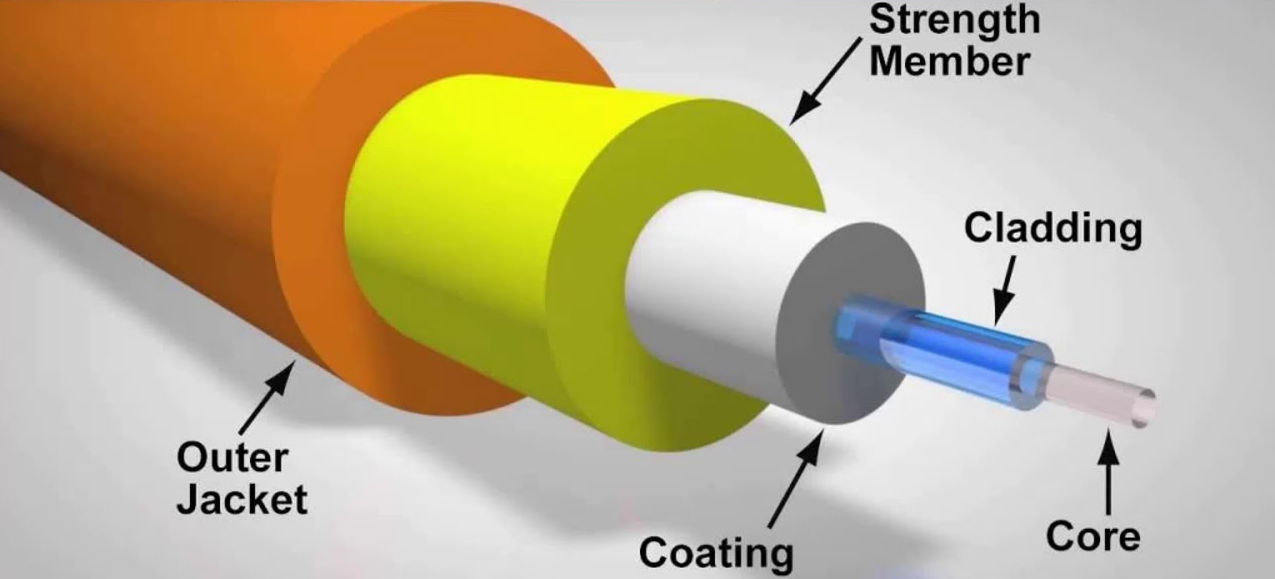
It marked a transformation in long-distance, high-bandwidth communications, replacing traditional copper cables. The basic structure of a fiber optic cable includes:
- Outer Jacket: Protects against environmental damage.
- Plastic Coverings: Encases and shields bundled fibers.
- Core and Cladding: Core transmits light, while cladding ensures light stays confined.
Advantages of Fiber Optic Cables
- High Bandwidth: Capable of transmitting vast amounts of data.
- Long Distance Transmission: Minimal signal loss over kilometers.
- Immunity to Electromagnetic Interference (EMI): Ideal for environments with high electrical noise.
- Enhanced Security: Difficult to tap into without being detected.
What is Optical Fiber?
Optical fiber refers to a flexible, transparent medium made by drawing glass or plastic into thin strands. Each strand is slightly thicker than a human hair and enables the transmission of light signals. Light, confined within the core, carries data in the form of digital pulses.
Key Components:
- Core: Carries the light signals.
- Cladding: Reflects light back into the core.
Coating: Protects against moisture and damage.
Types of Optical Fiber
Single-Mode Fiber
- Core Diameter: 5-10 microns.
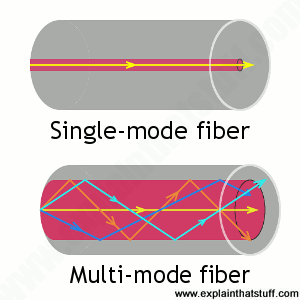
- Light Transmission: Light travels in a single path, reducing dispersion.
- Applications: Telecommunications, CATV, and Internet backbones.
- Advantages: High speed and long-range transmission (up to 100 km).
Compare single-mode and multi-mode fibers.
Multi-Mode Fiber
- Core Diameter: Typically 50-62.5 microns.
- Light Transmission: Multiple modes or paths, leading to dispersion.
- Applications: Local Area Networks (LANs), short-distance data links.
- Advantages: Economical for short-range applications.
Applications Beyond Communication
Fiber optics extend their utility into non-telecommunication fields, such as:
- Medical Industry: Endoscopic devices for minimally invasive surgeries.
- Industrial Applications: Fiberscopes for inspecting engines and pipelines.
- Lighting and Decorations: Used in smart lighting and aesthetic designs.
- Military and Aerospace: Secure communication and advanced weapon systems.
Fiber Optic Cable Design
Fiber optic cables are tailored to withstand diverse environments. A standard cable consists of the following:
1. Buffer Layers
Protects optical fibers from external forces and stresses. Types include:
- Loose Tube: Rugged and filled with gel for outdoor use.
- Tight Buffer: Compact and suited for indoor applications.
2. Strength Members
Provide tensile strength and enhance durability. Examples:
- Aramid Yarn (Kevlar): Commonly used for its lightweight and robust properties.
- Steel Strands: Adds flexibility and structural integrity.
3. Cable Jacket
The outer jacket ensures the cable withstands environmental challenges. Options include:
- Polyethylene (PE): UV resistant and durable.
- Polyvinyl Chloride (PVC): Flame retardant.
- Low Smoke Zero Halogen (LSZH): Suitable for public areas.
4. Water/Flooding Barrier
Essential for outdoor and underground cables:
- Moisture-Resistant Coatings: Such as silicone rubber.
- Metallic Barriers: Axial aluminum foils block water ingress.
Innovations in Fiber Optics
Fiber optic technology continues to evolve. Key advancements include:
- Wavelength Division Multiplexing (WDM): Enables multiple signals on a single fiber.
- Bend-Insensitive Fibers: Minimizes signal loss in tight installations.
Plastic Optical Fibers (POF): Cost-effective solutions for short-range applications.
A fiber optic cable carries data as pulses of light through ultra-thin glass (or plastic) fibers. Because it uses light instead of electrical signals, it can deliver high bandwidth, stable performance, and long-distance transmission with low interference.
In practice, optical fiber is widely used for FTTH (fiber to the home), ISP backbones, data centers, and reliable telecom links where copper becomes limited.

Fiber Optic Cable
Is fiber optic better than WiFi?
This isn’t a fair fight because they solve different problems. Fiber is the wired delivery line. WiFi is the wireless connection inside your home or office.
- Speed: Fiber plans can deliver very high and consistent throughput. WiFi speeds depend on distance, walls, interference, and device quality.
- Latency: A fiber link is typically more stable and predictable than a busy wireless environment.
- Reliability: Fiber is not affected by local RF congestion. WiFi can degrade in crowded areas (apartments, offices, events).
- Best setup: Fiber to ONT/router, then WiFi for mobility. That’s how modern networks are built.

Fiber vs WiFi
What are the disadvantages of fiber optic cable?
Fiber has major advantages, but the real-world downsides are mostly about installation and handling.
- Upfront cost: Building fiber infrastructure (ducts, splicing, termination, testing) costs more than basic copper in many scenarios.
- Bend radius: Tight bends and bad routing increase loss and can cause faults over time.
- Specialized work: Splicing, connector end-face cleaning, and testing (power meter/OTDR) require proper tools and trained technicians.
- Repair process: Physical damage can take longer to locate and fix compared to a simple copper replacement.
- Security: Tapping is possible with physical access and expertise, but it’s generally harder than copper.

What is the difference between fiber optic and Ethernet?
People often mix these up. Ethernet is a networking standard. It can run over copper (RJ45) or over fiber (via SFP/SFP+ optical modules). So the practical comparison is usually fiber cabling vs copper cabling.
- Signal type: Fiber uses light; copper uses electrical signals.
- Distance: Copper Ethernet links are commonly limited to around 100 m for standard twisted-pair runs. Fiber can run much longer depending on optics and design.
- Interference: Fiber is immune to EMI/RFI, which helps in noisy industrial environments.
- Typical use: Copper is practical for short indoor drops; fiber is ideal for backbones, risers, campus links, and high-speed uplinks.
- Connectors: Copper uses RJ45; fiber commonly uses LC/SC (and others like ST, MPO/MTP).

Is fiber optic safer than 5G?
Fiber is a wired optical medium and does not emit RF energy. 5G is wireless and uses radio waves. In modern networks, these technologies usually work together: many 5G sites rely on fiber backhaul.
External reference: ITU-T G.652 (single-mode optical fibre characteristics).
Is fiber optics becoming obsolete?
No. Fiber is the backbone of the internet: metro networks, subsea cables, data centers, and FTTH deployments depend on it. Wireless networks still need high-capacity transport, and that transport is most often fiber.
Will fiber replace Ethernet?
Ethernet will stay because it’s a standard used everywhere. What changes is the medium: Ethernet links already run over fiber in backbones and high-speed uplinks, while copper remains common for short indoor connections.
Is fiber optic cable wired or wireless?
Fiber optic is wired. The cable must be physically installed and terminated with fiber connectors. WiFi is typically provided after the fiber terminates at the ONT/router inside the building.
Do I need a special Ethernet cable for fiber?
You don’t use RJ45 copper patch cords directly on fiber. Fiber connections typically require optical modules (SFP/SFP+) and fiber patch cords (often LC/SC).
Related reading: What is a fiber optic cable? and What is an MPO/MTP cable?.
How is fiber optic connected to my house?
- Fiber drop: A fiber line is routed from a nearby distribution point to the building.
- Termination: The fiber is spliced/terminated at an indoor box or wall outlet.
- ONT installation: An Optical Network Terminal converts the optical signal to Ethernet.
- Router/WiFi: Your router connects to the ONT and provides wired LAN and WiFi.
Can fiber internet be wireless?
The delivery is wired (fiber). The network inside the building can be wireless via WiFi, once the fiber terminates at the ONT/router.
Interesting facts about fiber optic cables
- Connector cleanliness matters: Many “fiber failures” are actually dirty connectors.
- EMI immunity: Optical fiber is unaffected by electromagnetic noise.
- Massive global reach: Most international data travels through subsea fiber systems.
- Designed for scale: Fiber networks can be upgraded by changing optics, not necessarily replacing the cable.
Related guides
What is Optical Fiber?
Optical Fiber is a transmission technology that carries data as light through ultra-thin strands of glass or plastic. Unlike copper cables that transmit electrical signals, fiber optic cables transmit information using light pulses, enabling extremely high-speed and long-distance communication with very low signal loss.
If you want broader context and related articles, you can explore our Fiber Optic Cables knowledge hub and the detailed overview: What is Fiber Optic Cable?.
Modern telecom infrastructure — including FTTH fiber networks, data centers, and backbone networks — relies heavily on fiber optics for scalable bandwidth and reliable connectivity.
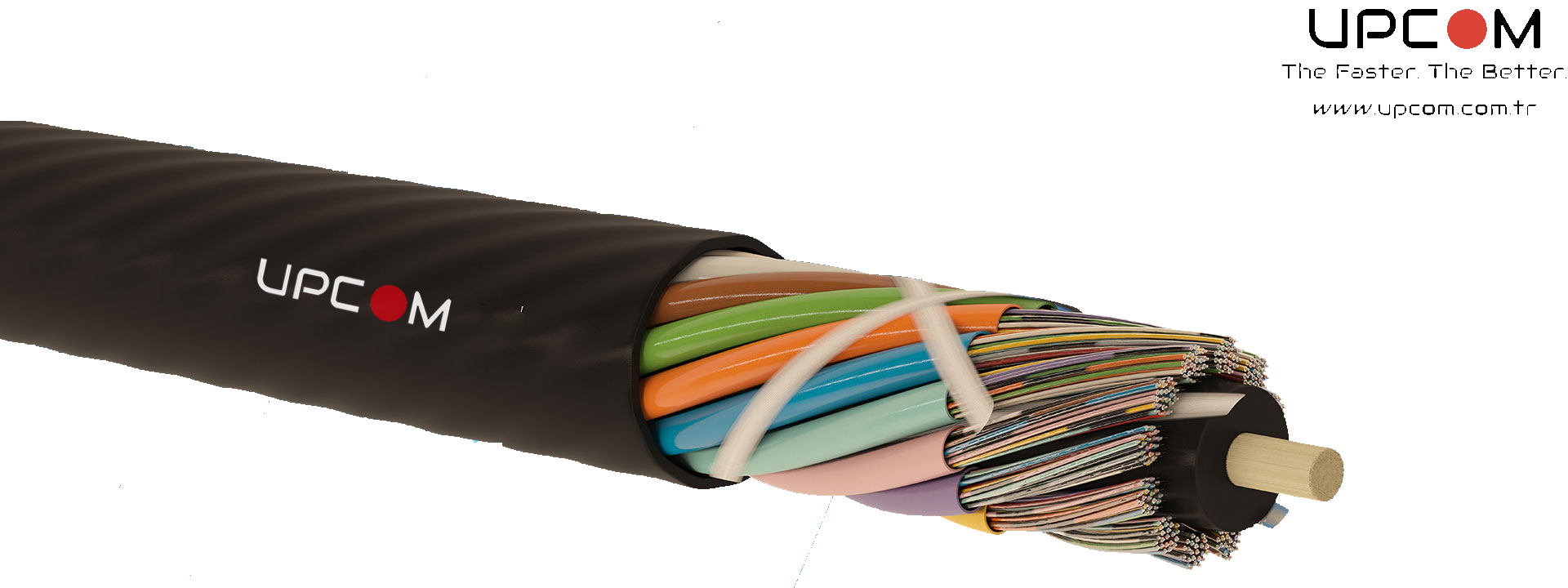
A typical fiber optic cable contains multiple fibers, each thinner than human hair. They transmit data using laser or LED light sources, enabling extremely high bandwidth capacity. For practical deployment and field considerations, see our Fiber Optic Cable Installation Guide.
How Fiber Optic Transmission Works
Fiber optic communication is based on total internal reflection. Light travels through the fiber core and continuously reflects from the cladding layer, allowing signals to move long distances with minimal loss.
External references: Encyclopaedia Britannica and Wikipedia.
Because optical transmission is immune to electromagnetic interference and has extremely low attenuation, fiber optic networks provide higher reliability, longer transmission distance, and greater bandwidth than copper communication systems. For deeper background, see: Fiber Optic Technology.
Types of Fiber Optic Cables
Single-Mode Fiber
Single-mode fiber (SMF) uses a very small core diameter (around 9 µm) and allows light to travel in a single path. It is used for long-distance telecom infrastructure, backbone networks, and FTTH deployments. External standard reference: ITU-T G.652.
Multi-Mode Fiber
Multi-mode fiber (MMF) has a larger core diameter (typically 50/62.5 µm) and allows multiple light paths. It is commonly used in LAN networks and data centers for shorter distances. External standard reference: ITU-T G.651.1.
Applications
Telecommunications and Internet Infrastructure
Most global internet traffic travels through fiber optic cables, including terrestrial backbone routes and submarine cables. High-capacity infrastructure enables cloud computing, streaming, and real-time communication.
To understand deployment strategy, see: FTTH deployment guide and our learning section: Fiber Optic Cables category.
Medical Applications
Fiber optics are widely used in endoscopy, imaging systems, and sensing applications. Research reference: NCBI (PubMed Central).
Military and Industrial Systems
Fiber optic links are lightweight, secure, and immune to electromagnetic interference, making them suitable for aircraft systems, radar communication, and industrial inspection equipment.
Why Fiber Optic Technology Matters
Compared to copper communication systems, fiber optic cables provide:
- Lower signal attenuation
- Higher bandwidth capacity
- Longer transmission distance
- Immunity to electromagnetic interference
- Lower long-term infrastructure cost
For telecom distributors and suppliers, logistics and sourcing are also important. Read our fiber optic importing guide for distributors.
FAQ
Is Optical Fiber the same as fiber optic cable?
Not exactly. Optical Fiber refers to the glass/plastic strands that carry light. A fiber optic cable is the complete assembly designed for installation. For details, see: What is Fiber Optic Cable?.
Why is fiber optics faster than copper?
It carries data as light and is highly resistant to electromagnetic interference, enabling higher bandwidth and stable transmission over longer distances. For deeper technical background, see: Fiber Optic Technology.