A-DQ(BN)2Y-CLT · Central loose tube · Single PE jacket

CLT Non-Metallic Armored Fiber Optic Cable

CLT non-metallic armored fiber optic cable uses a gel-filled central loose tube, water-blocking glass yarn reinforcement and a UV-resistant PE jacket for outdoor access and distribution links. The published A-DQ(BN)2Y-CLT construction covers 2, 4, 6, 8 and 12 fibers.

Choose this compact, all-dielectric cable where a duct or conduit route needs mechanical reinforcement without steel armor. Glass yarn provides tensile support and rodent resistance; it does not make the cable rodent-proof.
2–12 fibersPublished configurations
7.0 mmNominal outer diameter
55 kg/kmPublished cable weight
1200 NInstallation tensile load
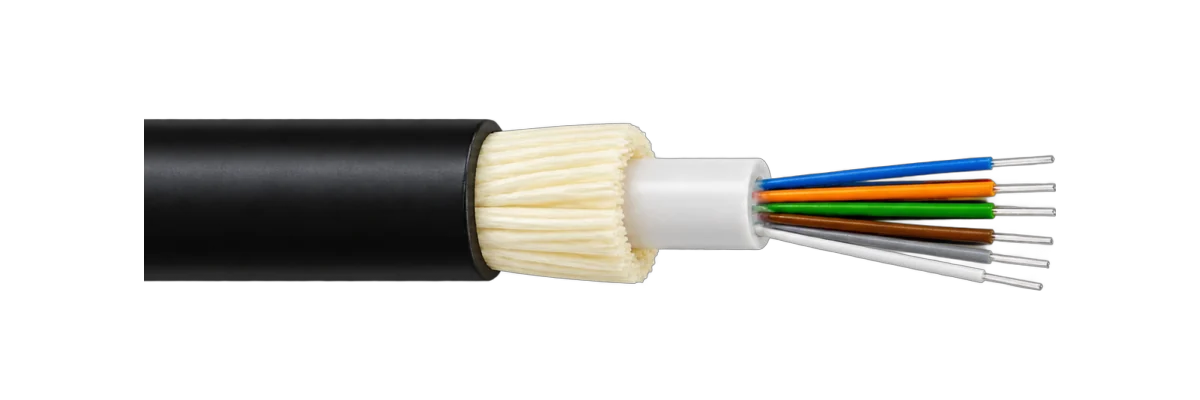
CLT non-metallic armored fiber optic cable cross-section with glass yarn and PE sheath
Representative 6-fiber A-DQ(BN)2Y-CLT construction: PE sheath, glass yarn and a gel-filled central loose tube.

Non-Metallic Armored Cable Construction

Central loose tube

A 3.0 mm PBT tube houses the optical fibers in thixotropic gel. This separates the fibers from the outer reinforcement while the filling material limits moisture movement within the tube.

Glass yarn reinforcement

Water-blocking glass yarn surrounds the tube and carries tensile load. There is no corrugated steel tape in this construction, so the cable contains no metallic armor.

Single PE jacket

The polyethylene sheath resists UV exposure and stress cracking. Ripcords assist jacket opening during preparation for splicing. LSZH and L-M-HDPE sheath options are listed on request and require a configuration-specific quotation.

Outdoor Access and Distribution Applications

Duct and conduit links

Use the CLT construction for low-fiber-count access links, secondary distribution and inter-building voice or data routes installed in ducts or conduits.

Campus and industrial networks

Connect distribution boxes, frames and customer-side panels where a compact all-dielectric cable fits the route and published mechanical limits.

For building entry and indoor sections, specify the required fire performance and jacket material. Do not treat the standard PE version as an LSZH or CPR-classified cable. Aerial suspension and direct burial suitability require project-specific confirmation.

CLT Non-Metallic Armored Cable Specifications

The values below reproduce the linked UPCOM datasheet, Rev. 00, published 11 April 2018. Its upload path is newer than the document revision. Confirm the ordered configuration against the quotation.

ParameterPublished value
Fiber count2 / 4 / 6 / 8 / 12
Loose tubePBT, 3.0 mm diameter
Strength membersWater-blocking glass yarn
Outer jacketPolyethylene (PE)
Nominal outer diameter7.0 mm for all listed fiber counts
Cable weight55 kg/km for all listed fiber counts
Tensile load800 N permanent / 1200 N during installation
Crush resistance1500 N; IEC 60794-1-2 E3
Temperature range−30 °C to +70 °C; IEC 60794-1-2 F1
Minimum bending radius20 × outer diameter = 140 mm for the 7.0 mm cable; IEC 60794-1-2 E11

Optical values in the datasheet

The PDF lists multimode attenuation at 850 and 1300 nm. These are wavelengths, not bandwidth values. Single-mode options and their attenuation limits should be specified in the RFQ rather than inferred from this table.

Fiber typeCore / claddingWavelengthMaximum attenuation
OM162.5/125 µm850 / 1300 nm3.2 / 1.2 dB/km respectively
OM250/125 µm850 / 1300 nm3.0 / 1.0 dB/km respectively
OM350/125 µm850 / 1300 nm2.8 / 0.8 dB/km respectively
OM450/125 µm850 / 1300 nm2.7 / 0.7 dB/km respectively

How to Specify A-DQ(BN)2Y-CLT

  1. Define the route: duct or conduit dimensions, pulling sections, bends and environmental exposure.
  2. Select the fiber: required count, single-mode or multimode type and optical loss budget.
  3. Check mechanical limits: 1200 N installation tension, 800 N permanent load and the published bend radius. Installation equipment must stay within these limits.
  4. Specify the sheath: PE for the published outdoor version; request a separate LSZH or L-M-HDPE configuration when needed.
  5. Complete the RFQ: total length, drum length, jacket color, fiber identification, cable printing, fire requirements and delivery destination.

Compliance and jacket selection

The PDF cites the IEC 60794 family for cable tests and lists IEC 60754-1, IEC 61034-1/2 and IEC 60332-1 references. These references do not establish a fire class for every sheath option. Request the applicable test evidence and, where required, a configuration-specific Declaration of Performance.

Use our CPR cable selection guide for project requirements and the standards overview for supporting documentation. For installation background, see the FOA guide to fiber optic cable construction.

CLT Non-Metallic Armored Cable FAQ

Does this cable contain steel armor?

No. The published A-DQ(BN)2Y-CLT uses glass yarn reinforcement and a PE sheath. Choose a separately specified steel-armored construction if the route calls for metallic armor.

How many fibers are covered by the datasheet?

The linked PDF lists 2, 4, 6, 8 and 12 fibers. Counts outside this range need a separately confirmed construction and datasheet.

Can the standard PE cable be used inside a building?

Confirm the fire requirements for the indoor section before selection. The standard PE construction must not be presented as equivalent to an LSZH option or as carrying an unverified CPR class.

What bending radius should I use?

The PDF specifies 20 times the outer diameter. For the published 7.0 mm cable, this equals 140 mm. Confirm installation conditions and any configuration changes before laying the cable.

Is the cable rodent-proof?

No. The glass yarn construction is described as rodent-resistant. The level of protection needed depends on the route; severe exposure may require a different armor or protective duct.

Request a CLT Cable Quotation

Send the fiber count and type, route details, total length, drum length and jacket requirements. UPCOM will confirm the construction and documentation for your order.

CLT Non-Metallic Armored Fiber Optic Cable