
Outdoor FTTH / FTTx cable solution
Aerial FTTH Drop Cable with Steel Messenger
Aerial FTTH Drop Cable is a compact, dry-design cable for short last-mile overhead routes between a distribution point and subscriber premises. Two 0.5 mm FeZn strength members and a 1.0 mm FeZn messenger support 1, 2 or 4 G.657.A2 fibers inside a nominal 2.0 × 5.2 mm LSZH-FR, UV-resistant jacket.
The published datasheet specifies a maximum tensile strength of 400 N. The cable is intended for controlled short-span aerial access, facade routing and building-entry transitions within the published bending, crush and temperature limits.
- Steel messenger support
- LSZH-FR, UV-resistant jacket
- G.657.A2 single-mode fiber
- Compact flat profile
- 1, 2 or 4 fibers
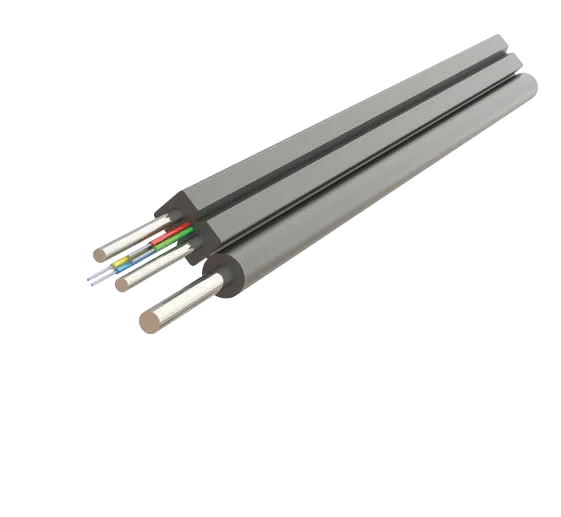
Aerial FTTH Drop Cable overview
This steel messenger drop cable is designed for the access-network section between the local distribution point and the subscriber connection. Its compact flat profile is easier to route along facades and through building-entry zones than a larger loose-tube trunk cable.
The construction is completely dry. Individually coloured G.657.A2 fibers run between two metallic strength members, while the integrated FeZn messenger carries the load on short overhead sections. Because the cable contains metal, it is not an all-dielectric option and must be assessed against the project’s electrical-clearance, bonding and lightning-protection requirements.
Built for last-mile routing
Suitable for subscriber drops, facade routing, short aerial access spans and building-entry transitions where a compact cable profile simplifies installation.
Compact dry construction
The 2.0 × 5.2 mm flat design contains no gel, reducing preparation work when the cable is opened for splicing or termination.
Defined mechanical limits
The datasheet states 400 N maximum tensile strength, 20 mm installation bend radius and 15 mm in-service bend radius.
Design and key features
Steel messenger support for aerial routing
A 1.0 mm FeZn messenger is integrated into the profile to support short overhead drop sections. The route design must remain within the published 400 N tensile limit and should account for span length, sag, wind and ice loading before installation.
UV-resistant LSZH-FR jacket
The black LSZH-FR outer jacket is UV resistant and designed to limit smoke and corrosive gases under the stated fire tests. Its flame, smoke, halogen and acidity performance is listed against IEC 60332-1-2, IEC 61034-2, IEC 60754-1 and IEC 60754-2.
Bend-insensitive G.657.A2 fiber
G.657.A2 single-mode fiber is suited to access routes with tighter bends than conventional outside-plant cabling. The cable-level minimum bend radius remains 20 mm during installation and 15 mm in service.
Applications and installation scenarios
Aerial FTTH Drop Cable is intended for the final access section, not as a substitute for a self-supporting distribution or armored backbone cable. Confirm the complete route and environmental loads before specifying it for an overhead span.
Typical uses
- FTTH subscriber drops from access point to home or office
- Facade routing and controlled short-span aerial access runs
- Building-entry transitions requiring compact cable geometry
- Low-count access-network connections
- Outdoor routes within the stated temperature and mechanical limits
- Projects that permit metallic strength and messenger members
When to choose another cable family
- For indoor-only routing, see FTTH Drop Cable Indoor Non-Metallic.
- For an all-dielectric aerial alternative, see Aerial FTTH Drop Non-Metallic Cable.
- For longer routes, higher fiber counts or harsher mechanical exposure, compare Multi Loose Tube Metallic Armored Single LSZH Jacket and Multi Loose Tube Metallic Armored Single PE Jacket.
Aerial FTTH Drop Cable technical specifications
The values below follow the datasheet currently linked from this product page. Project-specific construction, marking, packaging and test requirements should be confirmed in the approved technical datasheet before ordering.
| Parameter | Value |
|---|---|
| Available fiber counts | 1, 2 or 4 fibers |
| Strength members | 2 × 0.5 mm FeZn wire (±10%) |
| Messenger wire | 1.0 mm FeZn wire (±10%) |
| Outer jacket | Black LSZH-FR, UV resistant |
| Nominal cable size | 2.0 × 5.2 mm |
| Fiber type | Single-mode G.657.A2 |
| Fiber coating diameter | 0.25 mm |
| Approximate weight | 20 kg/km (±10%) |
| Maximum tensile strength | 400 N — IEC 60794-1-2 E1 |
| Minimum bending radius | 20 mm during installation; 15 mm in service — IEC 60794-1-2 E11 |
| Crush resistance | 4,000 N/dm short term; 2,000 N/dm long term — IEC 60794-1-2 E3 |
| Impact resistance | 3 impacts at 5 J — IEC 60794-1-2 E4 |
| Repeated bending | 10 cycles; 120 mm radius; 1 kg load — IEC 60794-1-2 E6 |
| Installation temperature | +5 °C to +50 °C |
| Operating temperature | -30 °C to +70 °C |
| Storage temperature | -30 °C to +70 °C — IEC 60794-1-22 F1 |
| Combustion test references | IEC 60332-1-2, IEC 61034-2, IEC 60754-1 and IEC 60754-2 |
How to choose an Aerial FTTH Drop Cable
Specify the cable from the route conditions first. Fiber count alone does not determine whether a metallic aerial drop construction is suitable.
- Review the complete route. Record the aerial span, support points, facade path, building entry and indoor transition. Include local clearance and metallic-cable requirements.
- Confirm fiber count and compatibility. Select 1, 2 or 4 G.657.A2 fibers and verify compatibility with the splice plan, connectors, active equipment and link budget.
- Calculate the mechanical demand. Check span length, sag, wind and ice load against the 400 N tensile limit. Apply the published bend, crush, impact and temperature values to the installation method.
- Confirm the environment and cable construction. The standard datasheet specifies a black, UV-resistant LSZH-FR jacket and metallic support members. Choose an all-dielectric design where metal is restricted.
- Approve the datasheet before ordering. Confirm marking, drum length, packaging and any project-specific test or compliance requirement. For route comparison, use the FTTH Drop Cable Selection Guide and the wider FTTH deployment guide.
FAQ about Aerial FTTH Drop Cable
What is an Aerial FTTH Drop Cable used for?
It is used on low-count last-mile FTTH and FTTx routes where a compact cable with an integrated steel messenger is needed between the distribution point and subscriber premises.
When should I choose metallic instead of all-dielectric?
Choose the metallic version when its steel messenger and strength-member construction suits the route and local electrical-clearance rules permit metal. Use an all-dielectric cable where bonding, lightning exposure or proximity to power lines makes metallic construction unsuitable.
Which fiber type is specified?
The linked datasheet specifies single-mode G.657.A2 fiber in 1, 2 or 4-fiber constructions.
What is the maximum tensile strength?
The published datasheet states 400 N maximum tensile strength. Final span approval must also consider support spacing, sag, wind, ice and the installation method.
When should I move to an armored loose tube cable?
If the route becomes longer, harsher or requires higher fiber counts than a typical drop section, an armored outdoor loose tube cable is usually the better engineering choice.
References and external standards
For the bend-insensitive fiber family specified on this page, see ITU-T G.657. For broader optical fiber cable standardization context, see the IEC 60794-1-1 family entry.
Mechanical and environmental values on this page are taken from the linked product datasheet. Where project specifications differ, the approved order-specific datasheet takes precedence.