
Fire Resistant Fiber Optic Cable
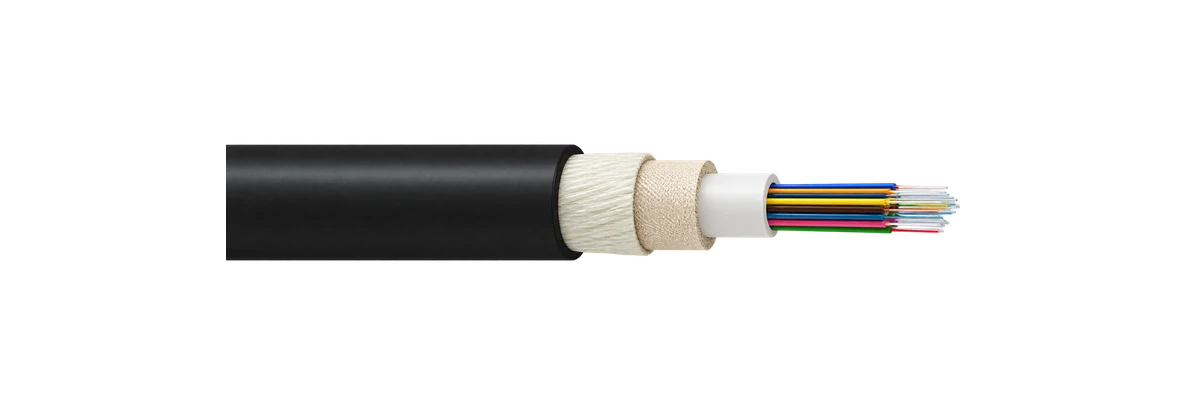
Fire resistant fiber optic cable U-DQ(ZN)H uses a central loose tube, mica fire barrier and non-metallic glass yarn for indoor and duct routes requiring a halogen-free jacket. Specify fire-integrity performance separately with a test report for the ordered cable.
The published datasheet lists a PBT loose tube, thixotropic gel, mica tape, non-metallic glass yarn, ripcord and a UV-resistant low-smoke zero-halogen (LSOH) jacket. It does not list steel-tape armour or an achieved 120/180-minute test duration.
For indoor and duct routes requiring a halogen-free jacket and mica barrier, verify fibre count, installation method, bending radius and the project's fire-test evidence before selection.
Fire Resistant Fiber Cable Overview
Built for signal continuity
Reaction to fire and circuit integrity are separate performance requirements. The linked datasheet references IEC 60331-25 as a fire-test method, but does not report a verified fire-survival duration for this cable construction.
Balanced indoor and outdoor use
The LSZH-UV outer sheath makes the cable suitable for demanding routes where low smoke performance is required indoors, while UV stability supports outdoor exposure and duct-based deployment.
Practical installation profile
The central loose tube format is listed for pulling, pushing and cable-blowing applications. Confirm installation force, duct suitability and bending radius for the selected fibre count.
Where to Use Fire Resistant Fiber Cable
Fire resistant fiber cable use cases
- Fire alarm and voice alarm cabling routes, subject to approval of the required operating duration
- Tunnels, metro lines and transport infrastructure
- Public buildings with evacuation and life-safety requirements
- Critical communication backbones in industrial or utility sites
- Indoor or duct routes specifying an LSOH jacket; circuit integrity must be verified separately
Why designers specify this construction
- Mica fire barrier within an LSOH cable construction
- LSZH behavior for smoke and corrosive gas control
- Non-metallic glass-yarn reinforcement; no steel-tape layer is listed in the datasheet
- UV-resistant LSOH outer jacket; sheath colour to be confirmed at quotation
- Indoor/outdoor flexibility to simplify project logistics
Fire Resistant Fiber Cable Construction
Core structure
The published construction includes optical fibres, thixotropic jelly, a PBT central tube, mica tape, non-metallic glass-yarn reinforcement, ripcord and a UV-resistant LSOH jacket. A separate inner jacket and a steel-tape layer are not listed.
Glass yarn and outer protection
Glass yarn provides non-metallic reinforcement. The outer jacket is specified as UV-resistant and halogen-free (LSOH). Steel tape, a second jacket and a fixed sheath colour are not stated in the linked datasheet.
Fiber options
The published fibre choices are G.652.D, G.655, G.657.A1, G.657.A2, OM1, OM2, OM3 and OM4. Confirm the exact fibre grade and count in the quotation; additional options require a separate approved datasheet.
Installation profile
The cable is suitable for critical network routes in MAN, WAN and LAN environments, as well as duct installations where a lighter and more compact construction is preferred over heavier specialty designs.
Technical Specifications
| Fiber count | 2, 4, 6, 8, 12 or 24 fibres (listed part numbers) |
|---|---|
| Fiber types | G.652.D, G.655, G.657.A1/A2; OM1, OM2, OM3 and OM4 |
| Strength members | Non-metallic glass yarn and thixotropic gel within the PBT tube |
| Loose tube diameter | 3.4 mm (12F), 4.2 mm (24F); verify other counts |
| Fire barrier | Mica tape (per published datasheet) |
| Metallic armour | Not listed for this U-DQ(ZN)H construction |
| Outer jacket | UV-resistant halogen-free (LSOH) jacket; colour to confirm |
| Approx. cable weight | Confirm cable mass for the ordered fibre count |
| Outer diameter | Confirm diameter for the ordered fibre count |
| Tensile load | Confirm rated tensile loads for the selected build; IEC 60794-1-2-E1 reference in datasheet |
| Crush resistance | 2500 N/100 mm, max. 15 min (IEC 60794-1-2-E3 reference) |
| Temperature range | Operating -20 to +70 °C; installation -30 to +60 °C; storage/transport 0 to +70 °C |
| Minimum bending radius | 20 x outer diameter (IEC 60794-1-2 E11) |
| Reference optical characteristic | Optical parameters depend on the selected fibre type; request its corresponding specification |
Note: fiber type, core count and exact construction details can be configured according to project scope, fire requirement and installation environment.
Fire Resistant Fiber Cable Standards and Compliance
IEC 60331-25 defines circuit-integrity testing for optical fibre cables exposed to fire. IEC 60754-2 covers the acidity and conductivity of gases released during combustion, while IEC 61034-2 covers smoke density. The IEC 60794 series, TIA/EIA-568-C.3 and Telcordia GR-409-CORE address relevant optical cable performance and application requirements.
What the fire standards cover
- IEC 60331-25 addresses circuit integrity testing for optical fibre cables under fire exposure.
- IEC 60754-2 evaluates the corrosivity and acidity of gases evolved during combustion.
- IEC 61034-2 measures smoke density under defined burning conditions.
- EN 50575 / CPR is used in building applications to classify reaction to fire.
Fire resistant vs flame retardant vs CPR
Fire-resistant performance concerns continued operation during fire. Flame-retardant performance concerns limiting flame propagation. CPR under EN 50575 classifies a cable's reaction to fire in construction works, including flame spread, heat release and, where applicable, smoke, flaming droplets and acidity. A CPR class does not by itself demonstrate circuit integrity.
FAQ About Fire Resistant Fiber Cable
What does FE180 / PH120 mean on a fire resistant fiber cable?
Is fire resistant fiber cable the same as CPR B2ca cable?
Can this fire resistant fiber cable be used outdoors?
Which fibre types are available in this fire resistant fiber cable range?
Does the U-DQ(ZN)H datasheet include steel tape armour?
Is this cable only for fire alarm systems?
Need the right fire-performance cable for a project?
For a quotation, provide fibre grade and count, route conditions, required CPR class, fire-integrity test standard, duration and acceptance documents. A test-standard reference in a datasheet is not evidence of an achieved fire-survival duration.