



Kucuksu Rasathane
Uskudar Istanbul Turkey

Mon–Fri 09:00–18:00 (GMT+3)
Weekend: Closed
Indoor FTTH Flat Cable
FTTH Drop Cable Indoor Metallic Armored
FTTH Drop Cable Indoor Metallic Armored is a compact flat LSZH indoor drop cable developed for direct FTTH and FTTx termination where controlled routing, easy handling and extra mechanical support are required. The structure combines metallic strength members with a slim 3.2 x 2.0 mm profile and supports project-based configurations up to max. 8 fibers.
- Up to 8 Fibers
- LSZH Jacket
- Metallic Strength Members
- 3.2 x 2.0 mm
- Indoor FTTH Use
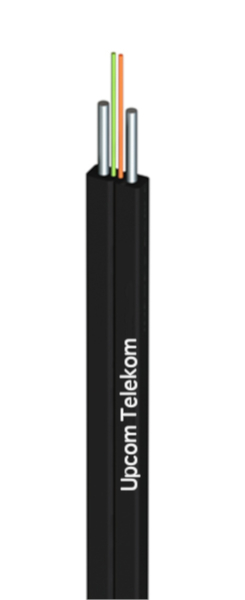
FTTH Drop Cable Indoor Metallic Armored Overview
This flat indoor drop cable is designed for last-meter and in-building fiber routing where installation simplicity matters but the cable still needs better mechanical protection than a basic soft indoor construction. The metallic reinforcement helps the cable maintain its shape during routing, clipping and direct termination work, while the LSZH sheath supports indoor fire-safety expectations.
The product is suitable for indoor FTTH distribution, subscriber access lines, patching between building entry points and end-user termination zones. For buyers comparing structures, you can also review the FTTH Drop Indoor Non-Metallic Cable, the standard FTTH Drop Aerial Cable and the Aerial FTTH Drop Non-Metallic Cable for span-based installations.
Key design points
- Flat indoor FTTH cable with metallic strength members
- LSZH outer sheath for indoor installations
- Common listed fiber counts: 1F, 2F and 4F
- Product family positioned up to max. 8 fibers
- Direct termination friendly structure
- White or black outer jacket available on request
Applications for FTTH Drop Cable Indoor Metallic Armored
Typical installation areas
- Indoor FTTH subscriber routing
- Horizontal floor distribution and riser transitions
- Direct clipping to interior surfaces and skirting boards
- Access network and local area network connections
- Indoor interconnect and direct termination points
When this structure makes sense
Choose this structure when the route is fully indoor, the cable must stay compact, and a stronger flat geometry is preferred for cleaner handling. If the route includes tougher outdoor exposure or longer backbone sections, compare it with Multi Loose Tube Metallic Armored Single LSZH Jacket and Multi Loose Tube Metallic Armored Single PE Jacket alternatives.
Helpful technical references
The optical fiber options on this page align with commonly requested single-mode families such as ITU-T G.652 and ITU-T G.657. For broader optical cable test methodology, buyers can also review the IEC 60794 framework. If you want the wider deployment context, see our FTTH guide and fiber optic cable overview.
FTTH Drop Cable Indoor Metallic Armored Specifications
The table below reorganizes the live product data into a cleaner format for buyers and project teams.
| Specification | Value |
|---|---|
| Cable structure | Indoor flat FTTH drop cable, metallic armored / metallic reinforced |
| Fiber capacity | Up to max. 8 fibers in the product family; common listed configurations are 1F, 2F and 4F |
| Fiber options | 9/125 G.652.D, 9/125 G.657.A1, 9/125 G.657.A |
| Strength members | 0.5 mm metallic strength member |
| Outer jacket | LSZH |
| Nominal cable size | 3.2 x 2.0 mm |
| Attenuation, max. dB/km | G.652.D: 0.35 / 0.25 at 1310 / 1550 nm G.657.A1: 0.34 / 0.24 at 1310 / 1550 nm G.657.A: 0.34 / 0.22 at 1310 / 1550 nm |
| Weight | 9.0 kg/km |
| Tensile load, perm. / inst. | 100 / 200 N |
| Crush resistance | 200 N/10 cm |
| Temperature range | -10 °C to +60 °C |
| Minimum bending radius | 15x outer diameter / 10x outer diameter |
| Jacket color options | White or black |
| Referenced standards on current page | EN 50173-1, IEC 60754-2, IEC 60794-1&2, IEC 60793-1&2, IEC 60332-1 & 2 |
Need a different route condition or construction logic? Start from the broader cable category page and compare indoor drop, aerial drop and armored loose tube options together.
Metallic vs Non-Metallic FTTH Drop Cable Comparison
This page: metallic indoor drop
Best suited to indoor FTTH routes where a compact flat construction and added mechanical support are needed in one cable.
Indoor non-metallic option
Review the non-metallic indoor version when a dielectric structure is preferred for indoor routing and active equipment environments.
Aerial-oriented options
For façade, pole-to-building or span-based routes, compare the FTTH Drop Aerial Cable and Aerial FTTH Drop Non-Metallic Cable.
How to Specify FTTH Drop Cable Indoor Metallic Armored
For faster RFQ handling and cleaner technical alignment, define the cable in the sequence below.
-
Confirm the route.
Define whether the installation is fully indoor, partially exposed or includes aerial transitions. This page is for indoor routing logic. -
Select the fiber count.
Standard request levels usually start from 1F, 2F or 4F, while project-based configurations can extend higher within the family. -
Choose the fiber standard.
Specify whether the project requires G.652.D, G.657.A1 or G.657.A performance. -
Confirm fire and sheath requirements.
State indoor LSZH expectations clearly, especially if the cable will run inside risers, corridors or subscriber spaces. -
Define color and termination preference.
Jacket color, connector strategy and direct termination expectations should be clarified before quotation. -
Match the structure to the real environment.
If the route becomes outdoor, armored loose tube or aerial drop structures may be more appropriate than an indoor flat drop cable.
FTTH Drop Cable Indoor Metallic Armored FAQ
What is FTTH Drop Cable Indoor Metallic Armored used for?
It is used for indoor FTTH and FTTx routing, including subscriber access lines, direct termination points, horizontal distribution and riser-related indoor paths.
Is this cable intended for aerial outdoor spans?
No. This page describes an indoor flat drop structure. For outdoor span use, review the FTTH Drop Aerial Cable or the Aerial FTTH Drop Non-Metallic Cable.
Which fiber types can be requested?
The listed optical characteristics include 9/125 G.652.D, 9/125 G.657.A1 and 9/125 G.657.A single-mode fiber options.
What is the difference between metallic and non-metallic indoor drop cable?
The main difference is the reinforcement structure. This model uses metallic strength members, while the non-metallic indoor version is preferred when a dielectric structure is required.
What are the nominal dimensions of this cable?
The live product data lists a nominal flat dimension of 3.2 x 2.0 mm.