
Individually buffered fibers
Colored 900 ±50 µm tight buffers protect the fibers and support identification during connector assembly. The PDF specifies color and black-ring identification.
I-A-V(ZN)H(BN)H · Indoor LSZH · Non-metallic
Tight buffer breakout fiber optic cable I-A-V(ZN)H(BN)H is a dry, all-dielectric indoor cable with 900 µm tight-buffered fibers, non-metallic reinforcement and an LSZH outer jacket. The datasheet covers 2–24 fibers for riser, horizontal cabling and fiber-to-the-desk routes.
The compact construction supports direct connector assembly. Choose the fiber type and count to match the link, then check the corresponding diameter, weight and tensile load.
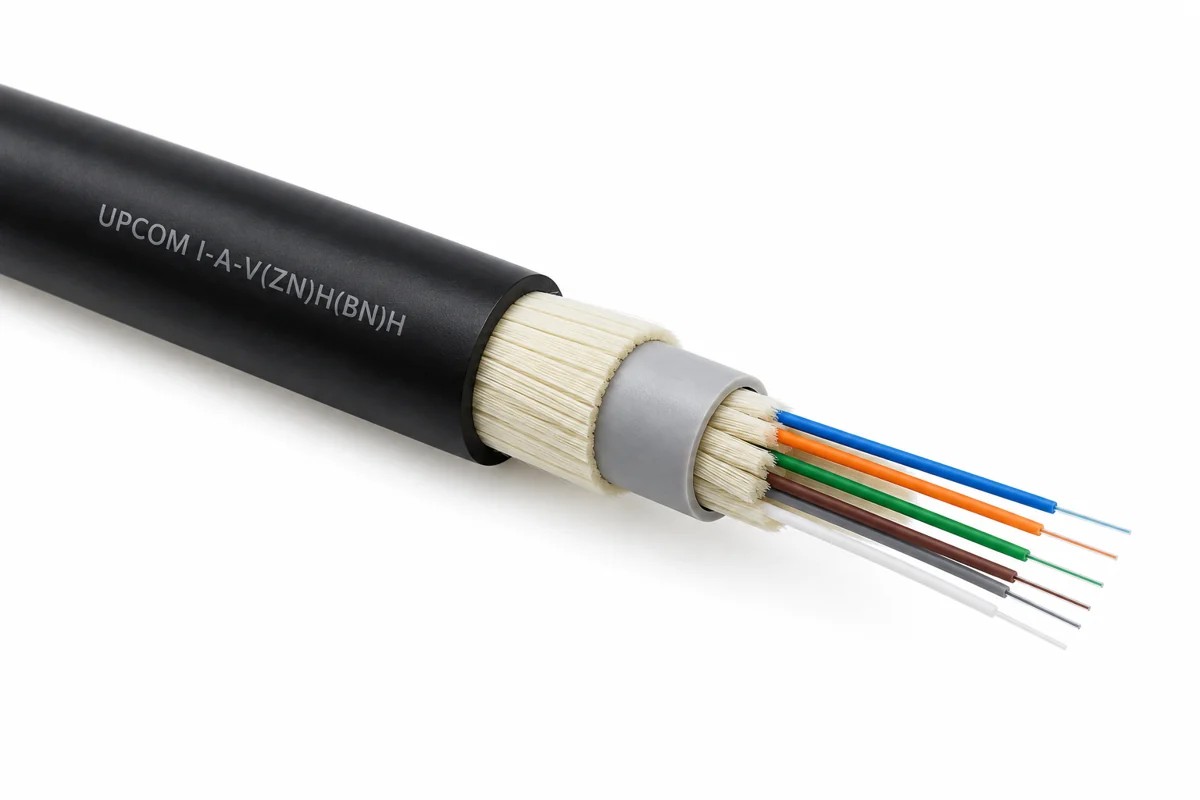
Colored 900 ±50 µm tight buffers protect the fibers and support identification during connector assembly. The PDF specifies color and black-ring identification.
The construction drawing identifies glass yarn armor; the technical table lists aramid or glass yarn strength members. Confirm the reinforcement in the ordered variant. This model contains no corrugated steel tape armor.
The published indoor version uses LSZH buffer and outer jackets and contains no gel or metallic element. It suits indoor cable preparation and direct termination where a low-smoke, halogen-free sheath is specified.
Use this mini breakout cable in shafts, underfloor spaces, indoor backbone risers and horizontal working-area routes. It can form trunk, patch and adapter cables after the required termination work.
The linked datasheet defines an indoor cable. Direct burial and outside-plant use are not standard applications for this model. A PE-jacket drawing option must be separately specified; it does not establish burial suitability.
Values are taken from the linked UPCOM datasheet, Rev. 00, published 11 April 2018. Tensile loads are shown separately for permanent service and installation.
| Fiber count | Outer diameter | Weight | Permanent load | Installation load |
|---|---|---|---|---|
| 2 | 4.5 mm | 26 kg/km | 400 N | 600 N |
| 4 | 5.5 mm | 31 kg/km | 400 N | 600 N |
| 6 | 6.0 mm | 42 kg/km | 600 N | 1000 N |
| 8 | 6.8 mm | 48 kg/km | 600 N | 1000 N |
| 12 | 7.2 mm | 54 kg/km | 800 N | 1200 N |
| 16 | 8.0 mm | 67 kg/km | 1000 N | 1600 N |
| 24 | 8.6 mm | 85 kg/km | 1200 N | 2000 N |
| Parameter | Published value |
|---|---|
| Tight buffer diameter | 900 ±50 µm |
| Buffer / outer jacket | LSZH / LSZH |
| Strength members | Aramid yarn or glass yarn |
| Crush resistance | 1000 N; IEC 60794-1-2 E3 |
| Temperature range | −20 °C to +60 °C; IEC 60794-1-2 F1 |
| Minimum bending radius | 20 × outer cable diameter; IEC 60794-1-2 E11 |
| Maximum published length | 2000 m |
The PDF's “Bandwidth (nm)” label refers to test wavelengths. Bandwidth is not expressed in nm. G.657A is the designation in this document; request the required subclass when ordering.
| Fiber type | Wavelengths | Maximum attenuation |
|---|---|---|
| OM1, 62.5/125 µm | 850 / 1300 nm | 3.2 / 1.2 dB/km |
| OM2, 50/125 µm | 850 / 1300 nm | 3.0 / 1.0 dB/km |
| OM3, 50/125 µm | 850 / 1300 nm | 2.8 / 0.8 dB/km |
| OM4, 50/125 µm | 850 / 1300 nm | 2.7 / 0.7 dB/km |
| G.652-D, 9/125 µm | 1310 / 1550 nm | 0.34 / 0.25 dB/km |
| G.657A, 9/125 µm | 1310 / 1550 nm | 0.34 / 0.22 dB/km |
The PDF cites DIN VDE 0888 Part 6, IEC 61034, IEC 60332-1/2, IEC 60754-2 and the IEC 60794 family. Ask for the configuration-specific documentation required by your project.
For handling background, see the FOA fiber optic cable guide.
No. The linked I-A-V(ZN)H(BN)H datasheet describes a non-metallic construction with glass yarn reinforcement. A steel-armored cable is a different construction.
2, 4, 6, 8, 12, 16 and 24 fibers. Diameter, weight and tensile load vary with the selected count.
The tight-buffer design is suitable for direct connector assembly. Specify the connector, polish, fiber type and required termination method; connectors are not implied by the bare cable designation.
The listed outer diameter is 7.2 mm. At 20 times the diameter, the published minimum radius is 144 mm.
The datasheet defines indoor applications. Select a separately specified outdoor or burial construction when the route requires it.
I-A-V(ZN)H(BN)H
Share your quantity and delivery country. Technical details are optional; you can ask us to help with the specification.
You can also email info@upcom.com.tr.