
How to Choose the Right Air Compressor for a Cable Blowing Machine
Choose an air compressor for a cable blowing machine by matching sustained working pressure and delivered airflow to the duct’s airflow demand and the machine’s published requirement. Cable and duct diameter, route length, bends, hose losses and air treatment then determine the reserve capacity needed for stable installation.
The highest pressure rating is not automatically the best choice. A compressor must maintain the required flow under load throughout the duty cycle; otherwise blowing distance, feed stability and cable handling deteriorate even when the pressure gauge looks adequate.

Record the cable OD, duct OD and ID, target length, bend profile, route condition, hose run and exact machine. Use the UPCOM quote form to submit these inputs together; compressor capacity cannot be selected reliably from cable diameter or maximum pressure alone.
Why the air compressor for a cable blowing machine affects the whole job
An undersized compressor does not just slow the blowing machine down. It shortens stable blowing distance, makes feed speed harder to hold, increases operator corrections, and turns a good machine into a stop-start system. On the other side, a larger compressor than the job really needs adds capital cost, transport burden, fuel or power spend, and site noise without fixing leakage, bad couplers or a dirty duct.
Compressor selection is therefore an installation-system decision, not a generic air-tool purchase. Fiber blowing works when compressed air, controlled mechanical feed, sealing, lubrication and duct preparation work together. A stronger machine or larger compressor cannot compensate for leakage, poor duct preparation or mismatched tooling.
For the wider process, review how a cable blowing machine works and the fiber optic cable blowing guide before finalizing the compressor package.
How to match the air compressor for a cable blowing machine to UPCOM models
The machine class comes first, because cable range, duct range, drive architecture and route ambition change what the compressor has to support. MiniFOK, FOK and HidroFOK overlap in some work, but they do not create the same demand pattern.
| UPCOM model | Verified machine range | Drive structure | Verified air-side data | What that means for compressor choice |
|---|---|---|---|---|
| MiniFOK | Ø2.5–12 mm cable, tooling for Ø7–50 mm ducts, up to 80 m/min and up to 1500 m benchmark | 1 pneumatic motor | Maximum air-motor consumption: 1.5 m³/min at 6 bar (about 53 CFM at 87 psi). Use the published compressor reference below for ducts up to Ø20 mm. | Compact machine, but not a “small compressor only” assumption. On longer microduct runs, the duct airflow requirement is larger than the motor number suggests. |
| FOK | Ø9–22 mm cable, Ø20–50 mm duct OD, up to 80 m/min and up to 3000 m reference case | 2 pneumatic motors | Maximum air-motor consumption: 3 m³/min at 6 bar (about 106 CFM at 87 psi). Use the minimum published compressor reference below. | Do not size only to air-motor consumption. FOK needs the compressor to feed the complete blowing system, not only the onboard motors. |
| HidroFOK | Ø9–25 mm cable, Ø20–60 mm duct OD, up to 80 m/min and up to 3000 m reference case | Hydraulic power unit with 2 hydraulic motors | A separate air compressor is required. Use the minimum published compressor reference below. | Hydraulic drive raises the feed-force side. It does not remove the need for strong, stable compressed air through the duct. |
Published compressor reference: about 10.5 m³/min at 12 bar (about 371 CFM at 174 psi) for MiniFOK with ducts up to Ø20 mm; minimum recommended capacity for FOK and HidroFOK. These linked product specifications are sizing references, not guaranteed field results. Final capacity depends on the actual cable, duct ID, route geometry, sealing and hose setup.
Air-motor consumption covers only the machine-drive demand. The compressor must also supply airflow through the duct while overcoming losses across the hose, fittings, seals and air-treatment equipment. Sizing only to motor consumption will leave the full blowing system short of air.
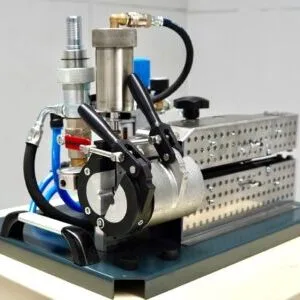
MiniFOK
Best for mixed FTTH, feeder and access-network work where portability matters but you still need serious duct-air support.
Compact pneumatic machine for crews handling multiple cable sizes on the same site.

FOK
The pneumatic workhorse for backbone, metro and feeder routes where stable air management matters as much as pushing force.
Dual air motors, integrated lubrication and a defined compressor requirement for longer route work.

HidroFOK
For larger cable diameters, longer routes and jobs where extra operating margin is cheaper than a stalled crew.
Hydraulic drive on the feed side, separate compressor still required on the air side.
Air compressor for a cable blowing machine: pressure vs free air delivery
Pressure gets most of the attention because it is easy to compare. It is not the whole answer. Cable blowing needs enough pressure to keep the process inside the working envelope, but it also needs enough free air delivery (FAD) at that working pressure to keep airflow moving through the duct. A compressor that can touch the target pressure for a moment but cannot sustain the delivered volume under load is the wrong compressor for the job.
This matters even more in air-drag installations. The cable is not simply pushed through the duct; the airflow helps carry it while the machine keeps the entry force controlled. The FOA’s fiber-installation reference makes the same point from another angle: in blown installation, the air reduces friction so the machine can push the cable into the duct more effectively.
Do not confuse air-motor consumption with total compressor demand. The motor value covers the drive system, while the compressor also has to maintain airflow through the duct. The gap between those two figures is expected and should be included in compressor sizing.
Ask for delivered airflow at the intended working pressure, not just maximum pressure or open-flow marketing numbers. Then check that number again after hose length, couplings and any air-treatment stage are added to the setup.
Duty cycle and continuous operation: the brochure peak is not the field reality
Cable blowing is often closer to continuous industrial use than casual air-tool use. A telecom crew may hold airflow for extended periods, recalibrate, restart after an obstruction, then continue across multiple ducts in the same shift. That operating pattern punishes compressors that look fine on a cold start but lose consistency as temperature rises.
A practical buying question is simple: can the compressor maintain stable output through the full working day, not only through the first installation? If the answer is weak, operators start compensating downstream by increasing force, raising machine pressure or changing feed speed too aggressively. That is exactly when heat, slippage and jacket marking show up.
For recurring contractor work, a compressor with a genuine continuous-duty operating profile is usually cheaper than living with repeated stalls, extra labor hours and the false economy of a smaller unit.
Air treatment: moisture, filtration, oil carryover and when an air cooler is not enough
FOK and MiniFOK include on-machine air preparation and lubrication for motor protection. These components do not replace upstream treatment when the compressor sends hot, wet or oil-contaminated air into the line.
The UPCOM Air Cooler is installed between the compressor and cable blowing machine to reduce discharge-air temperature and moisture carryover. It is recommended for long-distance work and field conditions above 20°C (68°F).
Its published limits are 12 m³/min maximum airflow, 12 bar maximum operating pressure and 0.2 bar maximum pressure drop. Any cooler, filter or dryer added to the line must handle the target airflow without restricting compressor delivery.

The Air Cooler provides first-stage cooling and moisture management; it is not a complete downstream drying system. An aftercooler overview from Atlas Copco explains the same principle: cooling discharge air condenses part of its moisture, while applications requiring a lower pressure dew point still need suitable drying and filtration.
That matters on humid routes, after rain, in warm climates, on long shifts and anywhere condensate is likely to build. It also matters if you are using an oil-injected compressor. Controlled lubrication at the machine or in the duct is one thing; uncontrolled oil carryover from the compressor is another. Filtration, separators, drains and service condition need to be part of the buying decision.
Hose diameter, hose length and fittings: the quiet source of pressure loss
Treat the air line as part of compressor sizing, not as an afterthought. The FOK setup specifies a 1-inch air hose at the quick connection, because hose diameter becomes part of system performance at high airflow.
Long hoses, small internal diameter, repeated reducers, worn quick couplings, harsh bends and rough internal surfaces all create losses before the air reaches the machine. Kaeser’s pressure-drop guidance calls out loose fittings, harsh bends, wear and damaged hose interiors for exactly this reason.
In practice, a compressor that looks adequate at the trailer can be under capacity at the blowing head. Protect delivered airflow by keeping the hose run short and straight, minimizing adaptors and using full-bore fittings sized for the target flow.
Diesel vs electric compressor scenarios
There is no universal winner. The better option depends on how the site is powered, how often the crew moves, what the emissions and noise limits are, and whether the compressor has to work like a mobile civil-engineering asset or a fixed utility package.
| Scenario | Diesel compressor usually makes more sense | Electric compressor usually makes more sense |
|---|---|---|
| Outdoor telecom build with frequent moves | Yes — easier where no reliable site power exists and mobility matters | Only if site power is already available and relocation is limited |
| Indoor, tunnel, plant or emissions-restricted environment | Usually less attractive because of exhaust and noise | Often the better fit if supply capacity and cable management are verified |
| Remote rural work or multi-pit daily operation | Usually the practical choice | Less practical unless temporary power is easy and stable |
| Fixed, repeatable production-style installation zone | Possible, but often heavier and costlier to run long term | Attractive when continuous-duty output and lower local emissions are priorities |
For many field contractors, diesel remains the easier answer because it travels with the crew. Electric becomes attractive where emissions, indoor safety, neighborhood noise or permanent site power change the economics. In both cases, the same warning applies: compare real delivered output and duty cycle, not only the drive type.
Oversizing vs undersizing: what it really costs
Undersized
Cheaper to buy, expensive to live with. Expect stalled runs, lower average installation speed, more resets, more operator intervention and more wasted crew hours.
Oversized
Useful reserve can be smart, but excessive size adds capital cost, transport weight, fuel or electricity spend, and noise without curing air leaks or a poor duct.
Right-sized
Enough delivered air and pressure for the machine, the route and the treatment package, plus a sensible margin for real field losses and environmental conditions.
Keep enough reserve for bends, weather, hose losses and long-route uncertainty, but avoid paying to transport and operate capacity that the project mix will not use. This is especially relevant for contractors and distributors selecting one setup for a defined range of jobs.
Machine choice and compressor choice should be assessed together. The UPCOM cable blowing machine selection guide can show when moving to a different machine class is more effective than increasing compressor capacity around the wrong platform.
Field conditions that change the answer: humidity, ambient temperature, altitude and long-route jobs
Sea-level brochure numbers are not the full story. Real jobs happen in heat, humidity, altitude, old ducts, long routes and variable terrain. Those conditions change compressor performance and change how the blowing setup behaves.
Humidity and condensate
Moisture inside the air line or duct makes performance less predictable. It also raises maintenance risk on air-side components. If humidity is high, treat air quality as part of the compressor package, not as a last-minute accessory decision.
Ambient heat
Hot discharge air can raise friction and cable-jacket heat load. For warm or long-distance work, size the cooler and condensate management around the compressor’s real flow.
Altitude
Higher elevation means lower air density, which reduces compressor output and changes the pressure ratio required to do the same job. Atlas Copco’s guidance on compressor installations at high altitude is worth reviewing if your routes climb well above typical sea-level conditions.
Long-route and bend-heavy work
As distance accumulates, small inefficiencies multiply. Stable FAD, good sealing, correct lubrication and proper hose management usually matter more than chasing another bar on the gauge.
For route planning, buyers should keep one rule in mind: a compressor cannot turn a bad duct into a good duct. On long jobs or uncertain legacy routes, it may be smarter to keep a reserve margin in the compressor package and break the installation into controlled stages than to keep forcing one continuous blow.
Air compressor for a cable blowing machine: practical checklist
- Confirm the target UPCOM machine or shortlist: MiniFOK, FOK or HidroFOK.
- Record cable OD and cable type, not just “fiber cable”.
- Record duct size accurately. If you know OD/ID, keep both.
- Set the target installation length and note whether that is one continuous blow or a staged plan.
- Mark route condition honestly: straight, few bends, many bends, existing busy duct, unknown friction or moisture risk.
- Check the compressor’s delivered airflow at the intended working pressure, not only its maximum pressure figure.
- Include hose ID, hose length and coupling style in the sizing decision.
- Decide whether the job needs first-stage cooling, extra filtration, drains or a dedicated dryer in addition to the machine’s own air-side components.
- Decide whether diesel or electric drive fits the site logistics, power availability and emissions limits better.
- For warm, humid or long-route jobs, plan the air-treatment package before the first site day, not after the first failed run.
Common mistakes and how to avoid them
1) Buying on bar or psi alone
Fix it by checking delivered airflow at working pressure and matching it to the route, not just the gauge.
2) Ignoring the hose set
Fix it by treating hose diameter, hose length and fittings as part of the compressor system. The wrong hose can make a good compressor look weak.
3) Assuming hydraulic drive removes compressor demand
Fix it by remembering that HidroFOK still needs strong, stable compressed air for the blowing side.
4) Skipping air treatment on hot or humid jobs
Fix it by planning the Air Cooler, filters, drains and dryer logic with the compressor package, especially for long routes and warm conditions.
5) Expecting the compressor to hide duct problems
Fix it by proving, cleaning and drying the duct. Bigger air supply helps only when the rest of the route is fundamentally sound.
6) Ordering the machine before confirming cable and duct tooling
Fix it by sending cable OD, duct size and route condition at the quotation stage. UPCOM’s own quote workflow is built around that for a reason.
Need the right machine and compressor package for the same project?
Send UPCOM the cable OD, duct OD and ID, target length, route condition and hose details. The quote team can then match the machine, compressor reference, tooling and air-treatment package to the same project inputs.
FAQ
Is the highest bar or psi rating the main thing to compare?
No. Buyers should compare delivered airflow at the working pressure, then subtract the real losses created by hoses, fittings and treatment stages. A compressor that can hit the pressure number but cannot sustain the flow is the wrong compressor for the route.
Do I need an air cooler if I already have a dryer?
They solve different parts of the problem. The Air Cooler lowers discharge temperature and removes part of the condensate load before the machine. A suitable dryer is still required when the application needs a lower pressure dew point than cooling and separation alone can provide.
Can one compressor cover MiniFOK, FOK and HidroFOK jobs?
Sometimes, but only when the compressor is chosen around the largest machine and the hardest route you intend to support. Buyers need to compare real delivered output, pressure, hose losses, duty cycle and air-treatment capacity, not only the headline compressor size.
Does HidroFOK remove the need for a strong air compressor?
No. HidroFOK uses a hydraulic power unit for cable feed, but the blowing side still depends on compressed air moving through the duct. A separate compressor remains part of the required installation setup.