



25 Jan Tight-Buffered and Loose-Tube Cable Guide for Fiber | UPCOM
Tight-Buffered vs Loose-Tube Fiber Optic Cables: Construction, Differences and Applications
Tight-Buffered and Loose-Tube Cables are built for different installation conditions, termination methods, and mechanical demands. Choosing the right cable construction affects installation speed, bend handling, water resistance, fiber protection, and long-term network reliability.
This guide explains the structural difference between tight-buffered and loose-tube fiber optic cables, where each design performs best, and which UPCOM cable types fit indoor premises, inter-building links, FTTH routes, and harsh outdoor infrastructure.
- Tight-bufferedIndoor-focused, easy stripping and termination
- Loose-tubeOutdoor-focused, better water and temperature protection
- Hybrid casesIndoor/outdoor routes may require purpose-built cable designs
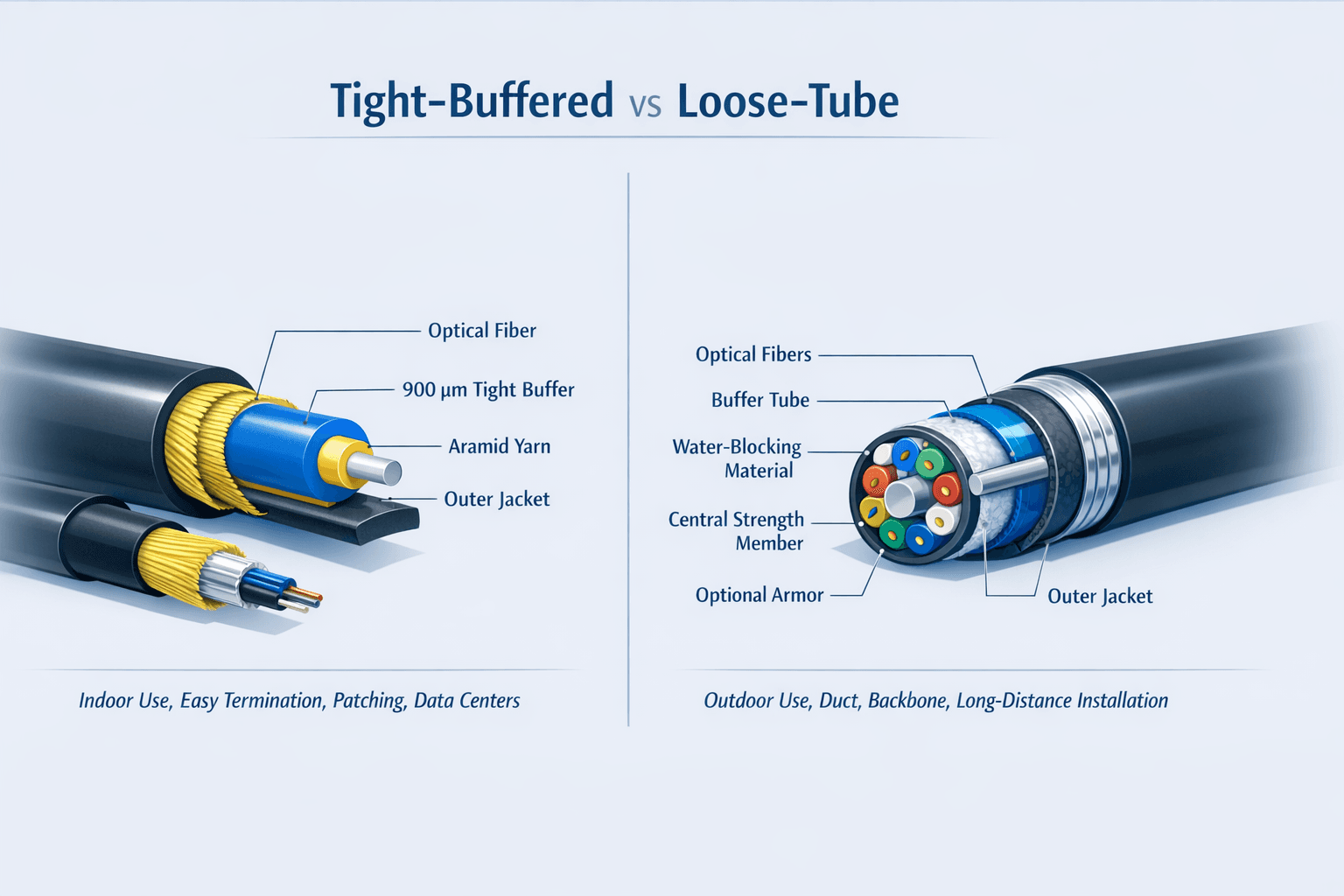
Tight-Buffered and Loose-Tube Cables: Quick Comparison
| Feature | Tight-Buffered Cable | Loose-Tube Cable |
|---|---|---|
| Typical environment | Indoor, controlled premises, risers, equipment rooms, patching | Outdoor, duct, aerial, campus, backbone, harsh environments |
| Fiber protection method | Each fiber is surrounded by a 900 µm tight buffer | Fibers are placed inside a buffer tube with isolation from external stress |
| Termination speed | Faster and simpler | Requires tube opening, preparation, and breakout handling |
| Water resistance | Usually lower unless purpose-built indoor/outdoor design is used | Higher, often with gel-filled or dry water-blocking elements |
| Temperature performance | Good for controlled spaces, less forgiving in extremes | Better for temperature variation and outdoor exposure |
| Fiber count scalability | Typically lower to medium | Typically medium to high |
| Typical use cases | Distribution, simplex, duplex, mini-breakout, indoor drop | Central loose tube, stranded loose tube, armored, aerial, ADSS |
Rule of thumb: use tight-buffered constructions where easy handling and indoor termination matter most; use loose-tube constructions where distance, water exposure, temperature variation, or outdoor mechanical stress become the real problem.
Tight-Buffered and Loose-Tube Cable Construction Explained
The difference between tight-buffered and loose-tube cables starts at the fiber protection layer. That one design choice changes how the cable behaves during pulling, bending, splicing, temperature cycling, and long-term outdoor service.
Tight-buffered fiber optic cable construction
In a tight-buffered design, each optical fiber is directly surrounded by a tight protective layer, typically up to 900 µm. This makes the fiber easier to identify, strip, route, and terminate in indoor cabling systems.
- 250 µm fiber at the core
- 900 µm tight buffer around each fiber
- Aramid yarn for tensile support
- Indoor sheath, often LSZH for premises use
- Simple access during connectorization and field termination
Loose-tube fiber optic cable construction
In a loose-tube design, fibers sit inside a protective tube rather than being tightly bonded to the surrounding structure. This gives the fibers room to remain more isolated from pulling force, thermal movement, moisture, and other external stress.
- 250 µm fibers housed inside buffer tubes
- Gel-filled or dry water-blocking elements may be used
- Optional central strength member and armor
- UV-resistant and outdoor-capable sheath options
- Better suited for long outdoor and backbone routes
In practical terms, tight-buffered cables are easier to work with at the end point. Loose-tube cables are better at protecting the fiber before it gets there.
Tight-Buffered Fiber Optic Cables
Tight-buffered fiber optic cables are widely used in indoor cabling because they are compact, clean to handle, and faster to terminate. The 900 µm buffer around each fiber simplifies connector fitting and patch panel work, which is why tight-buffer designs are common in buildings, data rooms, and controlled telecom spaces.
They are a strong fit where cable routes are shorter, environmental exposure is limited, and termination labor matters. In these conditions, a tight-buffered cable often reduces installation complexity and saves time at the final connection point.
Where tight-buffered cables work best
- Indoor distribution networks
- Data centers and equipment rooms
- Patch systems and cross-connects
- Campus indoor runs
- FTTx indoor drop sections
Main advantages
- Easy stripping and termination
- Cleaner fiber management indoors
- Compact and installer-friendly construction
- Good choice for direct connector fitting
Main limitations
- Less forgiving in harsh outdoor exposure
- Usually not the first choice for long wet routes
- Lower suitability for extreme thermal movement
Common tight-buffered cable examples
In the UPCOM range, tight-buffered applications are represented by indoor-oriented constructions such as Mini-Breakout Cable, Premises Distribution Cable, and Drop Fiber Cable. These are the types you review when low-to-medium fiber counts, direct handling, and indoor routing are more important than maximum outdoor resistance.
Loose-Tube Fiber Optic Cables
Loose-tube fiber optic cables are the standard choice for outdoor telecom infrastructure because the fibers are better isolated from mechanical force, moisture, and temperature-driven movement. This construction is especially valuable in duct, aerial, campus, and inter-building routes where the cable must survive real-world abuse instead of just looking obedient on a datasheet.
Water-blocking materials, UV-stable sheath options, and armored constructions are commonly combined with loose-tube designs. That is why loose-tube cables dominate long-distance outdoor deployment, backbone sections, and infrastructure projects where environmental durability matters more than quick indoor termination.
Where loose-tube cables work best
- Outdoor duct networks
- Campus and backbone routes
- Aerial and pole-mounted links
- Underground and buried applications
- FTTH feeder and distribution sections
Main advantages
- Better water and moisture protection
- Improved performance under temperature variation
- Higher suitability for long-distance deployment
- More scalable for higher fiber counts
Main limitations
- Termination takes more preparation
- More installation steps at the end point
- Not as convenient for short indoor patching work
Common loose-tube cable examples
Good UPCOM examples include Armored Loose Tube LSZH Cable, Outdoor Armored Fiber Optic Cable, and other central loose-tube designs used for indoor/outdoor transition, harsh routes, and protected outdoor backbone sections.
Tight-Buffered and Loose-Tube Cables in Real Applications
Indoor building network
Choose a tight-buffered construction when you need clean routing, easier termination, and direct connector fitting inside a building, cabinet room, or data space.
Inter-building or campus route
If the cable leaves the protected interior, reevaluate immediately. Outdoor exposure, moisture, and temperature cycling often push the decision toward loose-tube or purpose-built indoor/outdoor cable.
FTTH feeder or backbone
Loose-tube cable is typically the safer choice for feeder, duct, and backbone sections where route length, pulling conditions, and environmental stress increase.
Patch and device interconnection
Tight-buffered cable is usually more practical where technicians need direct access to individual fibers, shorter cable lengths, and fast end-point preparation.
Tight-buffered versus loose-tube is not a branding debate. It is a route-condition decision. Choose based on where the cable lives, how it will be terminated, and what can damage it over time.
How to Choose Tight-Buffered and Loose-Tube Cables
Before choosing a cable, answer these six questions. They prevent the most common selection error: buying an easy-to-terminate cable for an environment that will quietly destroy it.
- Is the route fully indoor, fully outdoor, or mixed? Mixed routes may require indoor/outdoor or transition-friendly constructions.
- How will the cable be terminated? Tight-buffered designs are faster for direct connector fitting and indoor handling.
- Will the cable face water or moisture migration? If yes, loose-tube or water-blocked designs should move to the front of the shortlist.
- How much thermal movement will the cable face? Outdoor routes, roofs, ducts, and exposed runs usually favor loose-tube construction.
- Do you need low smoke or fire-performance requirements? Sheath and CPR class matter as much as cable construction in many buildings.
- What fiber count and future capacity are required? Higher-count infrastructure routes generally align better with loose-tube families.
Choose tight-buffered cable when
- The installation is fully indoor
- Fast termination is important
- Fiber access at the endpoint must be simple
- The route is relatively short and controlled
Choose loose-tube cable when
- The route is outdoor or indoor/outdoor
- Water-blocking matters
- Temperature variation is significant
- Mechanical protection and route length are higher priorities
For related reading, see What Is Fiber Optic Cable?, Fiber Optic Cable Blowing Guide, and the Fiber Optic Cables tag archive.
Tight-Buffered and Loose-Tube Cable Standards
Cable selection is not only about construction. Standards define how the cable is tested, where it is used, and what performance level is expected in telecom and premises installations.
- IEC 60794 for optical fibre cable requirements and test methodology.
- ISO/IEC 11801 for generic cabling in customer premises, including optical fiber cabling.
- TIA-568.3-D for optical fiber cabling and components in structured cabling systems.
- EN 50173 for European generic cabling requirements covering optical fibre cabling in premises environments.
- FOA Cable Reference for a practical overview of fiber optic cable constructions and applications.
Standards do not replace engineering judgment, but they stop projects from turning into expensive guessing games.
FAQ: Tight-Buffered and Loose-Tube Cables
What is the main difference between tight-buffered and loose-tube cables?
Tight-buffered cables protect each fiber with a 900 µm buffer layer, making indoor handling and termination easier. Loose-tube cables place fibers inside a protective tube, giving better isolation from water, temperature change, and mechanical stress.
Are tight-buffered cables only for indoor use?
Usually they are chosen for indoor use, but some indoor/outdoor cable families exist. The route conditions, sheath type, UV resistance, and water-blocking design must all be checked before using any cable outside.
Why are loose-tube cables preferred for outdoor installation?
Because loose-tube construction protects fibers better against moisture, temperature cycling, and route stress. That makes it more reliable for duct, aerial, underground, and long-distance outdoor deployment.
Which is easier to terminate?
Tight-buffered cable is generally easier and faster to terminate because the fibers are easier to access and manage at the end point.
Does loose-tube always mean armored?
No. Loose-tube describes the fiber construction. Armor is an additional protection feature that may or may not be added depending on installation risk and route conditions.
Which cable type is better for FTTH?
It depends on the section of the network. Indoor drop sections may use tight-buffered designs, while feeder, duct, and outdoor distribution sections often rely on loose-tube constructions.
Related UPCOM Fiber Optic Cable Pages
Conclusion: Tight-Buffered and Loose-Tube Cables
Tight-Buffered and Loose-Tube Cables solve different problems. Tight-buffered designs are easier to terminate, easier to manage indoors, and ideal for premises cabling where the environment is controlled. Loose-tube designs provide better protection against moisture, thermal movement, and route stress, which makes them the stronger option for outdoor and long-distance telecom infrastructure.
If the project is inside a building and termination speed matters, tight-buffered cable is usually the efficient answer. If the cable will face weather, water, distance, or mechanical load, loose-tube construction is normally the safer engineering decision.