
FTTH Drop Cable Selection Guide: Indoor, Aerial and Armored Options
Select an FTTH drop cable from the complete installation route, then confirm the strength member, jacket, required fire class, fiber type and termination method. Indoor, aerial, mixed and mechanically exposed paths can require different cable constructions even when the fiber count is identical.
Use an indoor FTTH drop cable for protected building routes, an aerial FTTH drop cable for suspended spans, an all-dielectric drop cable where metallic elements are prohibited or unnecessary, and a metallic-reinforced or armored construction only where the route justifies the extra weight, stiffness and cost.
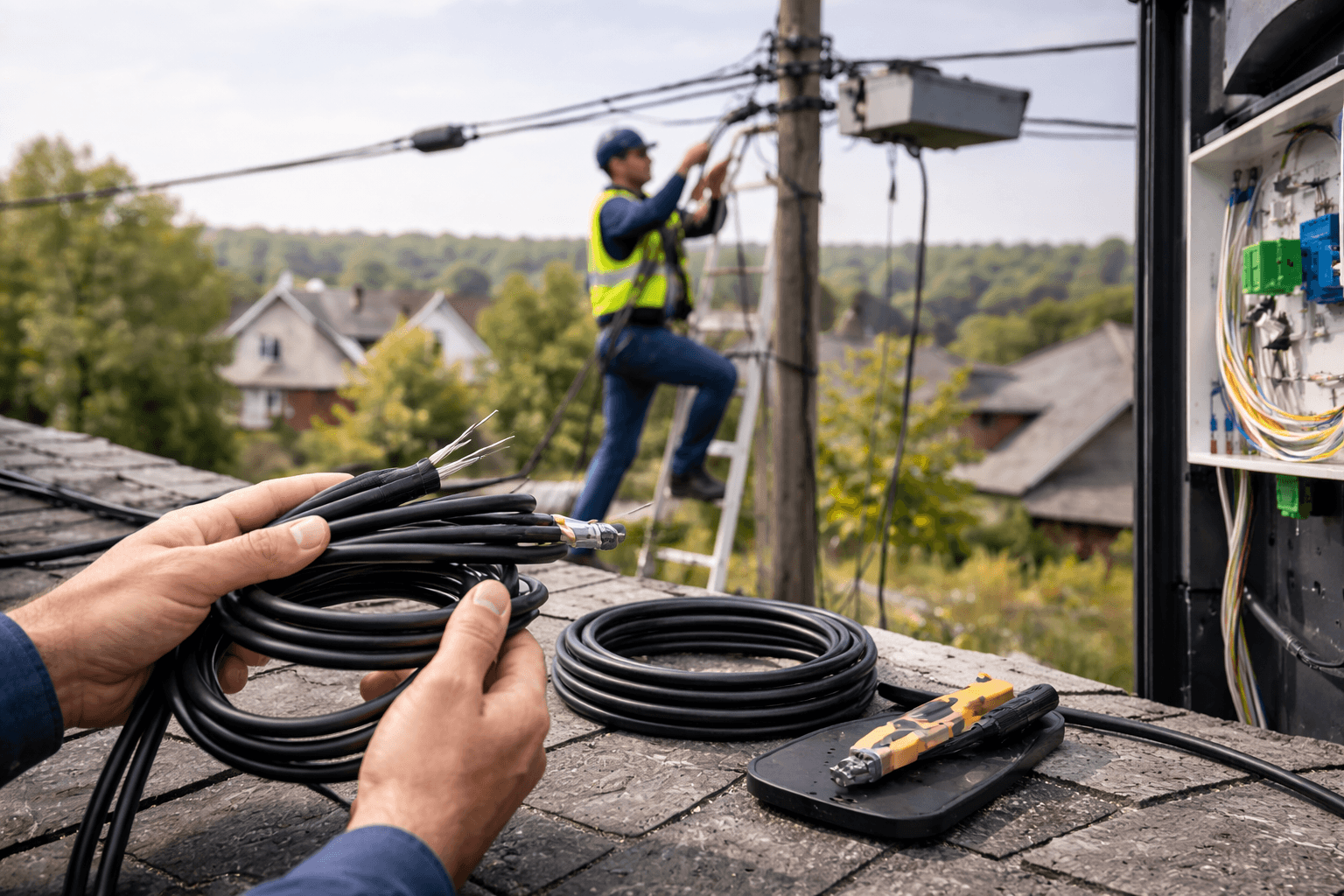
Define the full route before choosing the cable structure. Then verify the six fields that materially change performance, installation fit and price.
How to select an FTTH drop cable
The first decision in FTTH drop cable selection is the installation route and mechanical exposure, not fiber count alone. Map the indoor section, suspended aerial span, building entry and termination point before choosing a construction.
Next, specify the strength member, jacket, fire class, fiber type and termination method. The broader fiber-to-the-home deployment guide explains where the subscriber drop sits within the complete access network.
FTTH drop cable construction comparison
Use the table below before asking for price. It prevents the most common error in this category: comparing unlike constructions as if they were the same product.
| Option | Best fit | Why choose it | Main trade-off | Specification fields to confirm |
|---|---|---|---|---|
| Indoor all-dielectric FTTH drop cable | Indoor subscriber entry, risers, corridors, apartments, indoor distribution | Compact routing, easier handling in building pathways, indoor-focused jacket and construction logic | Wrong choice for unsupported outdoor spans or routes needing messenger support | Fiber type, FRP strength members, dimensions, jacket, declared fire class and termination hardware fit |
| Metallic aerial FTTH drop cable | Pole-to-building spans, façade runs, short suspended outdoor sections | Built for suspended routing with support logic that an indoor cable usually does not have | More structure and more cost than a simple indoor drop where no span exists | Approximate span, steel messenger or self-supporting design, tensile limits, jacket, clamp and building-entry detail |
| All-dielectric aerial drop cable | Aerial routes where a fully non-metallic cable and compatible support system are required | Eliminates metallic strength members and associated grounding or corrosion considerations | “All-dielectric” does not by itself prove that a cable is suitable for a given span or tensile load | Dielectric strength members or messenger, span, tensile limits, clamp compatibility, jacket and fiber type |
| Metallic-reinforced or armored drop cable | Routes where the specified construction and verified test values address higher handling, crush or impact risk | Provides more mechanical support or protection than a basic dielectric indoor drop, depending on the actual construction | Added weight, stiffness and cost; metallic strength members are not the same as steel-tape armor | Exact reinforcement or armor type, tensile and crush values, bend limits, route, jacket, fire class and hardware acceptance |
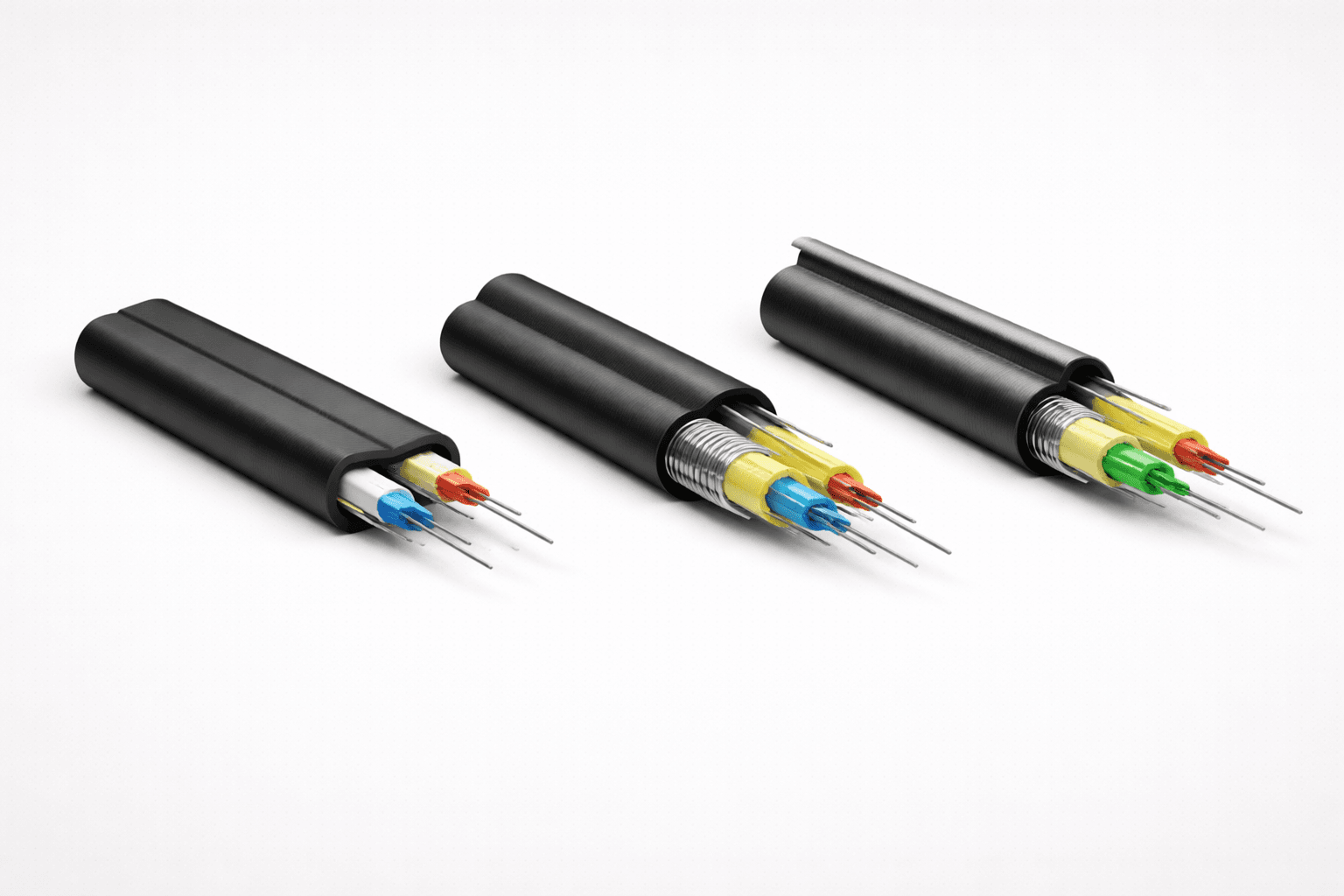
Strength-member material, messenger design, jacket, declared fire class, custom print, drum length and MOQ can move the price more than fiber count alone. Compare unit prices only after these fields and the packing basis are aligned.
Cable selection also needs to match the termination side. If the drop cable enters outlets, splice boxes, closures or distribution points, review the relevant fiber optic connectivity products before freezing dimensions and the termination method.
FTTH drop cable selection by route and environment
Indoor subscriber entry and building pathways
An indoor FTTH drop cable is usually the correct choice when the path stays inside a building or enters the premises immediately after handoff. Priorities are compact routing, bend handling, a suitable indoor jacket, the required reaction-to-fire class and practical fit inside subscriber boxes, conduits, corners and wall entries.
Do not treat “LSZH” as a fire classification. LSZH describes low-smoke, zero-halogen material behavior; a CPR Euroclass or other local fire rating must be declared and documented separately when the project requires it.
Aerial last-span and façade-to-building runs
An aerial FTTH drop cable becomes the right category when the cable must cross an unsupported outdoor span, even if the span is short. This is the point where many buyers accidentally request the wrong product because the route is “mostly indoor.” If the cable still needs to survive a suspended outdoor section, the outdoor span has to drive the structure selection.
For aerial routes, define the approximate span, installation tension, wind or ice conditions where relevant, clamp system and whether the design uses a messenger or a self-supporting strength system. Also state whether the same cable continues indoors after the span.
All-dielectric preference versus metallic protection
An all-dielectric drop cable contains no metallic strength or armor elements. This can remove grounding and galvanic-corrosion considerations, but route suitability still depends on its verified tensile, crush, bend and environmental limits.
A metallic-reinforced or armored FTTH drop cable is not automatically the superior option. Steel strength members, steel messenger wire and metallic tape armor perform different functions. Specify the construction that addresses the actual exposure instead of using “armored” as a generic request.
Mixed routes are where most specification errors start
Many FTTH jobs combine an outdoor span or façade section with an indoor continuation. Decide whether one cable is documented and suitable for the complete route or whether the design needs a transition point and a second cable family. The FTTH installation methods guide provides broader route-planning context.
Mixed routes should also be checked against the actual accessory path. A cable that works mechanically may still be awkward at the wall entry or mismatched with the planned box and clamp layout.
Compatibility and standards to verify
Reference only the standards and declared values that apply to the selected cable construction and destination market. A generic optical-cable standard does not prove route suitability, fire classification or accessory compatibility on its own.
Standards view
IEC 60794-1-1:2023 establishes generic requirements for optical fibre cables. The purchase specification should also identify the relevant product-family part, test methods and declared mechanical values for the actual indoor or outdoor construction.
Installation view
The FOA fiber optic installation guidance is a practical cross-check because it clearly separates outside-plant and premises installation logic. That is exactly the split buyers need to keep clear in FTTH drop selection.
At a minimum, verify the points below before releasing the purchase specification:
- Route type: state whether the route is indoor, aerial, mixed or mechanically exposed, including any outdoor-to-indoor transition.
- Strength member: identify FRP, steel reinforcement, messenger wire or another self-supporting design, plus the required tensile limits.
- Jacket: confirm material, indoor or outdoor suitability, UV and water exposure where applicable, and the required color.
- Fire class: state the required CPR Euroclass or local classification and supporting documentation. LSZH alone is not a fire class; see the CPR-compliant cable guide.
- Fiber type: state the required single-mode category. G.657.A1 or G.657.A2 may be appropriate where bend performance is important; do not write only “singlemode.”
- Cable dimensions: outer dimensions matter because clamps, wall entries, closures and subscriber boxes have real physical limits.
- Termination method: splice-only, field connectorization, preterminated delivery, or compatibility with an existing closure and box architecture.
Compatibility problems usually appear at the handoff point: wall entry, clamp, slack storage, splitter box or closure. Cable dimensions and stripping behavior matter almost as much as the cable family.
A technically acceptable cable can still delay installation if it is too stiff for the bend path or mismatched with the planned accessory layout.

For the hardware side, cross-check cable dimensions and bend limits against the planned wall-mount fiber termination box, closure, gland and clamp. Cable and accessory specifications must be evaluated as one installation system.
Common mistakes and rework triggers
If the route, strength system, sheath, fire requirement and hardware interface are vague, suppliers can quote different constructions under the same product name.
Mistake 1: treating FTTH drop cable as a generic SKU. The phrase covers several different constructions with different cost and installation behavior. If the route is not stated clearly, an indoor cable, aerial cable and armored cable can all sound correct and all be wrong.
Mistake 2: forgetting the outdoor section because the project is mostly indoor. A short aerial span can still change the strength-member, jacket and clamp requirements.
Mistake 3: specifying armor by default. Armor solves a specific mechanical problem, but it also adds material cost and handling stiffness. On clean routes it may create more penalty than value.
Mistake 4: writing “LSZH” in place of a required fire class. Material description, flame tests and CPR classification are separate specification fields.
Mistake 5: ignoring the interface with clamps, boxes and closures. A cable can be correct on paper and still create trouble because the clamp does not grip properly, the box entry is too small, or the termination plan assumed another cable shape.
Mistake 6: comparing only headline price. MOQ, drum length, print requirement, packaging format and mixed-product order structure all affect the quotation. Unit prices are comparable only when construction, documentation and packing are aligned.
RFQ checklist — exact fields buyers should include
A good RFQ should allow a supplier to quote without guessing the route, construction or termination method. The fields below reduce revision loops and improve price comparison.
- Project/application type — subscriber drop, building entry, aerial last span, indoor distribution, mixed route
- Route description — indoor only, aerial only, or mixed aerial plus indoor
- Requested construction — indoor, aerial, all-dielectric, armored, or supplier to propose
- Fiber count — exact count, not “small count” or “standard FTTH”
- Fiber type — required singlemode class or acceptable alternatives
- Strength member and support — FRP, steel, messenger, self-supporting, or no support element required
- Metallic or non-metallic preference — mandatory or optional
- Jacket/environment requirement — sheath material, indoor or outdoor rating, UV or water exposure where applicable
- Fire classification — required CPR Euroclass or local class and supporting document
- Approximate span or exposure detail — especially for aerial or mechanically exposed routes
- Cable dimensions or hardware limits — if clamps, boxes or entries impose real size constraints
- Termination plan — splice only, field connectorization, preterminated or existing hardware compatibility
- Quantity and drum preference — total quantity, preferred drum lengths, staged deliveries if relevant
- Destination market and documents — compliance expectation, marking language, project paperwork if required
- Commercial terms — Incoterm, delivery location, requested lead time and whether alternates are acceptable
If supplier alternatives are acceptable, identify mandatory values and supplier-proposed fields separately. This keeps technically equivalent alternatives visible without allowing a change to a contractual requirement.
Compare the matching FTTH cable constructions
Start with the fiber optic cable range, then compare the indoor, aerial, dielectric and metallic options against the same route and termination requirements.
FAQ
How do I select an FTTH drop cable?
Map the complete route first, including indoor, aerial and transition sections. Then confirm the strength member, jacket, required fire class, fiber type, dimensions and termination method.
What is the difference between all-dielectric and metallic FTTH drop cable?
An all-dielectric cable contains no metallic strength or armor elements. A metallic cable may use steel strength members, a messenger or armor, but these elements perform different functions and must be specified separately.
Does LSZH define an FTTH cable’s fire class?
No. LSZH describes low-smoke, zero-halogen material behavior. CPR Euroclass or another required reaction-to-fire classification must be specified and supported separately.
Which fiber type is normally used for FTTH drop cable?
FTTH drop cables use single-mode fiber. G.657.A1 or G.657.A2 is often selected where tighter routing and bend performance matter, while the exact category must match the network design and connected fiber system.
What should be included in an FTTH drop cable RFQ?
Include the route, construction, fiber count and type, strength member, jacket, fire class, dimensions, mechanical limits, termination method, quantity, drum length, marking, documents, Incoterm and delivery location.