



Kucuksu Rasathane
Uskudar Istanbul Turkey

Mon–Fri 09:00–18:00 (GMT+3)
Weekend: Closed
FTTH / INDOOR DROP CABLE
FTTH Drop Cable Indoor All Dielectric
FTTH Drop Cable Indoor All Dielectric is designed for indoor last-mile fiber routing where compact size, easy handling and non-metallic construction matter. With an LSZH outer jacket and FRP strength members, it is a practical choice for residential FTTH distribution, riser routing, indoor interconnect lines and similar low-fiber-count installations.
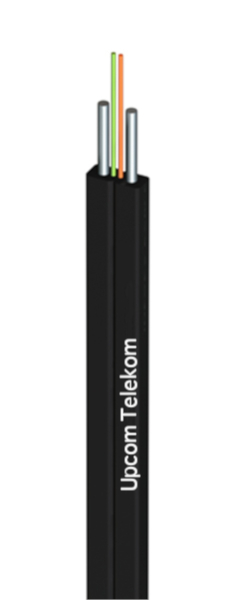
FTTH Drop Cable Indoor All Dielectric Overview
This flat indoor drop cable is intended for short-distance subscriber connections where safe indoor routing, low smoke characteristics and easy termination are priorities. The all-dielectric structure removes metallic elements from the cable body, helping reduce electromagnetic interaction while keeping the cable light and installer-friendly.
In practical FTTH deployments, this type of cable is used between distribution points and subscriber endpoints in apartments, villas, offices and other indoor access environments. It also supports neat routing along walls, skirting boards, risers and compact conduits where larger cable constructions would be less convenient.
Compact indoor structure
Flat 3.2 x 2.0 mm geometry helps with tidy indoor routing and easier handling in space-limited installations.
LSZH outer jacket
The LSZH sheath supports safer indoor use where smoke and halogen performance are important.
Non-metallic reinforcement
FRP strength members provide mechanical support without introducing metallic components into the cable body.
Related FTTH and fiber pages
For broader planning, installation and product comparison, you can review the related pages below:
Construction of FTTH Drop Cable Indoor All Dielectric
The cable structure is optimized for indoor FTTH use where straightforward handling and reliable fiber protection are required. Its flat profile and dry design help installers manage routing without unnecessary bulk.
Optical fiber
Single-mode fiber options are suitable for FTTH access transmission and indoor subscriber connections.
FRP strength members
Two FRP elements support the cable mechanically while keeping the structure fully dielectric.
LSZH outer sheath
The low smoke zero halogen jacket supports indoor use in buildings where safer fire behavior is expected.
Flat compact profile
The nominal 3.2 x 2.0 mm construction is well suited to wall runs, risers and compact indoor pathways.
Fiber types referenced for this cable family include options such as G.652.D and G.657 bend-insensitive variants. For reference, you can review ITU-T G.657 and the general background of LSZH materials.
Applications of FTTH Drop Cable Indoor All Dielectric
FTTH Drop Cable Indoor All Dielectric is mainly used for the final indoor leg of fiber distribution. It fits projects where clean installation, manageable bend behavior and reliable indoor service connection are required.
Residential FTTH lines
Suitable for apartment blocks, villas and subscriber-side indoor drop routing.
Office and building networks
A practical option for compact indoor access paths, distribution points and last-room delivery.
Indoor interconnect and patching
Useful where low-fiber-count indoor interconnect routes need a clean and compact cable form.
Short outdoor transition
Black LSZH jacket configurations may support short transition segments depending on the project layout.
Typical routing scenarios
- Indoor FTTH distribution in residential and commercial buildings
- Horizontal runs and riser paths
- Clipping to surfaces such as skirting boards
- Indoor interconnect and patch-cord related applications
- Local area network and access network segments
FTTH Drop Cable Indoor All Dielectric Specifications
The table below keeps the main technical values visible in a cleaner layout for faster review.
| Specification | 1 Fiber | 2 Fiber | 4 Fiber |
|---|---|---|---|
| Strength member | 0.5 mm FRP | ||
| Outer jacket | LSZH | ||
| Jacket size | 3.2 x 2.0 mm | ||
| Optical fiber type | 9/125 G.652.D | 9/125 G.657A1 | 9/125 G.657A |
| Wavelength | 1310 / 1550 nm | 1310 / 1550 nm | 1310 / 1550 nm |
| Attenuation | 0.35 / 0.25 dB/km | 0.34 / 0.24 dB/km | 0.34 / 0.22 dB/km |
| Weight | 9.0 kg/km | 9.0 kg/km | 9.0 kg/km |
| Tensile load (perm / inst) | 100 / 200 N | 100 / 200 N | 100 / 200 N |
| Crush resistance | 200 N / 10 cm (IEC 60794-1-2 E3) | ||
| Temperature range | -10 ºC to +60 ºC (IEC 60794-1-2 F1) | ||
| Minimum bending radius | 15 x outer diameter | 10 x outer diameter | |
Standards and Compliance for FTTH Drop Cable Indoor All Dielectric
For indoor fiber applications, standards and compliance are not a decorative detail. They are part of product selection, project approval and long-term installation reliability.
Referenced standards
EN 50173-1, IEC 60754-2, IEC 60794-1&2, IEC 60793-1&2, IEC 60332-1 & 2
Material and fire behavior
LSZH construction supports indoor environments where low smoke and halogen-free behavior are expected.
Project relevance
Compliance matters for building acceptance, network quality and alignment with indoor installation requirements.
If your project also includes fire-class related building cable requirements, review our CPR compliant cables page for the regulatory side of cable performance in construction works.
How to Choose the Right FTTH Drop Cable Indoor All Dielectric
The right cable depends less on generic brochure language and more on the actual route, end equipment and installation method. Before selecting the cable, check the items below:
- Fiber count: choose according to current subscriber requirement and possible future reserve.
- Fiber type: confirm whether G.652.D or bend-insensitive G.657 options better match the route and termination style.
- Indoor routing path: review wall clips, risers, conduit size, skirting board runs and bend points.
- Mechanical needs: confirm tensile and crush requirements before installation in narrow or shared pathways.
- Termination method: check whether the project uses fusion splicing, connectors or pre-terminated assemblies.
- Environment: for indoor-only routes, all-dielectric LSZH construction is usually the cleaner choice; for higher protection needs, compare armored alternatives.
Need a different FTTH drop cable type?
If your route requires additional mechanical protection or outdoor suspension, you may be better served by a different construction.
- Indoor metallic armored FTTH drop cable for stronger mechanical protection
- FTTH drop aerial cable for suspended outdoor access routes
FAQ About FTTH Drop Cable Indoor All Dielectric
What does all-dielectric mean in an FTTH drop cable?
It means the cable construction does not include metallic components in the main cable body. This keeps the cable light and suitable for indoor installations where non-metallic design is preferred.
Where is FTTH Drop Cable Indoor All Dielectric typically used?
It is commonly used in the final indoor connection segment of FTTH networks, including residential buildings, offices, risers, wall-mounted routes and short indoor access lines.
Why is LSZH important for indoor fiber cable?
LSZH jackets are preferred in many indoor environments because they are designed for low smoke and halogen-free behavior, which is relevant for building safety considerations.
How do I choose between indoor all-dielectric and armored drop cable?
Choose the all-dielectric version when indoor routing, compact form and non-metallic structure are the priority. Choose armored versions when the route demands stronger mechanical protection.
Looking for the right indoor FTTH drop cable?
Share your fiber count, routing details and installation environment. UPCOM can help you identify the suitable FTTH drop cable construction for your project.