



21 Jan CPR compliant Cables
CPR compliant cables are regulated under the Construction Products Regulation (CPR) (EU Regulation No 305/2011). In cables, CPR stands for the Construction Products Regulation, which defines the fire performance requirements for cables permanently installed in buildings and construction works in the EU.
For cables intended to be permanently installed in buildings and construction works in the EU, CPR requires a reaction-to-fire classification, a Declaration of Performance (DoP), and CE marking under the harmonised standard EN 50575.
Since 1 July 2017, CPR CE marking for cables used in construction works has been mandatory in the EU.
For deeper reference pages on UPCOM, you can also visit: CPR overview and our detailed guide: CPR for cables.

If you are selecting a CPR class for fiber optic cables, you can also review our fiber optic cable range and related products such as air coolers used in installation projects.
For installation works (especially duct-based deployments), cable preparation and friction control also matter. You can review our cable blowing lubricant here: UP-S-LUB-20 cable blowing lubricant.
What is CPR for cables?
The Construction Products Regulation (CPR) defines how cables behave in fire conditions when installed in buildings. CPR does not evaluate electrical performance, bandwidth, or transmission quality; it specifically measures reaction-to-fire performance under EN 50575.
In practice, CPR helps designers and contractors select CPR compliant cables according to building safety requirements, local codes, and project specifications. For a full explanation and examples, see: CPR for cables guide.
What does CPR classify on cables?
CPR classifies cables based on reaction to fire. The main Euroclass for cables is:
- Aca
- B1ca
- B2ca
- Cca
- Dca
- Eca
- Fca
For classes B1ca, B2ca, Cca and Dca, CPR also adds extra performance indicators:
- s = smoke production (s1a / s1b / s1 / s2 / s3)
- d = flaming droplets/particles (d0 / d1 / d2)
- a = acidity / corrosive gases (a1 / a2 / a3)
Example: Cca s1b d0 a1 means Cca fire class, low smoke, no flaming droplets, and low acidity/corrosivity.
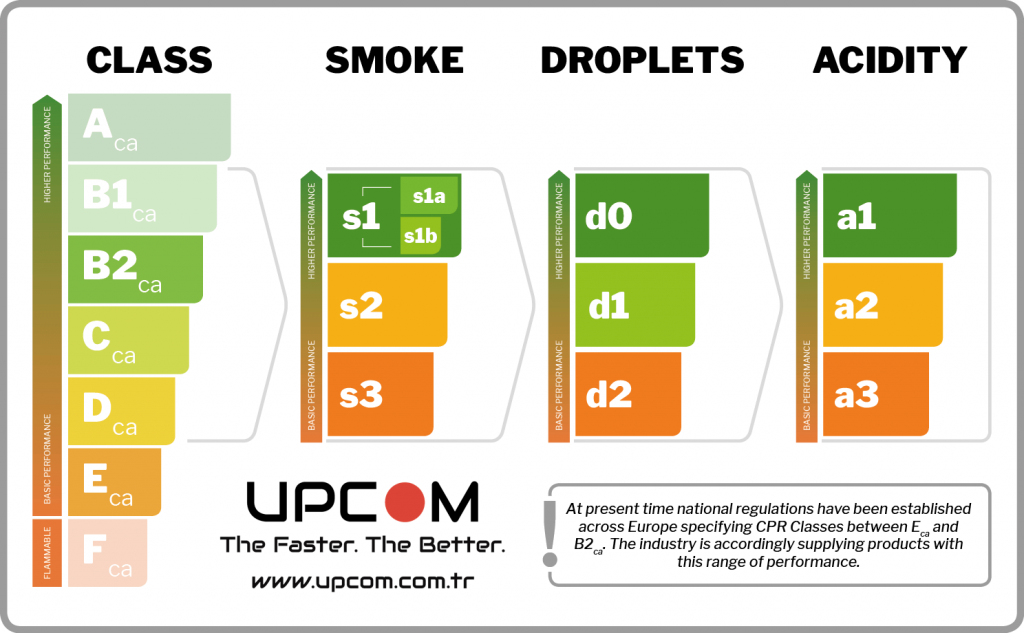
If you are evaluating a higher CPR class for fiber optic cables, you can check our B2ca example product page: B2ca Euroclass fiber optic cable.
CPR compliance: DoP and CE marking
To place a CPR compliant cable on the EU market for construction works, the manufacturer must provide:
- Declaration of Performance (DoP) for the specific cable family / product type
- CE marking with the declared Euroclass and relevant information
- AVCP system compliance (Assessment and Verification of Constancy of Performance)
For official reference, you can check: European Commission – Construction Products Regulation and the cable harmonised standard context via: EUR-Lex – Regulation (EU) No 305/2011.
A typical DoP includes product identification, declared reaction-to-fire performance (Euroclass + s/d/a where applicable), manufacturer details, and notified body information (where required by AVCP).

Smoke (s), droplets (d), and acidity (a) explained
Smoke development (s)
Smoke classification indicates the amount and optical density of smoke produced during fire testing. Lower smoke (s1a/s1b) improves visibility and evacuation conditions.
- s1a: very low smoke (highest performance)
- s1b / s1: low smoke
- s2: medium smoke
- s3: no defined limit beyond the standard
Flaming droplets / particles (d)
This indicator shows whether flaming droplets or particles fall during burning, which can spread fire to other materials.
- d0: no flaming droplets/particles
- d1: limited
- d2: not meeting d0 or d1
Acidity / corrosive gases (a)
This indicates the acidity/corrosivity of gases released during burning, which can damage equipment and infrastructure.
- a1: low acidity (best)
- a2: medium
- a3: no defined limit beyond the standard
Quick FAQ: CPR compliant cables
Does CPR apply to fiber optic cables?
Yes. If a fiber optic cable is intended to be permanently installed in EU construction works/buildings, it can fall under CPR requirements and may require classification, DoP, and CE marking under EN 50575. For details, see: CPR overview.
Is CPR the same as “fire resistant” cables?
No. CPR is a reaction-to-fire classification framework for cables installed in buildings. “Fire resistant” may refer to circuit integrity or endurance in specific fire tests. For example products, see: 2-hour fire resistant fiber optic cables.