
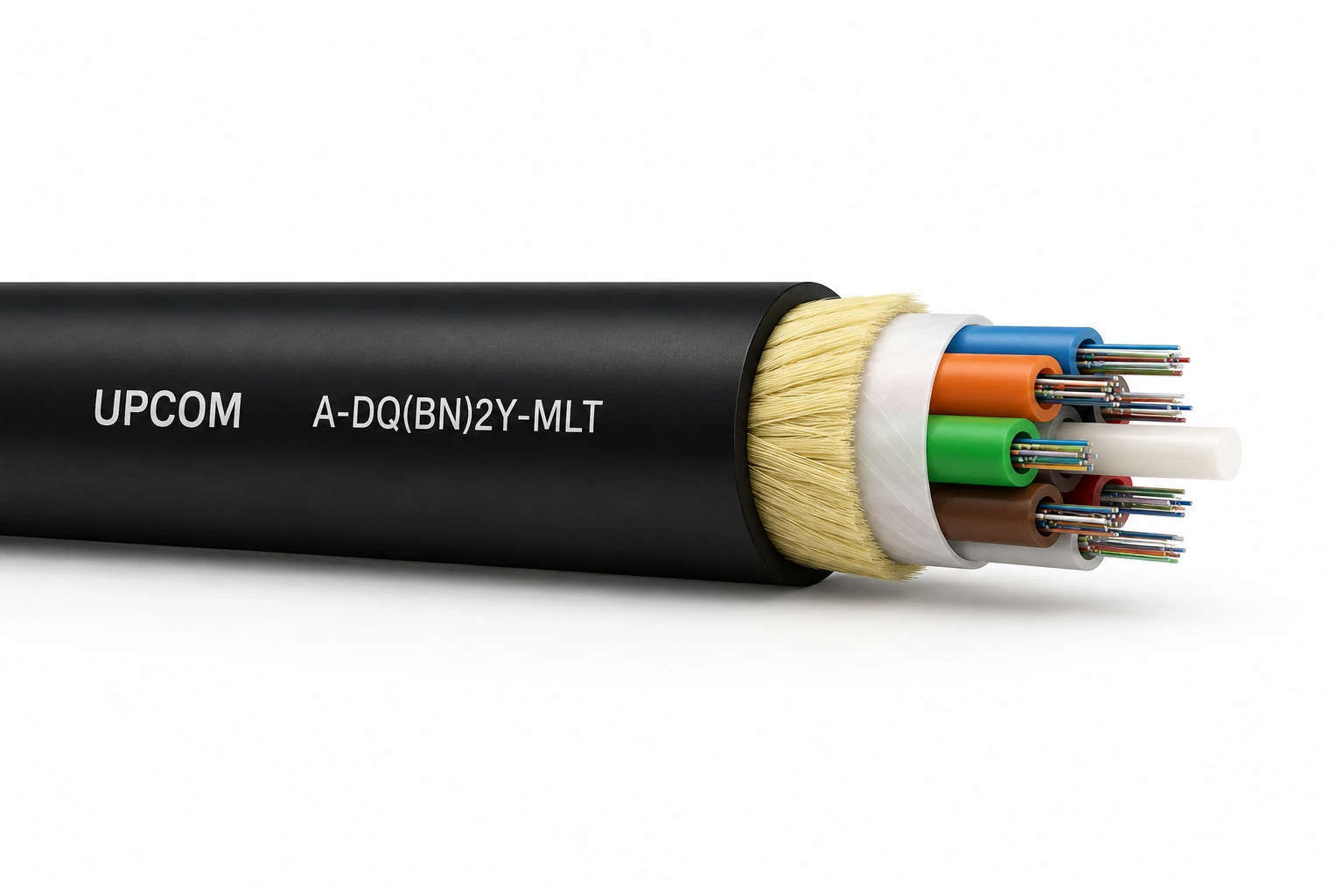
Outdoor Loose Tube Fiber Optic Cable Overview
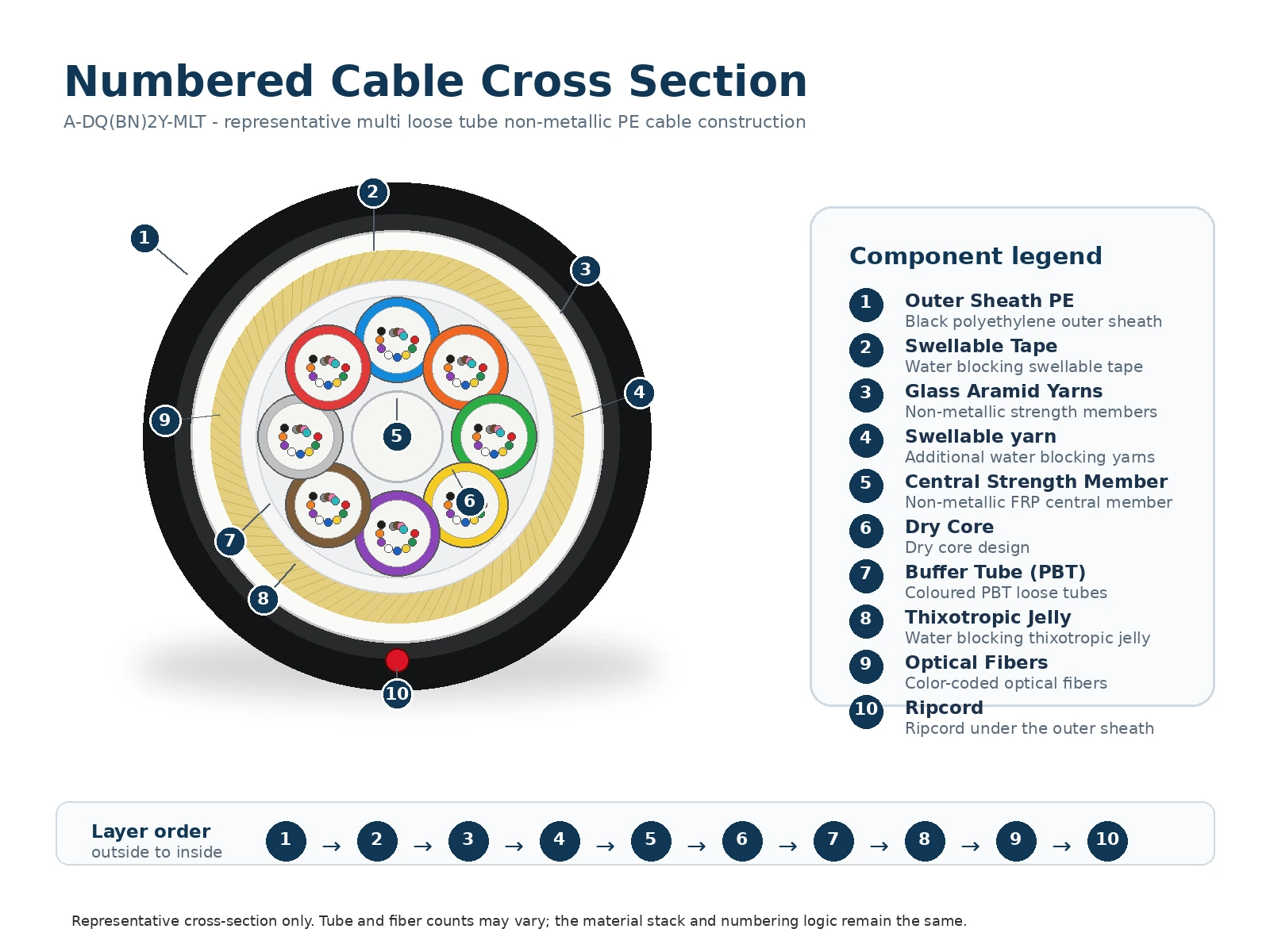
This A-DQ(BN)2Y multi tube cable configuration is built with colored loose tubes stranded around a central strength member. The interstices are protected against water ingress, while the PE outer sheath adds UV and stress-crack resistance for outdoor service conditions. The dielectric structure also helps where metallic elements are not preferred.
Compared with metallic armored alternatives, this dielectric design uses swellable aramid yarn reinforcement to provide a lighter construction without conductive armor. It is intended for outdoor moisture exposure, duct routes and direct-buried sections. Alternative constructions are available when the route requires metallic armor, higher crush resistance or a different jacket compound.
Key features of A-DQ(BN)2Y multi tube cable
Multi loose tube design
Suitable for higher fiber counts and organized fiber grouping in outdoor backbone applications.
Dielectric construction
The non-metallic structure avoids conductive armor and the associated grounding and bonding requirements.
Water blocking protection
Water-blocking elements and tube filling support long-term protection against moisture migration.
PE outer sheath
The PE jacket is suitable for outdoor use, UV exposure and demanding duct or buried routes.
A-DQ(BN)2Y multi tube applications
Outdoor duct installation
Suitable for campus, metro access, outside plant and inter-building routes installed in ducts and conduits.
Direct buried sections
Used where a duct is not available and the network design requires direct buried outdoor cable segments.
Access and backbone networks
Applicable in FTTC, FTTB, WAN, campus backbone and distribution-side telecommunication links.
A-DQ(BN)2Y multi tube technical specification
The values below describe an 8-tube × 12-fiber-per-tube (96F) construction using G.652.D single-mode fiber.
| Fiber count | 96 fibers (8 tubes × 12 fibers), G.652.D |
| Loose tube diameter | 2.3 mm |
| Loose tube material | PBT |
| Central strength member | FRP |
| Reinforcement | Swellable aramid yarns |
| Outer jacket | Black polyethylene (PE) |
| Cable weight | 135 kg/km |
| Outer diameter | 14.0 mm ± 0.5 mm |
| Tensile load perm./inst. | 1500 / 2700 N |
| Fiber type | 9/125 G.652.D |
| Attenuation (max) | 0.35 / 0.22 dB/km (1310 / 1550 nm) |
| Crush resistance | 2000 N (IEC 60794-1-2 E3) |
| Temperature range | -30 °C to +70 °C (IEC 60794-1-2 F1) |
| Minimum bending radius | 20 × outer diameter (IEC 60794-1-2 E11) |
Other tube counts, fiber types, color schemes, tensile reinforcements and L-M-HDPE or LSZH sheath options are available on request. Confirm the fiber count, fiber type, route conditions, marking, delivery length and final construction before production.
A-DQ(BN)2Y multi tube cable construction
How to select A-DQ(BN)2Y multi tube cable
1. Define the route
Confirm whether the cable will run in ducts, conduits or direct buried sections.
2. Confirm protection level
If the route needs higher crush or rodent protection, compare dielectric and armored alternatives.
3. Match fiber count
Select the required fiber count and fiber type according to backbone, access or distribution needs.
4. Review mechanical limits
Check tensile load, bending radius, outer diameter and installation conditions before final approval.
Standards and references
Referenced standards include IEC 60794-1 and IEC 60794-2, ISO/IEC 11801, TIA/EIA-568-C.3 and Telcordia GR-409-CORE. Confirm the applicable test and compliance scope for the final ordered construction. For broader standards context, review IEC, ISO and TIA.
If fire performance is part of the project requirement, also review our fire resistant fiber optic cable and the broader fiber optic cable overview.
A-DQ(BN)2Y multi tube FAQ
What is A-DQ(BN)2Y multi tube cable mainly used for?
It is mainly used in outdoor duct, conduit and direct buried fiber optic network sections, especially for backbone, campus and inter-building links.
Is A-DQ(BN)2Y multi tube cable metallic armored?
No. This is a dielectric multi loose tube cable reinforced with non-metallic swellable aramid yarns. If the route requires metallic armor, compare the dedicated metallic armored alternatives linked above.
Can the cable be customized?
Yes. Tube count, sheath color, fiber color, tensile reinforcement and jacket options can be reviewed according to project requirements.
What should be checked before specifying this cable?
Route type, protection level, required fiber count, jacket preference, tensile requirement and installation conditions should all be verified before final selection.