
How to Compare Micro Data Center Costs
An €18,400 offer appears to beat a €21,600 offer for the same edge site. Once both include the battery runtime, rack PDU, freight and commissioning the buyer needs, the second offer costs €300 less.
This worked example shows how to compare micro data center costs, which technical evidence can change the decision, and how much energy savings would justify a higher purchase price.
Agree one duty point before opening the price comparison
Use one site, one delivery point and one acceptance milestone for both offers. In this worked example the buyer requires 21 usable IT U, 4.33 kW of protected IT load and 15 minutes of backup at that load. The scope includes an intelligent rack PDU, freight to the named receiving point and on-site commissioning. Amounts are illustrative EUR per site, before tax. They are not UPCOM quotations.
Record the temperature conditions for cooling selection and list the circuits that must run on backup. Where one supplier protects only IT and another also protects cooling, obtain prices for the same outage behaviour. Otherwise the battery, UPS and cooling figures describe different systems. The worked RFQ and equipment schedule shows where the 4.33 kW requirement comes from.
How an €18,400 offer becomes €22,200 at handover
| Quoted item | Offer A | Offer B |
|---|---|---|
| Base system | €18,400 | €21,600 |
| Battery extension for the agreed runtime | €1,650 | Included |
| Intelligent rack PDU | €420 | Included |
| Freight to the named receiving point | €780 | €300 |
| On-site commissioning | €950 | Included |
| Comparable cost per site | €22,200 | €21,900 |
Offer A opens €3,200 lower. Its required additions total €3,800. Offer B adds €300, which puts B €300 lower for the matched scope. The result hinges on “included” being confirmed in writing. If B says commissioning is “available” and gives no amount, leave that cell blank. The worksheet withholds the total until the missing cost is priced.
Enter an upgrade as the additional amount over the base configuration. If a supplier quotes a complete replacement UPS, ask for the credit for the UPS already in its base price. Adding the gross replacement price would count the original unit twice. Similarly, give an unwanted extra zero commercial credit unless it displaces a purchase you would otherwise make.
Three quote lines that can conceal a different system
“6 kVA UPS, 15 minutes”
Ask for the rated kW output and a runtime point at the buyer’s 4.33 kW. A curve showing 15 minutes at 3 kW leaves 1.33 kW of the agreed load unaccounted for. Identify the number of battery modules and whether the runtime is quoted for new batteries or at an agreed replacement threshold. A kVA label alone gives neither the battery configuration nor the guaranteed runtime.
“5 kW cooling”
Ask whether the figure is gross total capacity, net sensible duty delivered to the rack or electrical input. Compare the useful cooling duty at the same inlet and heat-rejection conditions. If one offer includes a remote condenser and the other stops at the indoor unit, obtain the missing outdoor equipment and field-work price before adding the two columns.
“Ready for installation”
Trace who owns each step from unloading to signed site acceptance. A factory test record and an on-site commissioning visit cover different work. Request separate prices for lift or rigging, field pipework, electrician attendance, travel and the alarm handover if these fall outside the quoted scope. A single unpriced service visit can reverse this example’s €300 difference.
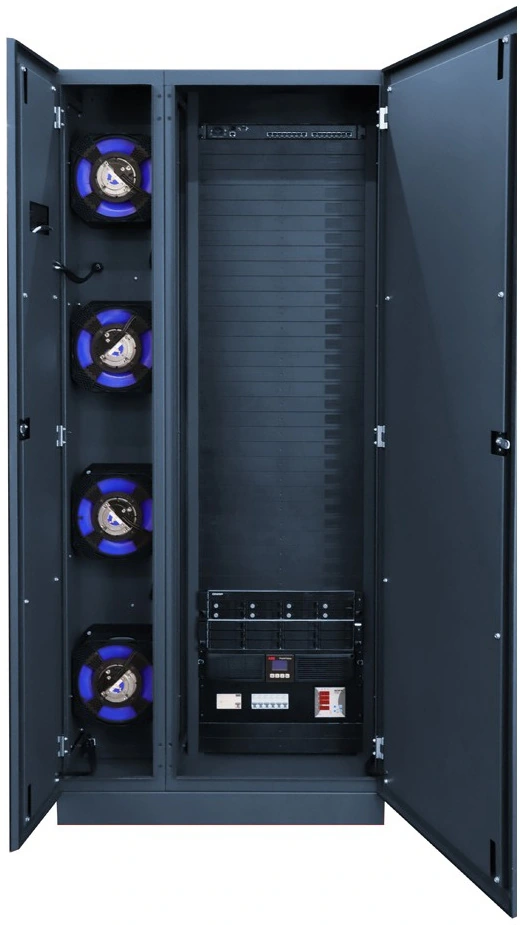
The UPCOM system catalogue shows the equipment bay, cooling module and PDU. Check usable mounting height and depth against the 19-inch rack dimensions guide. Use the product configuration and drawings when asking a supplier to indicate what its offer physically includes.
How much operating cost would reverse a €300 decision?
Suppose acceptance measurements later show Offer A draws 0.20 kW less at the site input for the same useful IT load and environmental conditions. For a site operating 8,760 hours per year at €0.20/kWh, the difference is €350.40 per year. The €300 purchase premium would be recovered in about 10.3 months if that average difference persisted.
| What changes | Calculation | Result |
|---|---|---|
| Annual electricity difference | 0.20 kW × 8,760 h × €0.20/kWh | €350.40 |
| Three-year electricity difference | €350.40 × 3 | €1,051.20 |
| Three-year advantage for A on purchase and energy | €1,051.20 − €300 | €751.20 |
A second way to read the calculation is to ask for the minimum difference worth verifying. Over three years at that tariff, €300 corresponds to about 57 W of average input. Compare supplier evidence at the same IT load and across the expected operating conditions. A nameplate figure or a single measurement on a cool day cannot establish a year-round saving.
Where measured data is unavailable, set the input difference to zero and keep the €300 purchase comparison visible. For a lifecycle budget, add battery replacements, maintenance visits, monitoring licences and service travel on their quoted dates. The example above covers purchase and energy only.
What to get in writing before issuing the purchase order
For these two offers, the next commercial question is narrow. Can B confirm its included commissioning visit, and can A substantiate a site-input advantage at the agreed duty? The first answer settles the purchase price comparison. The second establishes whether the operating-cost case deserves weight.
- For a multi-site rollout, request one first-site figure and a repeat-site price with the same bill of materials. An engineer may commission several sites on one trip, while freight and unloading may still differ by location.
- For each exception, record the supplier’s quoted increment, evidence reference, owner and date. Keep exclusions visible beside the figure they affect.
- For service and warranty, record coverage start, response terms at the actual site, travel charges and responsibility for replacement batteries. Express any unresolved service exposure separately.
If cooling and backup power are already provided centrally, compare the incremental cost of the rack-level system with the room-level data center solution actually available to the project.
Compare your own quotations
Enter written adjustments from two suppliers. The worksheet calculates the comparable purchase total and lets you change operating hours, electricity tariff and input-power difference.