
How to Write a Micro Data Center RFQ
Four servers, a storage array and two switches fit in the proposed rack. Add two servers next year and the supplier’s layout comes up one rack unit short. That is the kind of mismatch a good micro data center RFQ should catch before the buyer issues a purchase order.
Follow one depot project from its equipment list to a 4.33 kW design load, a doorway that rules out the assembled cabinet and a specification you can send to suppliers.
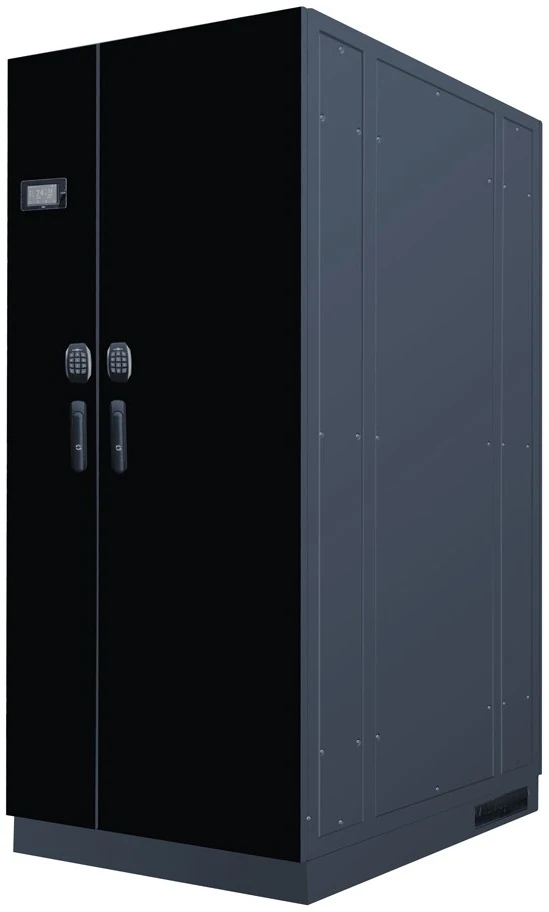
Build the equipment schedule before you choose the rack
Consider one edge site serving a distribution depot. The example buyer has four compute servers today and expects two more within 18 months. The equipment ratings below are illustrative planning inputs. For your own RFQ, identify which figures are metered peaks, manufacturer estimates or nameplate maxima, and date the measurements.
| Equipment | Quantity | U each | kW each | Total U | Total kW |
|---|---|---|---|---|---|
| Compute server | 4 | 2 | 0.55 | 8 | 2.20 |
| Storage array | 1 | 4 | 0.65 | 4 | 0.65 |
| Network switch | 2 | 1 | 0.15 | 2 | 0.30 |
| Firewall | 1 | 1 | 0.08 | 1 | 0.08 |
| Passive patch panel | 2 | 1 | 0.00 | 2 | 0.00 |
| Day one | 17 | 3.23 | |||
| Two future servers | 2 | 2 | 0.55 | 4 | 1.10 |
| Expanded installation | 21 | 4.33 |
Reserve 21U usable for IT in the final arrangement. A supplier offering a 24U bay with 4U occupied by its UPS and battery hardware leaves 20U. That offer fits the first delivery and misses the planned expansion by 1U. Ask for a front and rear elevation showing the UPS, batteries, patching and every reserved position. A vertical rack PDU can consume rear clearance even when it occupies zero horizontal U.
For a dual-cord server, record its total equipment demand and identify the A and B feeds on the power schedule. For measured rack totals, take the two feed readings over the same interval. Adding two full PSU nameplate ratings can substantially overstate normal operating demand.
Can the rack reach the room and accept the deepest server?
The deepest chassis in the example is 760 mm. Ask the supplier to mark the supported front-to-rear rail spacing, rear connector clearance and cable arm travel on the drawing. External cabinet depth alone cannot answer whether the rear door closes with power and network cables attached.
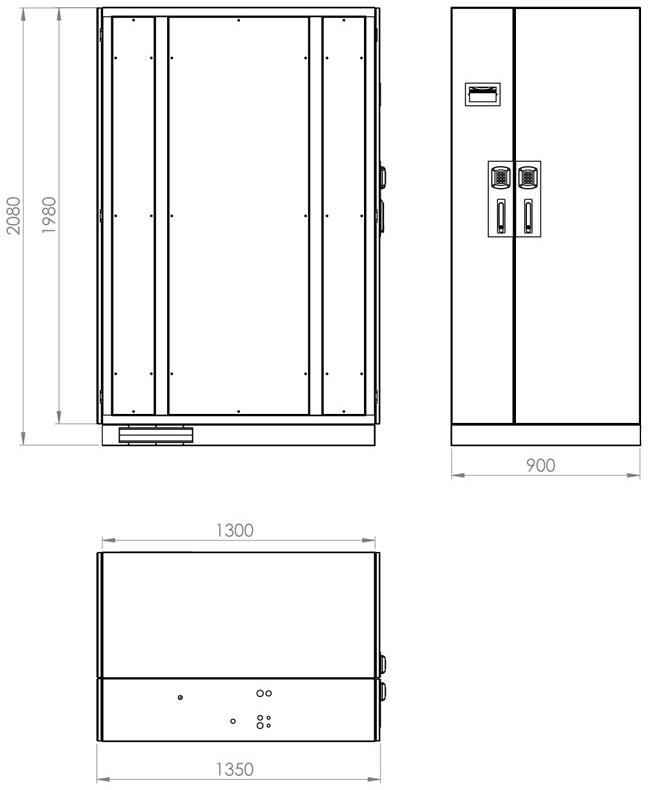
The UPCOM reference assembly pairs a 600 mm IT bay with a 300 mm cooling bay. Its outside dimensions are 900 × 1,350 × 2,080 mm (W × D × H). This site has an 860 mm clear doorway. The assembled reference cabinet is 40 mm too wide for an upright, straight-through delivery even before packing. Ask whether the bays can be delivered separately, who reconnects them, and whether the resulting installation carries the quoted warranty.
Attach a delivery-route sketch with door openings, lift dimensions, bends and the final maintenance clearance. For an 800 mm IT bay or a multi-cabinet system, request the corresponding project drawing. The 19-inch rack dimensions guide explains which dimensions belong to the mounting interface and which belong to the enclosure.
Write the UPS runtime as a load point and specify where the heat goes
What must stay on for 15 minutes?
For this depot the baseline requirement is 15 minutes at 4.33 kW of protected IT output. The load would receive about 1.08 kWh over that interval (4.33 × 15/60). Battery selection also depends on discharge rate, inverter efficiency, temperature and the battery’s condition. Request the selected UPS and battery model numbers, the supplier’s runtime curve at 4.33 kW, and the battery-age basis behind the quotation.
Ask the supplier to identify the source feeding the cooling unit and controllers during an outage. If cooling must run on the same UPS, obtain its electrical input and start characteristics, then ask for a second runtime calculation for that combined load. Cooling capacity in kW and electrical input in kW describe different quantities. IEC 62040-3 defines a framework for specifying UPS performance and tests.
Which cooling figure belongs in the offer?
At 4.33 kW of IT consumption, the rack releases approximately 4.33 kW of IT heat. If the UPS is inside the cooled boundary, its losses also contribute. Give the intended rack inlet temperature, the site’s design room or outdoor conditions, and the available heat-rejection route. Ask for net sensible cooling duty at those conditions, including the indoor and heat-rejection components in the bill of materials.
When a unit rejects heat into the equipment room, the room still has to remove it. When a remote condenser is offered, identify who supplies the condenser, pipework, drainage and commissioning. Ask the supplier to mark each connection and the handover point on the layout.
Ask for evidence you can use at handover
| Return item | What the buyer checks |
|---|---|
| Dimensioned general arrangement | Usable IT space, rail spacing, loaded rack weight, service access, door swing and the largest shipping piece. |
| Power schedule and runtime curve | Protected circuits, UPS output limits in both kW and kVA, battery configuration, runtime at the agreed load, and PDU outlet types. |
| Cooling selection | Net sensible duty at the stated conditions, heat-rejection equipment, condensate route and the scope of field work. |
| Monitoring and acceptance plan | Name the receiving monitoring system. Agree how the supplier will demonstrate loss-of-mains, high-temperature and door alarms and record the results. |
| Delivery and service scope | Named delivery point, unloading, installation, site acceptance, warranty start and the party responsible for service at this site. |
A reply such as “remote monitoring included” leaves an integration question open. If operations uses SNMP traps, ask which alarms are exposed, which interface or licence is required, and who will demonstrate receipt by the site’s monitoring platform.
A completed micro data center RFQ you can adapt
Please quote one integrated micro data center for our distribution depot in Lyon, France. Initial equipment requires 17U and 3.23 kW. Two additional compute servers take the installation to 21 usable IT U and 4.33 kW within 18 months. The deepest chassis is 760 mm. The delivery route includes an 860 mm clear doorway.
Price 15 minutes of UPS autonomy at 4.33 kW for the IT circuits. Identify the supply to the cooling and control equipment during an outage and price continuous cooling on backup separately. Return the battery runtime curve, the rack elevation and the dimensions of the largest shipping piece. Confirm the environmental inputs needed to finalise the cooling selection.
Itemise the rack, cooling and heat rejection, UPS and batteries, intelligent PDU, monitoring and freight. Identify the contractor responsible for unloading, installation and commissioning. Please list exclusions, warranty service location and the proposed lead time from drawing approval.
Replace the example city, loads and route dimensions. Attach the server list, a room sketch, available electrical supply and the site design conditions. The UPCOM Micro Data Center product page shows the IT and cooling bay arrangement. For projects with several rows of cabinets, review the room-level data center solutions. Once offers arrive, use the supplier quote comparison example to reconcile scope.
Prepare your project RFQ
Enter your own equipment in the worksheet to calculate occupied U and IT load. Send those figures with your room drawing when requesting a quotation.